Like Quintin Smith, recently I've found myself increasingly drawn to board games. It all started about a year ago, at PAX East, actually, when a friend of mine bought a copy of Arkham Horror. He'd heard great things! We barely knew of its reputation as the most complicated board game in existence.
Shortly thereafter, we found a time to get several people together and give it a go. Our first game took eight hours. We won, somehow. In the year since, we've played a few more times, understanding a little more each time. We still don't fully grasp it, I don't think. We joke that we'll know we get Arkham Horror when we finally lose a game.
Despite how cumbersome and complex Arkham is, I get something from it that I don't get from video games. I'm not even sure what that thing is. There's the communal aspect, for sure. And how purely the game focuses on mechanics, giving us a framework to fill in our own stories, free of cutscenes and tropes that I've long since grown tired of. But there's something else, something almost indefinable, what Robert Florence calls "the way the game lifts off the table and fills the room."
In an eight-hour session of Arkham (more recently whittled down to about four hours, as we've gotten more comfortable with it), I have a sense of total focus and involvement. My brain juggles dozens of pieces of information, plucking each bit out of the air as its needed. Since the game is cooperative, even during the long stretches where your character isn't doing anything directly, you're still involved. It is a wonderful experience.
Arkham Horror was my gateway drug. Since then, I've played and enjoyed Mansions of Madness, with its innovative approach to storytelling and cooperative mechanics; The Resistance, a card game about distrust and deceit; Dominion, the game where the most useless items you acquire are the most important ones for victory; Battleship Galaxies, a welcome update to the classic that brings honest-to-god strategy to the table; and much more. And I've read as much as I've played, about Battlestar Galactica's Cylon traitors, King of Tokyo's dice-rolling hijinks, and Space Alert's time-sensitive zaniness. Board game designers seemed to be doing so many fascinating things.
After all this, it wasn't surprising when a little voice in my head piped up and said: "I want to do that, too."
The idea came to me, as most of my ideas do, when I was at the gym, where my only hope for sanity is to concentrate on something besides my workout or pray for a power outage. Pedaling furiously on the elliptical, I was thinking about everything I had responded so well to in the games I'd played. I loved the cooperation of Arkham Horror. The exploration and the traps of Mansions of Madness. The duplicity of The Resistance. And I started to think... what could I do to combine all of these things?
What if I could make a game that required you to cooperate with the other players to have any prayer of winning, but with the ever-present danger that they could stab you in the back? What if the setting weren't your standard sci-fi or horror world, but something closer to reality? What if I could pull all of these disparate elements together with humor and a true sense of narrative progression?
I don't know if I can do any of these things, but I can certainly try. And so I have been working on a board game I'm calling Honor Among Thieves, the game of cooperative backstabbing.
So far, the answer to the question that sits atop this post is: making a board game is hard, but not as hard as I thought. I've been making progress. Tomorrow, I'll share some of the details.
My name is Mitch, and I have a problem. I rage at video games. For as long as I can remember, games have driven me to furious anger. I've broken controllers. I've screamed myself hoarse. I've hurt myself punching tables, chairs, walls. And I can't stop.
This may be news to people who know me, but haven't witnessed my fits firsthand. In the rest of my life, I'm mild-mannered and conflict-averse. I've never been in a fight. When spurred to anger at another person, I tend to walk away, cool off, and then come back with a level head. In other words, I act like an adult. Not with video games.
For people who have witnessed it, all I can say is that I'm surprised anybody is still willing to play with me. I have a solid core of friends who put up with my excitations. I don't know why. I wouldn't want to play with me. I blame them for everything that goes wrong, and have no sense of perspective when they make honest mistakes. They always seem to be in my way. They poach my kills. And they don't even care! They laugh and make jokes, and politely ignore the steady stream of howling profanity coming through the headset.
(My mistakes, of course, are the result of an unfair, rigged game, and not anything I might have done wrong.)
I'm afraid to share my Xbox Live username with other game writers because, if they have any respect for me on the basis of my work, I know they'd lose it after the fiftieth time I blurted "WHAT THE FUCK" about a minor setback -- or, honestly, after the first time. Online, I am neither racist, nor sexist, nor any other -ist, but my maturity level certainly is not any better than your average teenager's.
When I was younger, there were several occasions when I was almost kicked out of my friends' houses for flipping out about video games. My buddy Bob Dylan still tells the story of his dad pulling him aside at a LAN party and saying, "Your friend's got to cool it, or he's out of here." Is this embarrassing as hell, in the calm light of day? You bet it is. Did it matter to me one bit when I was raging at Quake 2? Of course not.
These days, I do most of my gaming in the solitary confines of my basement, but I'm still making everyone around me uncomfortable. My dog won't even come down to the basement with me anymore. All it takes from me is one stressed-out "Come on," and she slinks upstairs to the safety of her bed. My wife puts up with it only a little better. If I were her, I wouldn't be nearly as tolerant.
Every time, it follows the same pattern. When I begin a game, even a very difficult one, there's no problem. I have no idea what I'm doing, and no expectation that I should. Someone said that the enjoyment of a game is the process of learning, and when I start playing, that is often the case. Playing something like Trials, it's fun to mess around with the physics, and learn the basics of getting up hills and over obstacles. This period is rewarding, because I improve rapidly. The second run is always miles better than the first.
The trouble comes when I begin to expect competence from myself. There's a point at which I feel like I do understand how the game works, and am unable to execute at the level I desire. Again, in Trials, this usually comes after I've earned a silver medal and am going for the gold. To earn a gold medal in Trials requires a no-fault run, which means that a single mistake sinks you.
A typical scenario: I am relaxed and have a good run, earning a silver medal with a single fault and a great time. "No problem," I think, "I'll go back and nail that gold medal. Easy as pie." But it's not easy. I get hung up on a single obstacle, and fail it over and over again. When I do get past a difficult part, I lose focus and biff it on something that has never given me a problem. Hitting the back button to re-start the race becomes reflexive, and sometimes I hit it without even intending to. I feel my blood pressure rising and my heartbeat quickening, and a small part of my brain is starting to warn me that I need to stop. A dominant part of my brain tells the small part to shut the fuck up.
Before I know it, the occasional frustrated utterance has given way to unbroken streams of profanity, sometimes in sentence form but usually not. And frustrated shakes of the head have given way to stomping around the room looking for something to break. If I'm lucky, I don't find anything.
The worst part is I always know it's about to happen, and I can't seem to do anything about it. I can tell myself to take a breath and relax, to put it in perspective, but nothing helps. The rage is coming. It's like watching a tidal wave roll in.
I don't know why I'm telling you this. It's embarrassing. Maybe I'm a glutton for punishment, and I'm writing this for the same reason that I keep playing the games that turn me into the Incredible Hulk, minus the upper-body strength. Or maybe it's because I feel like I've been hiding a significant part of my game-playing identity for all these years. Could be that I want advice, or to know that other people have the same problem, but it doesn't really matter because I know I'll never change.
There are worse character flaws to have. I could be an addict, or a liar, or a thief. On the list of things that should disqualify you from participating in human civilization, "gets too mad at video games" is pretty low. But I hate it. I absolutely hate it.
Above: Geralt begins his quest to hunt down a guy who said something mean about him on the internet.
I can't take it anymore. Every day, it seems like people are all atwitter about another irrelevant nontroversy. Matters that a normal human being would dismiss as trivial are elevated, on the internet, to grand morality plays where nothing less than our fate as a species hangs in the balance. It is fucking ridiculous. If we could find a way to channel self-important outrage into kinetic energy, our dependence on foreign oil would be finished tomorrow. Instead, we're going to choke on it.
The latest? Some guy at Gamer Limit didn't like The Witcher 2. Now, you or I would hear about this and think, "Huh, someone has an opinion about a video game. I wonder what I should have for lunch." Witcher 2 fanboys hear about this and see a battle as pivotal as the invasion of Normandy. They regret that they have but one life to give for a game they enjoy.
It doesn't matter to them that reviews for the game are still almost uniformly positive. If anything, that's all the more reason to start wailing on the one guy who didn't like it. You let somebody step out of line just this once, and what happens the next time? We might have to start dealing with a real diversity of opinions, which would require us to engage with games critically, and with one another respectfully, and that just sounds too hard. Easier if everyone repeats one another.
I haven't played The Witcher 2, and I have no idea if I'd agree with Bobby Hunter's criticisms or not. But they sound fair to me. He talks about a tricky interface, cumbersome combat mechanics, and a storyline that didn't resonate with him. Not only does this sound reasonable, but I've read positive reviews of The Witcher 2 that make the same points! It's not as though he accidentally played some other game.*
Of course, there's a bigger issue here. The reason many people claim to be outraged -- the reason people think they are justified in firing whatever insults and accusations they can imagine at the writer and the site -- is because the Gamer Limit review dragged down the game's Metacritic score from 90 to 89. The horror!
We all know it's bullshit that developers have powerful, often unfair incentives to hit a certain Metacritic score. I was heartbroken to hear that the Fallout: New Vegas devs missed getting a bonus by one lousy Metacritic point, especially because I consider it to be nearly a masterpiece. But does the fault really lie with the reviewers of New Vegas, who accurately mentioned that it was buggier than a Victorian whorehouse?
Further, if CD Projekt, like Obsidian, does have the fate of their business riding on a 90+ Metacritic score, something I have not seen seriously suggested, then whose fault is that? I would suggest the blame should be apportioned in this order.
1. The executives who made a boneheaded deal.
2. Metacritic, which wields its influence like a cudgel.
3. Fans who, by giving a shit about Metacritic, grant it its influence.
5,000. Someone who wrote a bad review of The Witcher 2.
What do these people want, exactly? All critics to march in lockstep all the time? You hear so many complaints about how reviewers don't use the entirety of the 0-10 scale, but as soon as someone does, it's a bloodbath. Why, it's almost as though people want a validation of their own opinions, and nothing more.
What bugs me most about flare-ups like this are the accusations of bad faith. I don't doubt that there are people out there who are not interested in writing good, honest criticism, and see controversy as a shortcut to pageviews. But there is no evidence -- none -- that this is the case here. I happen to have right here a link to another review that Bobby Hunter wrote of an action-RPG called Kingdoms of Amalur: Reckoning. Let's see what kind of incendiary lying bullshit he made up about it just so Gamer Limit could get more hits.
Oh wait. He gave it a high score! Even weirder, his approach is consistent across both reviews. What he liked about Reckoning -- smooth combat, fast-paced action, and competent adherence to genre tropes -- he found lacking in The Witcher 2. Whether you agree with his conclusions is beside the point. Judging by his work (what a concept!), he's not somebody who flings shit at the wall to see what sticks.
The way so many people default to this line of attack tells me that they don't have anything substantive to say. They just want to gang up on someone. They want to elevate a simple disagreement into a clash of good versus evil -- with themselves radiating pure white light, of course, no matter what garbage they sling, because they are armed with the correct opinion about a video game. That's borne out by reading the comments on the piece. Not that I'm suggesting you read the comments, if you value your sanity. You could guess what they sound like, and you'd be right.
You know what the truth is? Writing a negative review sucks. It feels terrible. You know that a lot of dedicated people worked hard on something, and put a lot more hours into it than you did, and you're about to tell people that it's no good. And if you know that you're going against popular opinion, you have to live with the very real possibility that you're about to become ground zero for the next round of targeted fanboy fury. Many of the angry commenters suggest that Hunter should quit his gig as a game reviewer because he didn't get the same value from The Witcher 2 that so many of his peers did. I would suggest the opposite. The day that he pretends to find something in a game that isn't there, that's when he should quit.
Really, though, it's not this particular case that bothers me as much as the pattern. Whether it's a negative review of The Witcher 2, or the ending of Mass Effect 3, or somebody saying he felt weird at PAX, the story is the same every time. The mob moves, locust-like, from one controversy to the next, with no sense of perspective or decency. They'll pick Bobby Hunter's bones clean today, forget the whole thing within a month, and then swarm the next one who strays from the pack. Guaranteed.
People, I am begging you: the next time you read something on the internet that spurs you to anger, wait a goddamn minute before you react. Stand up. Walk out of the room. Pet your cat. Ask yourself what you're so pissed off about. Ask yourself if it matters to your life and your experiences. Ask yourself if your response is going to help.
If you're still mad after all that, okay. Go ahead and write a searing blog post.
It’s a peculiarly ill-judged baptism of fire (literally at some points).
Where you’re expecting a game to teach you how it works and lead you by
the hand, The Witcher 2 offers nothing but a few text-based tips boxes.
If you don’t take time to figure out that you have to constantly dodge
away with the spacebar, or use magic to buff your combat, you are going
to struggle. And the game does not tell beginners this. The
spells are barely mentioned, and you’ll need to stop and figure it out
for yourself if you want to know what they do. While there are
situations in which they /are/ introduced to you, at no point are you
explicitly taught that it is a lot easier if you use the shield power to
protect yourself in combat, for example
That's almost exactly the same thing that Hunter complained about. The difference is that Rossignol liked the game despite this, while Hunter didn't. Isn't that... good? Isn't that what we want from our writers? Different perspectives? When I read Rossignol's review, I thought to myself, "This does not sound like a game for me." It didn't make me want to string him up for liking it.
I want to start with some expectations management: as great as it is, The Raid: Redemption does not belong in the top echelon of action movies. Compare it to Die Hard, another movie about an overmatched cop trapped in a building with a bunch of lowlifes, and it's easy to see why. The Raid doesn't give us a sharply drawn hero, a memorable villain, or much of a story. Its faceless henchmen are just that, faceless, not like Die Hard's unforgettable team of Eurotrash terrorists, each of whom had a clear role and identity. When I say that The Raid is the best action movie I've seen in years, that's both high praise for the film, and an indictment of the current state of the genre.
What The Raid does offer, in spades, are fight sequences that are choreographed with aplomb and photographed with confidence. In an age when most cinematic action scenes are comprised of cartoonish CGI, incomprehensible blurs, and weaker impacts than touch football, here is a movie that radiates authenticity with every bone-crunching hit. It feels real -- not in the sense that you believe a real-life person could have the stamina that these characters have, or go the whole day without once having to go to the bathroom, but in the sense that you believe the people onscreen are getting hurt. The squalid tenement where the action happens feels like a real place, not a movie set. And as our hero faces down one frothing bad guy after another, you believe, despite the accumulated knowledge of a lifetime of moviegoing, that he might not make it through this thing.
So, no, The Raid doesn't have much in the way of a story. If you've seen the trailer, you've pretty much got it. A team of cops is set to infiltrate a high-rise and arrest a crime boss who acts as a landlord to the city's worst criminals. Naturally, about halfway up the building, the cops are ambushed and cut off. The ruthless efficiency of the gangsters would make a private equity firm proud. The crime boss calls in snipers from adjacent buildings to cover the windows, and their marksmanship is shown in detail. It's a small touch, but an important one -- the cops won't even be allowed to flee with their tails between their legs.
From then on, the movie is one mostly unbroken string of action scenes. Everybody runs out of bullets by about the 30-minute mark, both cops and criminals, leaving them to contend with batons, knives, machetes, and whatever impromptu weapons they can find. It's here that the movie hits its stride. Working mostly in an identical series of hallways and stairwells, director Gareth Evans and his co-fight choreographers (stars Iko Uwais and Yayan Ruhian) wring almost endless variety from their battles. I have read criticisms of The Raid that decry the repetition of the settings, but given the martial-arts chops on display, I wonder who even took the time to notice. Besides which, criticizing a low-budget movie for recycling sets is like slamming a sonnet for only having 14 lines.
Evans isn't a showy director who tries to dazzle audiences with fancy camera tricks. His m.o. here is to stick with medium shots and let his performers do the work. We're treated to full-frame displays of physical feats that are all the more impressive for appearing to be done without the aid of special effects. No one in this movie can fly or deflect bullets. The action is fast, yes, but it's comprehensible, and while there are plenty of cuts, they are all made in service of letting us know where the combatants are in relation to one another, and what they are doing. As viewers, we are grounded at all times.
With two other features under his belt, Gareth Evans is already showing growth as a director. His first collaboration with Uwais, Merantau, also featured kick-ass fight choreography, but it was slow to start and dragged for long stretches. (However, Merantau also features a fight in a service elevator between Uwais and Ruhian that is worth the price of admission alone. It's on Netflix streaming. Watch it.) The Raid gets started faster, is better paced, and has a sneakier sense of humor. But I think Evans can do even better.
What I'd like to see from him next is a movie that takes seriously its obligation to give us characters we care about, and a storyline that is about more than just the next plot point. I don't think that means easing up on the action. For instance, imagine if our hero in The Raid didn't lovingly kiss his pregnant wife goodbye before leaving for the disastrous mission, but left in a huff after a dumb argument. Imagine if, fighting for his life against a quartet of machete-wielding miscreants, in the back of his mind he knew that the last thing he may ever have said to his wife was an insult. None of that would require any more dialogue, or less screen time devoted to people kicking each other in the face and chest. Yet it would make him more of a character and less of a type.
All that said, if Gareth Evans just keeps making movies as awesome as The Raid, then we're in good hands for years to come. I hope other filmmakers are taking notice.
Above: I'm standing on the edge of tomorrow / And it's all up to me how far I go
My review of Journey is up now at thephoenix.com. It is the culmination of a lifelong scheme to infuriate honest gamers everywhere, and to troll good-hearted players for pageviews in a cynical cash grab. Or it's an accurate reflection of my experience with the game. One of those two things.
I admired thatgamecompany's Flower, mostly for the sensation of flight it gave, which remains the best use of the Sixaxis that I've encountered. Journey isn't much different from that game in the nuts and bolts. You wang around the levels, coming into contact with things that light up, and don't do much that feels traditional or objective-based. (Though Journey is more traditional than Flower in terms of your avatar's moveset, its appeal is also not predicated on your mastery of those moves.) I didn't find the same feeling of exhilaration in the moment-to-moment play of Journey as I did with Flower, and I also thought it strained much harder for relevance. I am all for games that break the rules in an attempt to offer a different kind of experience -- obviously -- but this one didn't do it for me.
I was interested to see that Tom Chick's Journey review was the only one indexed on Metacritic that resembled my own take on the game. Even more interesting was his follow-up, "The official Journey review FAQ," which was his response to the predictable shitstorm that arose after his original review. I have to wonder why a game like Journey, which has a Metacritic score of 92 and is the fastest-selling game in PSN history, needs such ardent defenders. Journey fans: you have already won! The slaughter rule is in effect.
This does speak to the difference between a game review and criticism, though. Are people concerned that Chick's review will dissuade potential Journey fans from trying the game? Are they just looking for validation of their own positive experiences, even though they could get it from almost every other review? Do they sincerely believe that Chick missed something, or that they can change his mind if they just call him an asshole loudly enough?
It is very likely that we'll be covering these topics and more at our PAX East panel, "Stuff Your Criticism, I Want a Review!" Friday afternoon at 3 in the Wyvern Theatre. Pick up a copy of the Phoenix before you come! You can roll it up and whack me on the nose with it.
Thousands of eager readers have written and tweeted to ask if Insult Swordfighting will have a presence at PAX East. I am happy to reply that the answer is yes, insomuch as I will be present at PAX East physically, if not mentally.*
That's not all! I was honored to be invited to participate in a panel hosted by freelancer extraordinaire Dennis Scimeca, along with some other impressive guests. It's called "Stuff Your Criticism, I Want a Review!" You can read the full description on the PAX East site, or in the following pasted paragraph.
Is there a difference between a game review and game criticism? Do you
expect reviewers to talk about why a game is important in the annals of
development or do you just want to know whether it’s worth your $60 or
not? Should game reviewers even CARE if you’re going to purchase a
title? As the video game media matures along with video games
themselves, the purpose of a review isn’t as clear as it once was. Come
hear what a panel of experienced reviewers and games media pundits have
to say about these questions, and then let them know what *you* want out
of your game reviews.
The panel will be held on Friday at 3 PM in the Wyvern Theatre. Don't be a loser and go to the Dragon Age panel that BioWare is hosting at the same time.
As for the rest of the weekend, I have a few plans, but not many, and will probably be roaming the show floors for most of the time. This is a good time to assure you of two things: yes, I would like to meet you, and no, I will not introduce myself unprompted, because I am an emotionally stunted manchild. Last year I averted my gaze and walked away upon recognizing Justin McElroy, of all people, perhaps assuming that niceness on the internet and niceness in real life are inversely related. Regrets? I've had a few.
At any rate, hope to see you there, and hope that you do not sucker punch me if you pick up this week's Phoenix and read my review of Journey. To PAX!
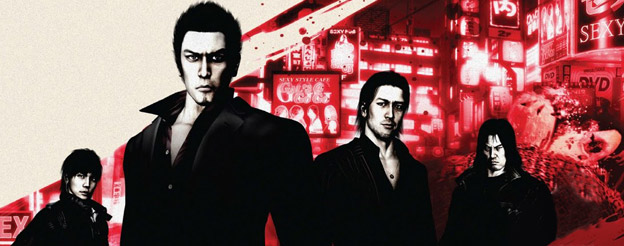
Above: You finally get to play as Majima, and this is the best they've got.
Ahoy,
I gave Yakuza: Dead Souls a spin for Paste, and did not like what I found. In a month when I spent more time than necessary feeling superior to Mass Effect fanpersons, here was my own chance to flip out in a righteous spasm of jilted fanboy rage. Dead Souls is a piss-poor entry in a series that I love. It's as simple as that.
Even though the zombies were a warning sign, I was willing to roll with it. It's Yakuza! How could it not be clever and surprising? The problem is simply that Dead Souls is predominantly a shooting game, and it is a bad one. There are long stretches where you have to run through corridors strafing zombies, without any sense of connection to your character or to the gun(s) in his hand. Despite the importance of headshots, precision aiming is essentially impossible, and the best way to succeed in the game is to rely on a generous auto-aim, which is less a helping hand from the designers and more a concession to the game's inherent brokenness.
I wouldn't recommend Dead Souls to newcomers or to fans. But! This would be an excellent time to remind everyone that my 2011 game of the year, Yakuza 4, is available for under $20 at Amazon. It is much, much better.
Above: Part man, part machine -- all the trigger for a 2,000-word rant about action movies
This week is RoboCop week over at Unwinnable, and with their prompting I have spent the last day devoting far more mental energy to thinking about RoboCop than I have to things like work, the GOP primary, or my personal hygiene. Unlike Garrett Martin, who just saw the film for the first time, I have seen RoboCop many times. I quote it with some frequency.
(Favorite RoboCop quotes, in ascending order:
"They'll fix you. They fix everything."
"I'd buy that for a dollar!"
"I used to call the old man funny names. 'Iron Butt.' 'Boner.' One time, I even called him... 'Asshole.'"
These come in handy more often than you'd think -- as does a triumphant vocal rendition of the film's score. Duhduhduh DUH DUH, duh DUH duhduh!)
Yet every time I watch it, I realize that I've made the same mistake. Since my last viewing, I've always come to think of RoboCop as that mega-gory action movie, the one where Peter Weller's hand gets blown off in close-up, a giant robot shoots an innocent man full of bullet holes the size of baseballs, and a bad guy disintegrates after getting doused in toxic sludge and hit by a car. Don't get me wrong: that stuff is all there, and it is spectacular.
But what I tend to forget is how funny, smart, and savage RoboCop is. As a satire of the Reagan 80s, it is absolutely merciless. 25 years on, its barbs still sting. Abandoned by the government, Detroit has gone bankrupt, and even the police force is now controlled by a shady corporation in search of profits. Anything the firm can do to reduce expenses will enhance shareholder value. The logic is as unassailable as it is reprehensible: the biggest expense on OCP's balance sheet is the labor -- the cops themselves. And so when some poor sap finally volunteers for the RoboCop program, it's not by choice. It's because a gang led by the dad from That 70s Show has blasted most of the flesh off his body. Talk about cutting expenses!
From here, the narrative follows two intertwined threads. RoboCop, along with his partner, uncovers the criminal conspiracy that goes right to the top of OCP, while RoboCop himself searches for his identity, haunted by flickering memories of his old life. He knows he wasn't always a machine, programmed to follow orders; he just can't make sense of the signals he's getting from his vestigial brain. The threads come together in a potent final shot, when the grateful old man says to RoboCop: "That's nice shooting. What's your name, son?"
And RoboCop turns toward the camera, in closeup, and answers, almost defiantly: "Murphy."
(Duhduhduh DUH DUH, duh DUH duhduh!)
Above: So good, Paul Verhoeven even scooped John Woo on the two-guns thing
There you have it. A stunning meditation on laissez-faire capitalism run amok, man's search for identity, and robot policemen who can shoot the nuts off a rapist from 50 yards. Now, I understand that RoboCop was fairly well reviewed in its day, and rightly so, but in the passage of time it has come to be lumped in with a whole bunch of other films as just another 1980s action movie. This is wrong.
First, as I've already made clear, RoboCop is not just another 1980s action movie, as typified by Commando, probably the quintessential Arnold Schwarzenegger movie.
(Full disclosure: I love Commando. But loving something means accepting its flaws, and let's face it, Commando is pure camp. Before the climactic scene, Arnold emerges from the ocean in a Speedo, carrying about 300 pounds of gear, which he then uses to murder like a hundred dudes before a fight to the death against the doughiest, least threatening heavy in film history, who, of course, has a mustache. And Arnold's flexing the whole time. I bet the gay porn industry tried to make a Commando parody in 1985 and realized it was impossible.)
But to call RoboCop "one of the good ones" only advances a false narrative, which is that all, or most, action movies in the 1980s were mindless. It's not the case.
Consider this stunning fact: within a 16-month span, the following four movies were released theatrically:
Lethal Weapon (March 6, 1987)
Predator (June 12, 1987)
RoboCop (July 17, 1987)
Die Hard (July 15, 1988)
Not only is each one of those movies not your standard brainless macho fare (not even Predator -- we'll get to it), they're four of the best action movies ever made. Why? Because they've all got something more happening under the surface.
Lethal Weapon today is remembered as the movie that gave us "I'm gettin' too old for this shit," but it's actually a portrait of profoundly damaged men, each of whom copes in his own way with the scars of a violent past. RoboCop, as noted, is a bitter anti-Reagan satire. Die Hard, probably the most important action movie ever made, gave us the blueprint for the next 20 years of action cinema, although nothing else would ever match it.
Above: Badass upon badass, like an MC Escher painting stabbing itself with a Bowie knife
As for Predator, it is clearly the best movie ever made about a badass alien being who travels to earth in order to hunt badass humans, but what's subversive about it is the idea that being a badass isn't always enough. I mean, the Predator is the biggest badass in the galaxy. He tears through some of the biggest badasses on earth, like Jesse Ventura and Carl Weathers, and still he's not enough of a badass to overcome Arnold Schwarzenegger. So what does he do?
He suicide bombs himself!
Are you kidding me? All movie long, we're led to believe this thing has a strict code of honor. It won't even attack unarmed people. Then, the second something's not going its way, it takes its ball and goes home. Like I said: being a badass isn't always enough. This was not the accepted narrative of the Reagan 80s. Even today, right-wingers will tell you that the hostages were released from the American embassy because the Iranians plotzed themselves the second the Gipper was sworn in.
(We learned that being a badass isn't enough in a more depressing way with Predator 2, in which being Danny Glover was apparently enough to take down a Predator. Really? In the first movie, the most badass dudes in the world couldn't stop a Predator, and only Arnold was barely, barely badass enough to do it, and now we're saying Danny Glover's on that level? Give me a break. Besides which, Predator 2 is horribly racist. Don't watch it.)
Here's my question: what the hell happened?
How did we go from four of the best action movies ever made in less than a year and a half, to entire calendar years where nothing good comes out? How did we go from hardcore, R-rated films where people get their brains blown out in slow-motion while Bruce Willis calls them all motherfuckers, to PG-13 movies where doughy guys are probably fighting but it's too up-close and choppily edited to tell? How did we go from action movies that snuck hidden meanings into the mayhem, to movies that clumsily comment on topical issues without taking a firm stance in case it'd hurt overseas box office?
Action movies just aren't as good these days. Not American action movies, anyway. They're still getting it done in Asia.
Above: Indonesia, gettin' it done
Part of it is genre distinction. You could ask me: what about Iron Man, or The Dark Knight? And I would say, yes, those are excellent examples of big-budget blockbusters that are fun and smarter than they need to be. But they're not action movies. They're superhero movies.
I realize it's a fine line. Why is RoboCop an action movie, but Iron Man isn't? They're both about guys who use advanced technology to give themselves incredible powers that they use for good, and not evil. They both have evil corporate antagonists who appropriate different advanced technology for evil, and not good.
All I can say is this: a good superhero movie is about wish fulfillment. You watch it, and you think, "Boy, wouldn't it be cool if I could do what that character can do?" That's not the case with an action movie. An action movie is about a desperate character in a desperate situation. You watch a good action movie and think, "Boy, I'm glad I don't have to do what that character has to do!"
RoboCop, in other words, is not an enviable or aspirational character. He's a tragic figure. So is John McClane, the shoeless cop trapped in a high-rise with a dozen highly-trained terrorists. So are the badasses of Predator, lost deep in the jungle with the one thing in the galaxy scarier than they are. So is Martin Riggs, a man suffering so badly from PTSD that his greatest asset in the field is a total disregard for his own life. That things may turn out all right in the end for some of these characters is beside the point. They are driven to action not by choice, but by necessity.
Above: No one would want to be in John McClane's (lack of) shoes
Try to think of a recent American action movie that fits these criteria. Taken has achieved "no way am I changing the channel" status whenever it's on TV. It's exciting as hell, and Liam Neeson is almost badass enough to make you think he could face down a Predator, but it's also one of those PG-13 movies where the craziest stuff is almost brushed aside. (Awesome exception: when he shoots the French guy's wife to show he means business.) What Taken lacks, especially, is that deeper level. Its message about human trafficking is a good one, but it's all right there on the surface, and not especially daring or sly.
The Bourne movies are good, and tap into the post-9/11 distrust of a government with too much data and too few scruples, but the endless shaky-cam and PG-13 violence don't have the grandeur we used to expect. Michael Mann's underrated Miami Vice is another good one, but it's too faithful a police procedural to rank with the all-time greats. (Plus, Colin Farrell's mustache is so ridiculous that you expect John Matrix to show up and impale him with a pipe.) People seem to like Crank, but holy hell is it silly -- like, Commando-level silly. Also, I feel like I'm the only person who noticed that Jason Statham's character rapes his girlfriend in public in that movie.
We could go on for awhile.
Above: Smoking? Talk about your bad role models!
The fact is, we're in a drought of great action movies. There could be any number of reasons. Studios might have realized that PG-13 movies make more money. The global marketplace might have made it more risky to put subtext in your blockbuster, either because it wouldn't translate or because it could translate too well and offend somebody. We might have lost our national appetite for shirtless men screaming while firing M60 machine guns into banks of computers. I don't know what it is. I just know it's a goddamn tragedy.
You might ask: Isn't it possible that I only think so highly of these movies because they came out when I was young and impressionable, and watching VHS copies of them out of sight of my disapproving parents was the most thrilling thing I could imagine?
Yes. Completely. I'm willing to say there's greater than a 50% chance that this is the case. And if it is, then anything else I've said here is irrelevant. But just in case, let's press on.
See, Hollywood in the 1980s knew something that today's filmmakers have forgotten. They knew that you could lure people to the theater with the promise of titillation, and sucker-punch them with a story of real substance. They knew that action was about pulling the camera back and letting the viewer see where the antagonists were in relation to one another, and what they were doing, and why. They knew that someone could be part man, part machine, and all cop.
Like Officer Murphy, the action movie industry has forgotten the best
part of itself. And like Officer Murphy, they can get it back. It'll take someone with vision, guts, and the guile to completely sneak it past the studio heads. It won't be easy, but I can promise you: those of us who were weaned on 1980s action movies will show up in force.
If not, maybe John McTiernan can just do a Kickstarter or something.
My review of The Darkness II is up now at thephoenix.com. Count me among many who were pleasantly surprised by the quality of the story. While the gameplay is a little slicker than before, I don't think it benefits by being more overtly game-like than its predecessor, and by having more traditional level design.
In the previous game, Jackie was the only one with magical powers, and his enemies could bring little more to bear than increasingly powerful weaponry. Here, they have enchanted abilities of their own, which may make for a more fair fight, but diminishes a key part of the allure -- the first game was like a monster movie where you got to play the monster.
The whole thing is a lot of fun and well worth playing, but after playing the PC version I would certainly recommend that you play on a console. The mouse and keyboard interface is all sorts of messed up. To use the Darkness slash power, you need to click the mouse wheel, and then move the mouse up, down, or to the side to direct it. It doesn't work well, and feels like you're flailing. Plus, you're likely to accidentally scroll and switch weapons. Additionally, when you're wielding two guns, mouse2 fires the lefthand gun, and the mouse1 fires the righthand gun. It feels completely unnatural.
Oh, and for some reason you use the N and M keys to swap between skill trees. Makes no sense at all.
At any rate, I expected the worst from The Darkness II and found it to be a worthy sequel. This has been a good winter for games, and Syndicate isn't even out yet. What a wonderful time to be alive.
Above: Caius and some lady who's barely in the game.
I reviewed Final Fantasy XIII-2 for Paste. I didn't like it too much, but then again I'm the guy who did like Final Fantasy XIII quite a bit, so make of that what you will. Because the review necessarily had to cover a lot of ground, I wasn't able to mention my single biggest gripe with the game, which would have required a laser-like focus on a seemingly minor point, and a mind-numbing amount of explanation.
Minds, prepare to be numbed.
Final Fantasy XIII-2 has a random battle system, but with a real-time element. Whenever enemies spawn, a timer appears and a big circle is drawn around your character. If you can run up to a foe and whack him with your sword in the first few seconds, you get the first strike, which casts haste on your party, and fills up your opponents' stagger meter. If not, most of the time you'll begin the fight on equal footing. You can also try to run away, which is usually successful, and in which case the enemies vanish.
Now, if you fail to run away, or if the clock otherwise ticks to zero, nothing bad happens unless you lose the fight. Usually, losing a fight gives you the option to "retry," in this case meaning that you end up right back where you were, no worse for wear. But if you lose a fight after the clock runs down, you don't have the retry option. You'll have to start all the way back at your last save.
It's not the most punitive punishment in the world, but it is a sufficient incentive not to let the clock run down. Almost every time enemies appear, it makes sense to try to get the drop on them. But the controls aren't very good, not compared to a good action game, and so you usually end up running around in circles trying to make contact. As a segue into a fight, this is still not a huge problem.
The problem comes when the fight ends. As a remedy to complaints about the last game, FFXIII-2 features big, open levels with no clear path to your objective. It's also fully 3D, of course, with a free-floating camera that you can control at will. When you are returned to the world map after your fight, the camera is no longer showing the same perspective. Your character is no longer facing the same direction. The only indication of which way you were going comes from a dotted line on your mini-map, which shows your most recent steps, and is not at all helpful.
And so, every single time a fight ends, it takes a couple of seconds to re-establish your sense of the game. There is a moment of complete disorientation, in which you spin the camera around and squint at the mini-map, trying to remember which way you were going. By the time you figure it out, quite often another random battle has triggered, starting the whole process over again.
It reaches a crescendo of shittiness in the Academia 400 AF level, wherein you are attacked within seconds of each new encounter by flying enemies that you cannot reliably run away from. Many other levels have an option to ride this Chocobo in order to avoid random battles, but not this one. I spent a solid two hours on an otherwise lovely Saturday morning feeling like K. in The Castle, knowing exactly what I needed to do but being stymied at every turn.
It isn't the biggest annoyance in the world; it's a small annoyance that happens thousands of times. It's not like a bad escort mission that you need to push through to be done with it. From the moment the game begins, it's there, throbbing like a toothache. It keeps you off-kilter and uncomfortable the entire time you're playing. And it makes it harder to focus on what the game is doing well.
It's not just Final Fantasy games that have these issues, but it does seem like RPGs especially can be so invested in their Big Ideas that they overlook the importance of giving users a smooth and responsive experience minute by minute. From Fallout's bugginess to Mass Effect's inscrutable interface, this stuff matters. At least, it should.
The Courier emerged from a shallow grave and became a contradictory, unpredictable force for good in the Wasteland. He always helped people when he could, even though sometimes he stole stuff when it was convenient for him. He also murdered about a half-dozen people for no reason, which he swears was by accident, such as when he meant to click through a closing line of dialogue without realizing that his hunting rifle was already swinging back up into view, and he shot old Alice McLafferty in the face. We tend to believe him, because this was the guy who scoured the desert for hours looking for a little girl's teddy bear. He never found it.
*****
Not the brightest bulb, our Courier. Oh sure, he was eager, almost desperate for work, and he sought out and accepted new assignments with vigor. The follow-through, that's what he had trouble with. We lost track of how many times the Courier appeared unbidden at our door, begged for a job, and then vanished for weeks. At first, we worried. Eventually, we just assumed that some other damned shiny object had caught his attention out there in the wasteland. And we were usually correct.
He'd show up again, months later, babbling about some crazy-ass vault he'd found, or some loony ghouls he'd befriended, and then he'd stare at us blankly when we asked: But what about our chems? Did you bring our chems? He had not. We are still waiting for our stimpaks. Our people are dying here!
F-, would not order from this Courier again.
*****
The Brotherhood of Steel had accepted the Courier into their private realm, and trusted him as they had never before trusted an outsider. They granted him weapons and armor, including their finest Power Armor, in exchange for nothing more than a few errands. When the Brotherhood looked at the Courier, they saw one of their own. Here was the man to bring science, technology, and learning into the new human age. The Courier repaid their trust by murdering them all when a talking computer told him to. Like, he didn't even think about it.
What a fucking psychopath.
*****
Talk about your faux pas! Guess who showed up at Camp McCarran in his best Brotherhood duds -- again? That's right, it was the Courier, or as we like to call him, The Zero of the Tastes. (Come on, it works.)
For the third time in a month, the Courier appeared at the gates of McCarran in a run-down suit of T-51b Power Armor, with, get this, a T-45d helmet! He could have worn brown shoes with a tuxedo and not looked half as ridiculous. We certainly can't blame the NCR for opening fire immediately. We can blame them for their lousy aim, though. Fellas, what happened?
*****
The Courier never found 50 of the Sunset Sarsparilla Star Caps. He tried. Really, he tried. He tried harder than any man should on a task so mindless. God, why did we even give him a quest like that? It was so stupid! What a goddamn waste of time! Arrgghhghgkhgdkjhdgsjhdsg
*****
When he arrived at Jacobstown, the Courier could not escape one single, insistent thought: "Is that Lieutenant Worf's voice?"
Indeed, actor Michael Dorn did provide the voice of the wise Super Mutant Marcus, a fact that the Courier quickly confirmed on the Fallout wiki. Throughout his travels, the Courier had a habit of vanishing for minutes at a time during conversations, leaving the other party standing mutely, with a blank expression, as the Courier chased down another tidbit of casting information on the Internet. He was right more often than he was wrong, instantly identifying actors such as Matthew Perry, Michael Hogan, and Dave Foley.
The Courier did once go awry. After spending several hours with Boone, he could have sworn the sniper was voiced by Nolan North. I mean, who makes a video game these days and doesn't cast Nolan North? Boone sounds just like him. But no, according to the credits it was some guy named "Jason Marsden." Although he would never admit it, the Courier privately believes that this is a pseudonym for Nolan North. But he was always sure that the guy who did the voice of Marcus had also played Lieutenant Worf. It was obvious.
My sniper and I are crouched in the tall grass in a field overlooking an antenna site. We have an excellent vantage point from which to observe the comings and goings of troops in enemy-controlled territory. The sniper is an expert. Slowly, methodically, he picks off one Russian soldier after another. It is a beautiful sight. I feel blessed to be here, in this moment, in the sun-dappled splendor of these Central Asian hills. I am moved. It is not enough to witness this moment -- I must become a part of it.
Here's your ammo! I cry, hurling a crate of ammo next to my sniper.
He has stood up and is running away. The dull metal crate sits in the grass, unloved, never to know the warm touch of a restocking sniper.
I sprint after him. Wait! Wait! Got your ammo!
My energy is flagging and he is disappearing over a rise. I wonder: Had he even known I was there? Had I imagined our moment of shared transcendence?
And I wonder: Will no one take my ammo?
*****
We are riding in an LAV through the streets of Paris. Through a small window, I see little but gray stone buildings passing by, sometimes only feet away. Judging by the thump-thump-thump of our machine gun above my head, we are eliminating hostiles with precision and efficiency. Our driver deftly navigates the narrow streets, as though he is driving a sports car rather than a truck loaded down with infantry and armor.
I am holding an ammo crate in my lap, drumming my fingers to the rhythm of the Rolling Stones' "Satisfaction."
We have captured an overpass that command has assured us is of utmost strategic importance. We have faced little resistance. We are moving on. There is a city square up ahead. Our leaders tell us that the fate of the entire battle may hinge on control of this square. Our gunner keeps firing. Our driver keeps rolling.
Soon, I am sure, we will stop, and someone will need ammo.
Someone must need ammo.
*****
Before the war, this marketplace must have been the place to be in Tehran. I can picture families strolling through the bazaar, politely shrugging off entreaties from enthusiastic salesmen. I imagine young men buying fancy baubles for their dates. I can almost smell the roasting lamb from a nearby kebab stand. You could spend a whole day here and not see it all.
No longer. This is nothing more than a meat grinder into which dozens of young men are being thrown with a terrifying fervor. No sooner has a squadmate been been cut down than another arrives to take his place. You stop even trying to tell them apart after awhile.
I am lying prone in an alleyway, sweeping the optical sight of my M249 across the narrow opening to a nearby plaza. Behind me I hear a more lusty firefight, but I have chosen to defend our rear flank, which, to my mind, is pitifully exposed.
Now and then an enemy straggler stumbles into my line of fire. I let loose a volley of suppressing fire. They are not killed. Nor do they return.
I toss a bountiful ammo crate into the empty alley next to me. No one is there to reap its fruits.
*****
Our company is huddled in the concourse of a Metro station, beset on four sides by encroaching enemy fighters. This is, at last, war at its most senseless. What possible strategic importance could this subway stop have for us? This isn't a battle -- it's mass murder. I can hardly hear myself screaming over the gunfire and the grenade blasts. But scream I do.
Got your ammo!
My comrades receive my ammo as manna. I have barely turned back to the fighting than the box is stripped and its contents depleted. It is no concern. I am prepared.
Ammo here!
Again they throw themselves onto my supply crate, gorging like starving men who have discovered a freshly killed boar. Again they turn toward our enemies, weapons laden with deadly cargo, and relieve themselves of their payload without sense or reason. Again their triggers click dry, and again they return to me. Again am ready.
Shoot! Shoot, my brothers, shoot! Empty your weapons and feast upon my ammo! May the fighting never end!
Above: Kazuma Kiryu will beat your ass if you complain about how this list fails.
Do you want to read another top 10 list with Skyrim on it? Then you'd better look elsewhere. My list of the top games of 2011 is up now at thephoenix.com, and it is entirely dragon-free.
Bitching about year-end lists is a tradition as old as making year-end lists, so I won't indulge here, except to say that I think it's more fun to see an individual's list than a group list, because the former is bound to be more idiosyncratic. The drawback, of course, is that one person can't have played everything in a given year, so -- gasp! -- the list won't be "objective."
Maybe Skyrim would have been my favorite game of the year if I'd played it, or at least a contender, but I honestly have to wonder: who cares what I think? It's sold millions of copies. It's a critical smash. It's picking up awards left and right. Nobody needs my validation. But if my list can convince someone to give Yakuza 4 a whirl, or Jetpack Joyride, or Shadows of the Damned, or Outland, then I think I've fulfilled a more important duty.
Oh right, I said I wouldn't bitch.
But if you do you come here for the bitching, you could also check out my review of The Legend of Zelda: Skyward Sword, which went up a couple of weeks ago. I promptly forgot about it, because this game has already taken up more of my mental energy than it deserves. Plus it's Christmastime. Why beat a dead horse?
Merry Christmas, happy holidays, and happy new year. And, from the bottom of my heart, thank you for reading.
The first two hours of The Legend of Zelda: Skyward Sword are just plain bad. You spend a lot of time reading endless boring dialogue; you receive lessons in the most banal gameplay mechanics, such as how to jump over a gap (you run toward the gap); you are leered at by grotesque circus freaks that represent some twisted Nintendo designer's idea of whimsy. You get a lot of minor quest objectives like, "Go talk to Pipit!" and "Hey, why not talk to Pipit again?" It's not a tutorial for people who have never played Skyward Sword, it is a tutorial for people who have never played a video game before, and it is excruciating.
When I complained about the slow start on Twitter, Kotaku's Stephen Totilo assured me that Skyward Sword becomes spectacular about 6-10 hours in. For a game that I've read is at least 50 hours long, that's perhaps a reasonable introductory period. In absolute terms, it's ridiculous. Only in a video game are you expected to log a work day slogging through nonsense just to get to the good part.
Every medium has its point of no return. If a book hasn't grabbed me by 100 pages, I'm likely to drop it. If a movie hasn't made its case within 45 minutes or so, I have no problem turning it off. In neither case does that seem like I haven't given the work a fair shot. In a video game, though, if I put 6 hours into something and don't enjoy it, people will still be counseling patience, telling me that it will all pay off eventually.*
Sure, some games have slow starts. All I ask is that it keep me interested during that period. One of my favorite games of the past few years, Far Cry 2, took a good 4-6 hours before it got completely up to speed, but it was good enough to start with that I was willing to make the investment. You do have to wonder: how good can a game become in order to justify a bad start? Isn't the beginning a part of the experience, too?
As usual, where you land on this argument depends on what you think the purpose of a video game is. Totilo made the analogy to learning to play a musical instrument: in Skyward Sword, he said, the game "is a piano and all you're doing right now is playing Twinkle, Twinkle, Little Star." But I think it's an imperfect comparison, because I already know how to play this metaphorical piano, and having to start with the simplest possible tune is, yes, a waste of my time. Where Skyward Sword deviates from the standard is by giving me 1:1 motion controls for the sword. So why not start there? Why not assume that I know how to jump across a gap without making some elfin freak explain it to me in numbing detail?
Besides which, I may have a more active role in playing a game than I would in listening to a song, but I'm still the consumer and not the artist. To use a different analogy, if Skyward Sword were a book, then the implicit agreement, when I crack the cover, is that I already know how to read. I don't need to be taken through the alphabet first.
I'm not trying to be cynical. I sincerely hope that the next time I talk about Skyward Sword, it's to say how good it's become. But no matter how good it ends up being, I can't imagine that it ever justifies such a slow start. There are only so many hours in the day.
*This was taken to extremes with Final Fantasy XIII, you may recall, when people talked about it getting good about 20 hours in. They weren't wrong, necessarily, but I thought the game was plenty fun from the beginning, thank you very much.
Above: Nathan Drake searches for something interesting to say.
My review of Uncharted 3: Drake's Deception is up at thephoenix.com. I was a little disappointed by it. Maybe it's just a case of expectations: the stuff that was good was not really better or different than what I expected, and the stuff that wasn't good seemed like a regression from Uncharted 2.
Even though Drake's Deception hit a lot of the same notes that I praised so much in Among Thieves, here it felt more obligatory. There were slow parts where you walked through city scenes, and puzzles, and some decent platforming, and a whole bunch of awful interminable shootouts. Worse still, I found myself less drawn to Nathan Drake as a character this time around. He still has some great lines (and some great line deliveries, thanks to Mr. North), but I just wasn't buying what Naughty Dog was selling. And I wasn't really sure why.
At any rate, it's still a decent enough game, but I do hope that if there's a fourth Uncharted, that it brings with it a few more surprises.
Match each of these games with the breathless quotation from its review.
1. LittleBigPlanet 2
2. Dead Space 2
3. Portal 2
4. L.A. Noire
5. Deus Ex: Human Revolution
6. Gears of War 3
7. Rage
8. Batman: Arkham City
9. Uncharted 3: Drake's Deception
10. The Elder Scrolls V: Skyrim
A. "The sequel is five times bigger and about a billion times better. You do the math."
B. "...every bit as charming and ingenious as its predecessor and, what's even
more impressive, it raises the bar for what people should expect from
the gaming industry as a whole."
C. "...capable of satisfying both fans and newcomers to the genre thanks to
great gameplay and an involving story. A strong contender to the title
of best game of the year and of the entire generation."
D. "...not only one of the best stories you ever went through, but one of the
best and most addictive multiplayer experiences ever to hit consoles."
E. "From the art
direction to the genre-bending gameplay... a
landmark in game design that is sure to be referenced in the years to
come. Buy it without hesitation."
F. "...jumps from one extraordinary set piece to the next, pushing the way a
videogame narrative can be presented. Equal parts exhilarating and
emotional, I can't say I have ever played a more perfectly paced game."
G. "...much more than just the best FPS experience I've had in 2011; it
is a pivotal and redefining moment for the future of game design that
will push your console further than anyone though it could go."
H. "The fantastic story, excellent pacing, interesting and engaging puzzles
and other incredible facets to the game make it one that people should
experience at any cost."
I. "...a ludicrously intense, graphically gorgeous, thoroughly
atmospheric game that takes everything the first title did and ramps up
the absurdity to dangerous levels."
J. "In the end it is something that will go down in history as one of the
most innovative games of our time, and for good reason. You are simply
supposed to have this game in your collection, if you consider yourself a
gamer by any definition of the word." ANSWERS:
Which the best game Seth Schiesel has ever played this time?
1. LittleBigPlanet 2
2. Child of Eden
3. Shadow Cities
4. Batman: Arkham City
5. Uncharted 3: Drake's Deception
A. "It may actually be the most interesting, innovative, provocative and
far-reaching video game in the world right now, on any system. That’s a strong, perhaps outrageous, statement. "
B. "...Sony’s stunning new entertainment ecosystem for the PlayStation 3.
Entertainment ecosystem? That may sound like hype..."
C. "the finest, most exciting action-adventure video game in years."
D. "In its ambition, scope and sheer love for its decades of lore... the finest comic book video game ever to slip into spandex."
E. "...one of the most inspirational exhibits of artistry to be found in interactive entertainment today."
This was a tough one to write, for reasons that I think will be clear when you read the review. When things go well, Battlefield 3 is stunning. The problem isn't just that things don't always go well, it's that sometimes they don't go at all. My play experiences tended to fall into one of five categories.
From best to worst:
Time of my life -- awesome squadmates, great connection, action-movie moments that make me weep with joy.
Dumbass teammates, but an incredibly fun shooter with constant surprises.
Connection troubles, lag, lost XP and unlocks. Starting to wonder if it's worth it.
"Joining Server" loop for three goddamn hours. Rebooting and cursing.
Single-player.
For instance, I once paired up with a squadmate who was a virtuouso with a tank. He was driving, and pummeling our enemies. I was acquitting myself serviceably in the turret, and ended the match with something like 10 kills to 2 deaths. (Usually, for me, it's the reverse.) Not only did we win the game, but we earned the ribbon for the best squad, and even though it was all him, it was a feeling of satisfaction that lasted me through many worse performances.
Even when there is little or no cohesion, the game is still somehow incredibly fun, if only because so many variables are at play. At times, I held down capture points by myself, just a solitary man lying in some tall grass with a heavy machine gun. Once, after respawning, I wiped out the entire squad that had cut me down just moments before. And then, of course, there are those magical moments when you accidentally crash a helicopter onto somebody. I find it hard not to run upstairs and recount these things to my wife in excruciating detail.
There's every reason to believe that the Battlefield experience will get better, and I hope it does, because right now the thin candy shell is not properly supporting the chocolatey middle. I don't think I'm done with this game, not by a longshot.
Above: Batman struggles with the new Google Reader interface.
My review of Batman: Arkham City is up at thephoenix.com. I think that some reviewers have gone a little overboard with their praise (even though this review score was hilarious), but it's still a great game, and one of the better ones I have played this year.
For as much as people are still griping about the sins of past Bat-games, I think that if this were a new IP, we'd be more measured in our praise. Arkham City can tip too far into fan service, and sacrifice narrative cohesion in favor of Jeph Loeb-style stunt casting. Even though I like Rocksteady's interpretation of lesser villains like Clayface and Solomon Grundy, they also serve the same function in this game as the moles do in Whack-a-Mole. The same was true of Arkham Asylum, but less so. City is the better game; Asylum was the better yarn.
Now that we're in the thick of things, I feel even more behind than usual. I've got a Battlefield 3 review in the pipeline (which marks my long-awaited return to Paste!), and Uncharted 3 on deck for the Phoenix. Somewhere in there, I've also got Lord of the Rings: War in the North to play. First world problems, indeed.
The buzz I had been hearing was not good, and the game's first few hours seemed to confirm it. Where Rage attempts to modernize, it doesn't work. It is kind of creepy how much time you spend standing mutely while people give you orders, and how un-interactive the world is. But where Rage plays to id's strengths, it soars. I forgot what it was like to play a first-person shooter as pure as large portions of Rage are.
There is strategy involved, of the sort where you're deciding whether you want to do a little damage or a lot of damage. There are fun, unexpected weapons to use, like a mind-control slug that allows you to walk an enemy, zombie-like, into a crowd of his compatriots before blowing him up. Traditional weapons are all given a chance to shine, as smartly designed levels transition from close-quarters combat to wide-opeen battlefields.
Mostly, it's a game about shooting, and so it gives you the tools to do that. You can carry 8 weapons at a time in rage. Your sniper rifle scope stays steady, even when you're zoomed in. The action is smooth and lightning fast.The best summation of Rage that I've read came from the Dead End Thrills blog, which in a post that was otherwise all about id Tech 5, had this to say about the game itself:
It reminds us how far we’ve erred from the thrills of ‘run-and-gun’ into
pedestrian ‘stop-and-pop’; how we’ve lost the rhythm of the firstperson
shooter; and how look and feel are still more important than gimmicks
and Gamerscore.
I couldn't agree more.
Of course, it's fair to say that not all of Rage consists of these shooting sections, and I'm with everyone who finds the vehicle portions and the world-building to be suspect. But I'm also the guy who will dismiss a game completely if I don't like the inventory menus.
I'm not contradicting myself. What I care about is what comprises the bulk of the experience. It doesn't matter to me how great the story is in an RPG if I am spending all my time grappling with the interface. And it doesn't matter to me that Rage's shooting portions are stitched together in a dead world with the occasional mandatory driving section, because those are easy and brief. If my buggy had constantly been blowing up, and if I had to spend long stretches doing more in the city hubs than picking up missions, my impressions would have been quite different.
As it is, if Rage had simply been a linear corridor shooter -- paced more like Metro 2033 than Borderlands -- it probably would be one of the best of the year.
Hey there! Forgot to mention that I reviewed Driver: San Francisco for Joystick Division.
Don't have much more to add that isn't in the review. It seemed like a good game and I kept waiting for the moment that I would completely buy in, and it never came. I had some fun with it, for sure, but I'd play a couple rounds of multiplayer, or a few missions in the campaign, and start thinking about other games I could be playing, or things I had to do around the house. I never had any problem turning the game off.
Next it's on to Rage, it looks like, with some time for the Portal 2 DLC and a little more Resident Evil 4 HD. There's not enough time in the day.


 It is much, much better.
 Damn.)