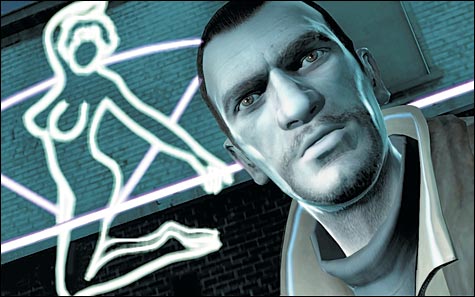
I've got problems with Grand Theft Auto IV. I appreciate its ambition, and the storyline is suitably engrossing. Overall I'm enjoying it a bit more than I expected to. Yet it's far from perfect. I don't think a perfect review score means a game lacks any and all flaws, but when those flaws undermine what makes the game good, a perfect score seems more like wishful thinking. There are small things that take me out of the world of Liberty City, annoying gameplay quirks that may have been unavoidable but still smack of poor design, and, most regrettably, a sexist and homophobic streak that gets close to crossing the line for me in some ways.
When I read discussions of the game online, it seems like most people are awed not only by the scale of the city, but for the almost limitless minor interactions with city dwellers. Sometimes I get what this is about. Upon loading up one session, I stepped out of the safe house and heard somebody yelling nearby. I walked across the street to investigate, and found a manic street preacher with a bible in one hand, sharing the gospel with anyone who would listen. It seemed as though I was the only one who was.
Nearby, I saw an ATM, and thought I might see if I could use it. As I approached, another pedestrian cut in front of me and took some money out. I thought about beating him up and robbing him, but it's just not how I roll. Instead, I went back to my parked car and saw someone crouching behind it. Suddenly a cop ran over, gun drawn, and shouted at him to put his hands up. Another police car screeched to a stop, sirens blaring. Man, I thought. This is amazing. It really was. A whole city, teeming with life, regardless of what I was doing at the time.
Then it fell apart.
The criminal, apparently apprehended, never got in the police car. He backed away and put his arms down. The cop, still pointing his gun, seemed to lose track of what he was looking at. The criminal ran about half a block, then started walking as though nothing happened. The cop walked in a circle. What had been an amazing display of dynamic AI seconds earlier had turned into gibberish. And this happens a lot.
In another mission, I was tailing a drug dealer. I was warned repeatedly not to get too close to him, lest I arouse his suspicion. So I was wondering, as I stopped in the middle of the road blocks from a stoplight, how I was any less conspicious there than if I simply pulled up to a red light like every other driver on the road. As I was musing on this, there was something of a traffic jam up ahead. The dealer couldn't get through a couple of stopped cars. I waited a full minute, and they didn't move. I started to wonder if I would have to restart the mission, when suddenly the cars in the intersection vanished into thin air, and the dealer kept driving.
That's one of the problems I keep having. It's not catastrophic to the gameplay, but every time I start to get immersed in the world, something happens to shock me back to reality. Maybe these kinds of problems are inevitable, but it's hard to dismiss them when they undercut the main attraction of the game.
Another thing I'm less than thrilled about is actually intrinsic to the game design. I wish there were checkpoints within missions. GTAIV is actually a big jump forward in this regard, because it lets you choose the option to restart immediately upon failing, and even teleports you back to the starting point. That's helpful. Problem is, lots of missions take place far from their alleged starting point.
For example, in the mission "The Puerto Rican Connection," you have to follow the train as it travels along elevated tracks. But first, you have to drive from Manny's place in South Bohan to a bridge in Algonquin (I think? I can't keep the place names straight). Only then does the chase begin. When you fail, you don't start at the chase -- you start back in South Bohan. That's all added downtime, and it's a problem I've had with open-world games in general. Since this game lets you warp to the beginning of a mission, why aren't there sensible intra-mission checkpoints?
Lastly, I've bent over backwards to defend the content of Grand Theft Auto, even though my reasons for doing so are no longer clear even to me. I had a tough time reconciling one mission in particular, called "Out of the Closet," which struck me as cold and bigoted even within the jokey tone of the game.
I want to be clear on one point: There's a difference between portraying homophobic characters, and homophobic portrayals of characters. Brucie is a good example of the former. He's a shirtless, 'roided-up beast who's constantly angling for bro hugs and chest bumps, and then without prompting proclaims his staunch heterosexuality. It's as though he's trying to convince himself moreso than Niko. I also accepted Manny's continual accusations that I was gay when we were trailing a drug dealer and got too close to our quarry's rear. That's reasonable for the character, I think.
But in "Out of the Closet," you find out that a gay guy owes Brucie money, and therefore needs to be killed. Simply retrieving the money from him is not an option. You set up a date with him through an Internet dating site, which is a pretty inspired idea in itself. The guy shows up at the diner and is, basically, a flaming queen -- theatrical lisp, ostentatious clothing, all that. He chatters at you, still thinking it's a date. He's a little annoying, but nice.
Then you stand up and gun him down. That's it. That's the mission. You lured the gay guy into a trap and killed him. You win.
Maybe it would have been better if he'd fought back instead of run. If Niko did something to tip him off and he pulled the gun first. Or if the date had moved to business talk and I had any better idea of what the hell the guy had done to deserve getting whacked. I don't know.
It may be a fair question to ask why this bothered me, and it hasn't bothered me to run over drug dealers or shoot a bunch of cops. After all, gang warfare is a problem in real life. Cops are killed in the line of duty all the time. None of that is any more fantasy than gay bashing is. I can only say that I have mostly understood Niko's motivations in the game to this point, even though I wish they'd made him a bit more reluctant to dive right back into a life of crime. But this mission really seemed senseless to me. At least the victims in the other missions shot back.
Showing posts with label Controversy. Show all posts
Showing posts with label Controversy. Show all posts
Monday, May 05, 2008


Friday, May 02, 2008
Boston Globe muffs the landing

I was disheartened to read an editorial in the Boston Globe this morning called "Nihilism at $60 a pop." As I've said before, I think there are plenty of legitimate criticisms to make about a game like Grand Theft Auto IV. The problem I have with these types of tirades is that they always seem to spring from a place of total ignorance, unsupported by facts. This editorial is typical. The editors make some wild assertions about the content of the game, but nowhere do they cite anything specific in support of their argument. It's just fear-mongering. Let's take a look at it, piece by piece:
WE LIVE in an amoral and violent world: human trafficking, gang warfare, beheadings, rape - oh wait, that's just the video game Grand Theft Auto IV.
I'm not so far into the game that I can say for sure, but in my experience to this point there has been a single reference to human trafficking in the main character's past, no beheadings, and no rapes. There has, however, been gang warfare. One for four ain't bad. Wait, yes it is.
I'm also confused by the implication: Are they saying those things don't exist outside of Grand Theft Auto? Or are they saying we live within the video game? Since a couple of the things they mentioned don't actually happen within the game, it's tough to say. In the meantime, there is more than enough of that stuff to go around in the real world, unfortunately. Which, again, is not to say that such content couldn't be fair game for criticism -- just that this is a sensationalistic way to start, and doesn't inspire much confidence that the rest of the piece will be educated or fair-minded.
Remember, this is only the lede! We're already off to a bad start.
Commercial movie theaters are expecting slow sales this weekend because the new edition of the addictive video game, released Tuesday, is expected to keep millions of youngish American males encased in their bedrooms, gleefully blasting people's heads off. The Entertainment Software Ratings Board, a voluntary industry group, has given GTA's new edition an M rating: "not suitable for players under 17." But there is little monitoring of video game sales, and few believe that a determined 14-year-old couldn't get his hands on the game.
It's interesting that they mention the possible loss of box office revenue this weekend, because you can bet your bottom dollar that the paper would never run an editorial condemning an R-rated movie. But why? There's little monitoring of ticket or DVD sales, and few believe that a determined 14-year-old couldn't make his way into the theater. Yet no one doubts that R-rated movies are intended for adults, even if they do hold inordinate appeal for young males.
I wonder what more the industry is expected to do here. The ESRB voluntarily rated the game and clearly marked it as inappropriate for minors. Retailers don't mess around with this stuff, either -- I'm 26, and I've often been carded at Best Buy when buying an M-rated game. Target and Wal-Mart keep their games in locked cases, and I believe both check IDs as a matter of policy. This isn't sufficient?
And, again, the characterization of "blasting people's heads off" is inaccurate. You can shoot people in the head if your aim is good, but heads remain attached. Triviality? Maybe, but when the purpose of the editorial is to sensationalize the content of the game, I think it's necessary to point out the hyperbole.
This poses a dilemma: No defender of free expression, such as a newspaper editorial page, can easily support censorship. And unlike cigarettes, guns, or alcohol, the danger even to minors of possessing debased video games is a murkier science to prove. Ultimately, parents must be the gatekeepers of the media their children consume.
We at least agree here. There is no data -- none -- that games are harmful to minors, much less that games turn them into zombie killing machines, so the Globe doesn't even attempt to cite any. Although they seem to believe otherwise, this does not strengthen their argument.
Still, the GTA-IV experience is particularly insidious. The very features its fans love - high-quality graphics that immerse the player in a convincingly realistic world - raise the stakes. The targets are not space aliens or cartoon characters but police officers, taxi drivers, strippers, and the occasional innocent bystander. The violence, especially toward women, is unusually gratuitous. There is nothing about GTA-IV that can be considered remotely "socially redeeming" - one of the tests the courts use to judge whether material is obscene.
I agree with the basic argument here, but again the specifics are misleading. Part of GTA's power comes from the familiarity of its setting, and its emphasis on verisimilitude. It's one of the many good reasons why the game is rated M. The characterization of Liberty City's inhabitants as "targets," though, shows the lack of understanding of what the game is about. To the extent that anybody in the game could be called a "target," you'd have to be referring to the drug dealers and gangsters whose elimination is often the objective of a mission.
But cab drivers? Strippers? Innocent bystanders? They exist to populate the world. You can harm them, but it is entirely your choice as the player to do that. This is what seems to bother editorial boards so much, and the implications may be worthy of discussion. Why do so many players get their kicks in this game by breaking the law? Unfortunately, answering that question would require a high-minded, academic look at the issues, and you just can't cram one of those into the short space of an editorial. It's easier to call the game "insidious" and pretend that you get points for going on killing sprees.
Furthermore, I'd say that I'm also bothered by some of the depictions of women in the game. It seems to have a preoccupation with women as strippers and prostitutes. The argument that GTA is sexist is a lot stronger than most of what the Globe is trying to say here. But they have to mischaracterize it and pump it up into something it isn't. Again, I haven't played through the whole game, but so far every bit of mandatory violence I've encountered has been between men. Is that more acceptable? I don't know. But it's a more accurate description of the game.
The other familiar obscenity test is whether something violates "community standards," and here the game may already be lost. Every time another rap song or video game pushes the envelope, it becomes the new standard.
"Community standards" is an awfully nebulous term -- but then, this whole article is vague and unhelpful, so why not cap it off this way? I do want to make one humble argument for the community value of video games in general, though. Multiplayer games, especially, provide a social outlet for people of all ages and abilities. They give people a meeting ground, and a chance to engage in both cooperation and competition. They encourage strategizing and decision making. In the case of Grand Theft Auto, almost everything you do involves a trade-off. Yes, you can mug somebody for money, but then the police will come after you. If you want, you can also drive a cab and pick up fares. This is the power and the appeal of video games -- the player gets to choose how to play, albeit within a pre-defined framework.
If we're going to write these pearl-clutching editorials bemoaning the depravity of video games because we think one or two people might be inspired by them to go bonkers, can't we also acknowledge that for millions more they provide a real benefit? With the advent of online play, they're a way for friends to connect across long distances. For people with disabilities, they're a way to feel empowered. For so many of us, they're a wonderful storytelling medium that engage us emotionally, intellectually, and morally.
We wouldn't ban Grand Theft Auto. But the death and maiming in Liberty City are too close to the real lives of too many children. To package that for profit and entertainment is the real crime.
Well, no, it's not a real crime. It's not even a fake crime, like everything that happens in the game. Grand Theft Auto is a crime story, like The Godfather or untold numbers of paperback books with shiny raised lettering on the cover. Again: Kids probably shouldn't play this game. But violence and sex as a part of popular entertainment goes back as far as entertainment itself. Somehow, we've survived. We've even thrived.
I do imagine the author typing out that last line, leaning back in the chair and cracking his knuckles, and congratulating himself on having finally solved every problem in the world.
Damn it, couldn't resist one sarcastic dig. I was doing so well!
Thursday, April 24, 2008
Reconciling the irreconcilable
The story I've been alluding to for over a week now has been posted at thephoenix.com: "Sex, violence and video games." In it, I look at the merits of a few recent controversies, including the ever-present Grand Theft Auto criticism, the Mass Effect "SeXbox" flap, and, of course, the Resident Evil 5 trailer. I also take the community to task for often acting as their own worst enemies. The crux of the argument is that gamers need to be repping themselves better in the discourse, making a real effort at empathy:
The less-helpful commenters accused [critics themselves] of racism, of creating a racial divide where previously there was none. They decried an assault on Capcom’s right to free speech. But the question wasn’t whether the game’s Japanese developers had intended any racism (cultural ignorance is a commonly invoked defense among gamers), or why nobody had complained before when Resident Evil zombies had been predominantly white. It was whether those claiming free speech in defense of divisive games were willing to extend the same rights to those whom the games offended.
I also made one more attempt at demolishing the "just a game" defense.
To spend the bulk of your time and money on a hobby that can be dismissed with a wave of the hand would require an act of cognitive dissonance. Some games do have the potential to be transformative experiences. Talk to Final Fantasy VII fans about the grief they felt when Sephiroth killed Aeris. Ask a few BioShock players whether they saved or harvested the Little Sisters, and why. Such indelible moments may be rare, but they give game developers something to strive for. And they give gamers hope that the next game we play will also engage us intellectually, emotionally, and morally. I can think of no more belittling way to discuss this medium than to ever call something "just" a game. So let’s scrap that argument.
Think it'll take? Me neither.
When I began this piece, I had intended to lay the hammer down. This was to be the last word on the subject, and the spark that ignited countless fanboy epiphanies around the world. But that's not how it ended up. It is, perhaps, a good place to start, presuming that angry mobs don't do their best to prove my point. I would love to know what people think.
P.S. It's the cover story in this week's print issue, which is exciting. Pick up a copy, if you're local.
P.P.S. Also check out the brief sidebar, "Not-so-great moments in video game controversy." Nothing new or particularly illuminating, but that stuff's always good for a laugh.
Subscribe to:
Posts (Atom)