Tuesday, February 17, 2009

The argument about Guitar Hero that I never want to hear again, part two

Continued from part one.

Yesterday, I talked about how much I hate the commonly expressed opinion that people who enjoy playing music games should learn to play real instruments instead.*

The absurdity of the argument becomes pretty clear if you replace Guitar Hero or Rock Band with something else -- for example, basketball. Say you're playing HORSE with a friend or two at the playground, and some snooty douche comes along and says, "How come you don't play real basketball?"

You would immediately formulate several cogent responses. "Because there aren't enough of us for a game of basketball." "Because we're not in good enough shape for 48 minutes of vigorous athletic activity." "Because we're bad at dribbling, passing, shooting, and keeping score." "Because playing HORSE is fun, you snooty douche."

Of course, no one would ever look down his nose at you for playing HORSE instead of training for a career in the NBA, because these things are all well understood. (It's also unlikely that our fictional person in this scenario would never have played the game or even dribbled a basketball, but that's what happens with critics of music games all the time.)

What's the key here? When you play HORSE, you are not trying to be a "real" basketball player. No one thinks you are. What you're doing is related to basketball, yes, but in the same way that your housecat is related to a cheetah. Although you may even do things like count down "3... 2... 1...!" before launching a 3-point shot and mimicking a buzzer, no one wonders why you aren't trying out for the Lakers. You are adapting your enjoyment of the sport into something that allows you to participate. It doesn't stop you from watching the NBA. Nor does it stop talented athletes from pursuing a career in pro sports.

This is also true of music games like Guitar Hero and Rock Band. They are an extension of our enjoyment of music, not a replacement. Playing these games shares more in common with singing in the shower and air-guitaring at your desk than it does with mastering the complexities of a musical instrument. One takes rigorous effort and discipline, while the other requires only a commitment to shaking your ass. Most of us never seriously consider dedicating a good portion of our lives to playing music, for any number of reasons. We participate in the music we like by attending concerts, by dancing or singing along, and -- to use a recent, personal example -- by cranking up the volume on the car radio when WZLX is playing a rock block of Dire Straits.**

In other words, there's a relationship between the artist and the listener, one that doesn't really change when the listener happens to be strumming along on a plastic guitar. As when you bop your head or hum, you're engaging with the artist's work when you play a music game. Maybe I'm crazy, but I think that's what the artists actually want. The obvious difference is that the Guitar Hero guitar or the Rock Band drum kit actually does affect the musical output, but there's little room to put your own imprint on it -- barely more than when you adjust the levels on your stereo. You're still consuming that which someone else has produced.

Look, we can't all be content producers. Or, at least, we can't all master the production of everything we happen to enjoy consuming. This has always been the balance. At the risk of oversimplifying it once again, the reason I don't play a real instrument is because I don't want to. I've already decided what I want to dedicate my time and effort to. I could try to be a musician, but I've chosen to be a writer instead. But I still love rock music -- it's occupied a meaningful place in my life for as long as I can remember. I have always sung along. I always will.

*Lest you think I'm just wailing on a straw man here, a recent example of this argument, and the one that has stuck in my craw since I read it weeks ago, comes from Rob Horning at PopMatters.

**We got to move these refrigerators. We got to move these color TVs.

Monday, February 16, 2009

The argument about Guitar Hero that I never want to hear again, part one

If you're interested in certain controversial subjects, you tend to run across the same facile arguments over and over. Among these are:
  • Communism works great -- in theory.
  • Religion is the cause of every major war in human history.
  • Evolution is a theory, not a fact.
All of which are shorthand for: "I don't understand what I'm talking about, and have no real desire to find out, yet I suffer from an uncontrollable compulsion to express an opinion about things." Here's another one I'd like to throw onto the pile:
Instead of playing Guitar Hero/Rock Band, you should learn to play a real instrument.

This more often expressed as a question: "Why don't you learn to play a real instrument?"

Well, why don't we learn to play real instruments? Because playing real instruments is hard. I know. I played the guitar daily for about a three-year period. In that time, I mastered 10 chords or so. You could say I had a repertoire of about a dozen songs, but only if you were being charitable toward me, and uncharitable toward the songs. This was something I put hundreds of hours of my life into, and I never progressed past the "woeful beginner" stage. It's no wonder -- in Outliers, Malcolm Gladwell cites research suggesting that approximately 10,000 hours of practice are necessary to master anything.

That's just one musician! It's even harder to get a whole band together. You need at least three people for a band, preferably four -- even, in the case of the E Street Band, several hundred. We're looking at 30,000 man-hours, minimum, just to get enough musicians together to start a decent band. But it's not enough to find people who are proficient at their instruments. They have to share a musical vision, and have the time and commitment necessary to write songs, practice, play gigs, and so on. When you look at it that way, it's a wonder there are any bands around at all, never mind good ones.

Guitar Hero and Rock Band are hard, too, but much less so, and with a much lower barrier of entry. Almost anyone can instantly get the hang of easy difficulty, and start playing whole songs right away. Even medium difficulty is within the grasp of many first-time players. It takes a while to get good enough to handle expert difficulty, but certainly not 10,000 hours.* Here's the real difference: you don't have to be an expert to play the songs and enjoy the games. If you have four people and the necessary equipment, you can tackle any song in the Rock Band library, regardless of each participant's level of ability. It doesn't really matter whether you're good at it or not. That isn't the case with real instruments, even if you're just noodling around at home.

So there you go. There's your answer. Playing instruments: hard. Playing Guitar Hero: easy.

I suspect that's not satisfying to the critics, and I'll admit that it's not satisfying to me. The reason why that's so is because the premise -- that playing Guitar Hero and Rock Band is a substitute for playing real instruments -- is false. Tomorrow, I'll explain why.

Continue to part two.

*It may very well take 10,000 hours to be able to play everything flawlessly on expert difficulty. God knows I can't do it.

Thursday, February 12, 2009

Anchorage aweigh

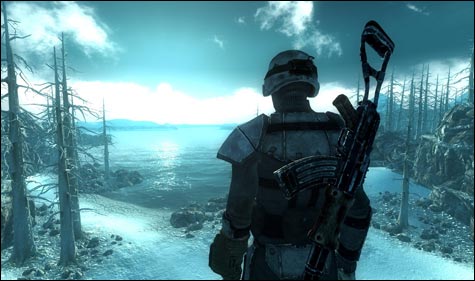
Above: You cannot explore any of that.

My review of the Fallout 3 expansion, Operation Anchorage, is up at thephoenix.com. The short version: It probably would have been really neat as an included quest in the original game, but it's not good on its own and not worth the money. One way to look at it is that Fallout 3 cost $60, and I got 50 hours of gameplay out of it, while Operation Anchorage cost $10 and I got 2 hours of gameplay out of it. I don't expect or demand a game to meet an ideal cost-to-playtime ratio, but that seems out of whack.

The worst part is something that was too convoluted to explain fully in the review. I think it'll only make sense if you've already beaten Fallout 3. My last manual save, with my level 20 character, was in Vault 87, or past the point of no return in the main storyline. I didn't think I could backtrack from there and take care of the Operation Anchorage quest. Instead, I loaded up my last save before that one, which was about 10 hours earlier. No real problem there, except that playing the expansion also overwrote my lone auto-save, which had been at the end of the game. If I ever want to experiment with the different choices the ending sequences offers, I'll have to re-play a bunch of stuff that won't be any different.

Not that I ever planned to do that. But still. It's the principle of the thing.

Like I said, if you're still on your first playthrough, or even starting a second or third playthrough, this expansion probably would be worth it, if just for the Winterized T-51b Power Armor. But since I'd already wrung everything I could out of the retail version, Operation Anchorage did not scratch my itch.

Wednesday, February 11, 2009

Request hour: Sound effects, great writers, and PC vs. console

We're nearing the end of the increasingly inaccurately named "request hour."

Jorge Albor asks:
What has been your favorite audio effect in a videogame (ambient sound, music, etc.)?
Sometimes I think we underestimate the importance of sound in a video game, particularly as a feedback mechanism. I love the way coins chime when Mario picks them up, and the jingle that plays when Link opens up a secret area. You learn to associate these things so closely with success or failure that when you hear something in real life that sounds similar, you feel a little jolt. Some of my favorite sounds in games have been:
  • Mega Man teleporting ("blort" is what it sounds like in my mind)
  • The high-pitched death rattle of the Combine soldiers in Half-Life 2
  • The whispering priests in Resident Evil 4
  • Hadoken!
  • The wind in ICO
  • Reloading the double-barrelled shotgun in Doom 2
And my all-time favorite background music is in Ridley's Lair in Super Metroid.

Iroquois Pliskin asks:
Which video games writer do you read, and say to yourself: "Man I really wish I could write like *that*"

I'll give my my answer: Tycho Brahe.

Maybe you aspire to write like some non-video-game critic instead. Like, I really love Dave Hickey; I'd push quite a few old ladies down the stairs in order to write like that.

Tycho would be one of my answers, as well. He has a way with metaphor and visual imagery that seems effortless, although it's probably not. And he's damn funny. I often find myself saying exactly what you do when I read his stuff. I also admire the elegance and lucidity of Tom Chick's writing, and the raw knowledge that Jeremy Parish drops in every sentence. A bit closer to home, I'm always impressed by Duncan Fyfe's creativity, N'Gai Croal's insight, Michael Abbott's humanity, and, yes, Iroquois Pliskin's erudition. Often when we get talking about what's wrong with the way people are writing about video games, it's easy to forget how many people are doing an awesome job these days.

In the non-game but still-critic arena, there's no one I hold in higher esteem than Roger Ebert. I also think Anthony Lane is hilarious (David Denby is fine, but when it's a Lane issue of the New Yorker, I always read the movie reviews first).

I'm also gonna throw out kind of a weird one: I have always been in awe of the Mystery Science Theater 3000 writing staff. I was flipping through The Amazing Colossal Episode Guide the other day, and I laughed all over again reading a sentence about an "oily" guy "lazing about on his grimy, sticky sheets." Their word choice is always perfect.

Ed Borden also has two questions:

Why do game on a console over a PC?

Growing up, I always did both, although I've always felt a greater affinity for consoles. I'm not sure why that is -- I have fond memories of playing Dark Castle on our Mac Plus, and then later Wolfenstein and Doom on the PC. In my high school years, I actually spent a good bit of money on graphics cards (3D accelerators!) for the family computer, so I could play the Quake games. I'm not even sure how many hundreds of hours I put into Quake 2 CTF. Had a clan and everything. A bumbling, incompetent clan, which placed dead last in the only competition we ever entered.

These days, I'm not sure I could really tell you why I don't play computer games. I almost said that it costs too much to buy a decent computer, but I've spent $1,250 on consoles since I bought my last desktop four years ago, so that can't be it. One of the reasons I bought the computer I'm using now was to play Doom 3 and Half-Life 2. I did that, and then proceeded to play nothing else. The funny thing is, I still prefer the mouse-keyboard combo to dual analog sticks in a FPS, and I'm far more proficient with it.

So the answer, clearly, is that I've been brainwashed.

Are you real, or just a construct for an ARG ad campaign?

I have some bad news for you.

That does it for request hour. Thanks to everybody who participated. I thought it was great to have the chance to explore a lot of different topics. We should do this again.

Tuesday, February 10, 2009

Request hour: Browser games, and the birds and bees

Greg Tannahill and Daniel Purvis ask related questions. First, Greg wonders:
Is the traditional game market in any way threatened by the rise of free-to-play browser games?

For the time being, no. There's such a gulf in the types of games available that it's hard to see anybody voluntarily giving up console or high-end PC games for browser games. Plus, I'm pretty sure that the kinds of people who play Bejeweled and its ilk exclusively are not also shelling out for fancy graphics cards and cutting edge game systems. I think we're talking about two disparate groups here.

But I could easily see something like this happening down the line. As we know, it's not always the most advanced, cutting-edge hardware that ends up getting adopted by the masses. It's all about having the right technology for the right price at the right time. With computers becoming ever more powerful and cheaper, and web access becoming ever faster and more prevalent, I could see a day where you just don't need to buy a dedicated gaming system in order to get a relatively robust gameplay experience. We could see a convergence of hardware and software such that the best possible value for your gaming dollar is simply a low-to-mid-range PC.

The real question is what the revenue model is for games of this type. Quake Live is going to be an interesting test, I think.

Daniel follows up with:

Could you live off free-to-download and play games, such as Flash and independent titles?

Would you miss the so-called "AAA" releases?

There's no way I could do this. Like anybody, I can get addicted to casual games. I already mentioned my love for FreeCell, and the Puzzle Quest Galactrix Flash demo has already sucked me in for way too many hours. But when it comes to what I really want out of a game, it's those robust, narrative experiences that you currently need a next-gen console or high-end PC to play. But maybe someday the distinction between those types of games won't be so clear.

Also, for whatever reason, I am totally ignorant of the indie scene. Not sure why.

In the spirit of openness and inclusion, I will also answer Ben Abraham's question:

Where do babies come from?

According to the introduction of Yoshi's Island, they are delivered by an incompetent stork.

Questions have been trickling in. More still tomorrow.

Monday, February 09, 2009

Request hour: Dinner for four, emulation nation, and the future of games criticism

Continuing with our reader-requested topics...

I love this one. Shoinan wants to know:
If you could have dinner with three video game characters, who would they be and why?

Phoenix Wright. He's the opposite of almost every other video game hero, most of whom preach honor and glory as they indiscriminately slaughter thousands of people. Phoenix is a bumbling, self-conscious dweeb, who also has an unshakeable sense of truth and justice. I think he'd be a great guy to hang out with. You know he'd probably suffer stoically through poor service and subpar cuisine, but if the bill was calculated wrong, he'd take care of everything.

Guybrush Threepwood. I picture him sitting there, practically breaking a sweat as he tries to remember which utensil he's supposed to use for each course. Plus, as we know from several Monkey Island games, the guy's a hell of a conversationalist. He always has at least four responses ready, no matter what you say to him.

I guess we'd need to invite a villain, just to make things interesting. There are a lot of good options here, but for some reason I keep coming back to Dracula in his Symphony of the Night incarnation. I would ask him to repeat his lines from the beginning of the game and see who else at the table cracks up first. My money's on Phoenix Wright.

From brilliam:

What gaming systems have you owned in your life? Which ones did you want most and never manage to get? Would you consider going back and buying those systems now, or would you more likely just emulate whichever older games you wanted to play?

Or, to put it in a more bookish way: how important is the artifact vs. the information?

The first part is easy, at least. I've owned:

  • Atari 2600
  • NES
  • Sega Genesis
  • Sega 32X (really!)
  • Sega Saturn
  • Nintendo 64
  • Sony PlayStation
  • Super NES
  • Game Boy
  • PlayStation 2
  • Nintendo GameCube
  • Nintendo DS
  • Xbox 360
  • PSP
  • Wii
  • PlayStation 3
That's in order of when I got them, as far as I can recall. The big systems that I missed were the Dreamcast and the original Xbox. I regret never owning a Dreamcast, but given that the 360 is at least somewhat backwards compatible, I don't mind missing out on the Xbox. I never really wanted some of those crazier ones, like the Neo Geo, 3DO, or Jaguar.

The funny thing is, I've held onto most of those systems, even the truly useless ones like the GameCube and the PS1. The artifact does seem to matter. If I felt the urge to play Super Metroid, say, it would be easier to simply download it onto the Virtual Console. It would look better and wouldn't take any setup time. But it would be more satisfying to hook up the SNES and play it for real. That I didn't even hesitate to say "play it for real" probably illustrates the point nicely.

I think it's basically impossible to separate your idea of a game as software from the context in which you played it. I can't think of games like Puzzle Fighter, Mario Kart, or GoldenEye without remembering where I played them, who I played them with, and, yes, what I played them on. Emulators are a valuable way to broaden your gaming horizons, but something about playing it on the original hardware -- getting that controller in your hands -- makes the experience seem authentic.

Brian asks a few questions, which I'll split into parts.:
As both a writer who is paid by a major publication to cover games, and a blogger who writes personal pieces on his own, what are the biggest differences in your approach to the two? Which do you prefer?

The biggest difference between writing for the paper and writing in this blog is my idea of who is reading. I think of the person reading a review in the Phoenix as not a committed gamer, who would therefore be turned off by jargon and highly detailed descriptions of gameplay mechanics. I have to assume that the reader is not an expert. I'm trying to write for the person who picked up the arts section for the movie reviews, say, and is now flipping past the half-page game review. Can I get their attention? Can I make them stop and care about this?

On the blog, I assume you're already interested. I can assume a level of knowledge on your part, and a shared set of reference points. Really, though, when I write in the blog I'm just writing for myself. That is, I'm trying to produce content here that I would find interesting if I read it elsewhere. Then I hope that there are other people who feel the same way.

And if you had your way, what would games writing look like 5 years from now?

I'd like it if game writing were less time-sensitive and less event-driven. It seems like the bulk of game reviews and game topics are all about trying to rank everything, and write history as it happens. A friend of mine recently complained about the modern state of arts discussion by saying that it's all an "attempt to determine if [album, movie, game, book, or show] is the most [Adjective] of the [Time period]." He's exactly right.

I'd like to see more people try to take games on their own terms, and ask: what's this really about? What is the game asking me to do, and how are my in-game actions affecting this world? What's the fiction here? How consistent is that fiction? How meaningful is it? And so on.

Especially in light of the fact that newspapers and even sites like 1up falling apart hint that some of the current avenues may not even be available by then. Is it possible there will be no professional, full-time games writing jobs left?

I think there will always be full-time writing jobs available, but they may take different forms. Things are bad all over in print media, but web readership is only expanding, and there will naturally be winners and losers in this landscape. 1up in particular is a sad story, but it may be cause for hope that it was their online publishing that UGO felt was worth preserving. Ziff's print properties were an anchor around 1up's neck.

Hey, we're almost done. More tomorrow.

Friday, February 06, 2009

Request hour: The hardcasualist's lament, review scores, and underrated games

Tyler echoes the hardcasualist's lament:
I don't play games that often. I own a Playstation 2, and own exactly zero games for it since I lost Guitar Hero. Other than that, I'll pull out the rare old favorite for the PC, play some web-based game, or load something on my iPhone. Occasionally there's a game I really want to play (Rock Band 2!), but to lay out the cash for a current console and a game or two is just not reasonable. Basically, the bar to entry for an extremely casual gamer is way too high.

Never mind that, I'm not even sure I'd be able to figure out how to play some of the newest games coming out before getting frustrated and giving up.

What should the video game industry do about us old fogeys who have more interest in games than Windows Solitaire, but not enough to go buy a PS3? Are there PC games that are more than browser-based time-wasters but don't require the latest and greatest hardware? Or are mobile devices the next gaming platform? Or what?

I was going to say that Nintendo had people like you in mind with the Wii, but that's actually not the case. The Wii was made for lapsed gamers, not people who were priced out of the next generation. There is still a large segment of people who want the graphics and the "hardcore" experiences of the PS3 and 360, but aren't willing to commit the capital. And let's face it: the so-called casual market, the one that plays Peggle and Bejeweled, is another group of people entirely. There's kind of a donut hole here.

But: the PlayStation 2 is actually still getting quite a bit of support, including Rock Band 2. You just can't download new tracks. And some noteworthy PC developers, like Valve and Blizzard, make sure to support lower-end systems, which means you don't need a cutting-edge system to play Left 4 Dead or World of Warcraft. Additionally, the Xbox 360 is rapidly approaching a true mass-market price point, so before long it may be a perfectly reasonable expenditure.

I think the most interesting part of this question is in the middle, though, about trying to learn how to play some of these new games. It's a real problem. I remember experiencing a moment of panic the first time I ever held the original Xbox controller, thinking "This is too much." But ultimately, playing games is work. They ask a lot of you. It's a matter of how much effort you're willing to put in to get out what's there.

I think the trick is to know what kind of complexity is right for you. For example, I'm fine at handling all the button combinations necessary to play a first-person shooter, but you can't streamline the interface of a strategy game enough for me. Think about it this way, too: you're a fan of Guitar Hero and Rock Band, but those certainly weren't easy to learn.

Danilo Vujevic really asked:

Do critic review scores actually mean anything?

A score can be helpful, but it's not the whole story. I make no secret of my love for Metacritic: it's an excellent way to get a snapshot of conventional wisdom. And it's often right. Games with a Metacritic score of 90 or above, in many cases, are games that I think are fully deserving. Having said that, I'm usually more interested in the score that goes completely against the grain. I'd rather read the dissenting view of a game like Fallout or Grand Theft Auto than another one that calls it the greatest game of all time. And I'm often intrigued when a game's Metacritic spread spans 40 points or more. So I guess I'd sum it up by saying that scores do mean something, but you're doing yourself a disservice if you rely on them exclusively.

Matthew Gallant asked:

What games do you feel are critically underappreciated? Games you loved that were overlooked by both bloggers and the gaming community at large.

I would have said both Yakuza and The Darkness, but at least in my circles those both seem to have gotten a little more attention recently. I still think they're both underrated and overlooked in the world at large, though. Both games have excellent stories starring fascinating lead characters, and showcase strong play mechanics. The Darkness, in particular, didn't get nearly enough credit for how well it executed its basic gameplay. Snaking along the ground as a tentacle before lashing up and eating an enemy's heart just never got old.

I'd love to dazzle you with some out-of-left-field pick from years ago, but my tastes have always run to the mainstream. Most of the games I'd pick are probably not under-represented in the hearts of people who read gaming blogs -- games like System Shock and (surprise!) The Secret of Monkey Island. But maybe you'd be surprised to learn of my deep, abiding love for FreeCell, the free Windows pack-in.

To be continued on Monday.

Thursday, February 05, 2009

Request hour: Defining genre, living the dream, and required reading

Continuing Insult Swordfighting request hour. Let's see if I can get everybody's name right this time. Ahem.

Ben had two questions.
Is game genre sheerly defined by the mechanics of the game interface, or do ineffible unengineered aesthetic/artistic qualities play any deterministic role?

It doesn't always have to be this way, but I think we define genre exclusively by the interface. It's why Halo is a first-person shooter and Halo Wars is a real-time strategy game. Sometimes the aesthetics can make a difference -- I think the shift from high fantasy to sci-fi wasteland is a big reason why I loved Fallout when Oblivion had left me cold -- but ultimately I think we tend to base our gameplaying preferences around mechanics first, and aesthetics second.

Hrm, that's not really an essay question. Bonus: Who's the awesomest turtle in gaming? Show your work

My favorite has historically been Donatello, the Teenage Mutant Ninja Turtle whose bo staff gave him excellent reach in combat (he was absurdly useful in the original TMNT game for the NES). But going the TMNT route is a little too easy, as is picking any of the Koopa Troopas. What does that leave? Nothing I can find. I defy you to find any combination of Google queries incorporating "video games" and "turtles" and not find your heroes on the half-shell exclusively. Or hey, about that turtle-like colossus in Shadow of the Colossus?

This one's from L.B. Jeffries:

You just won the lottery. Big time. Assuming you set aside enough to be comfortable for the rest of your life AND assuming you dedicate the other portion to gaming in some way...what would you do? Start a magazine? Make your own game? Start a museum?

If I won the lottery, I am pretty sure that no one would ever see or hear from me again. I would drop off the grid entirely. But I would spend plenty of money putting together the most bitchin' man cave you've ever seen, of which gaming would be the central focus. I would spend much more time playing far fewer games.

In the spirit of the question, it's entirely possible I would get bored and feel the need to give back in some way. Now that you mention it, if I could self-fund a magazine without having to worry about the bottom line, that would be a great idea. There are too many good writers spread too far apart for this not to happen. Most of my favorite writers remain either unaffiliated with professional publications, or do their most interesting writing on the periphery. It would be awesome to have a central place for all this.

Of course, there's no reason this couldn't happen now, in website form, but then I'm a lazy, lazy man. Also, I think I just described the Escapist.

Anonymous asks:

What should be essential/required reading for a college-level course on analysis and criticism of video games?

There's not anything I can think of directly related to video game criticism, in the sense that it deals with that as its subject. But I have read a few books that have broadened the way I think about games. Among them are James Paul Gee's What Games Have to Teach Us About Learning and Literacy, Steven Johnson's Everything Bad Is Good for You, and, just this past week, Jim Rossignol's This Gaming Life. All three books take a hard look at games that isn't reflected by most mainstream reviews. The first two break down games into components much different than the usual graphics-sound-control axes, while the third book is about how games provide singular experiences that have the power to shape lives.

I'd also recommend reading Roger Ebert's Awake in the Dark, because the way Ebert writes about movies is the way I think more people should be trying to write about games: he's literate, informed, and respectful, and his love for all movies shines through everything he writes.

To be continued.

Wednesday, February 04, 2009

Request hour: It begins

Yesterday, I solicited questions to answer in future posts, and, uh, you guys weren't messing around. I was expecting more along the lines of "What's your favorite game ever," but there's some heavy-duty stuff in here. Let's plow right ahead with it. I'll answer in the order they were posted, and try to get as many as I can into each post. (By the way, feel free to keep adding new questions in comments to the original post.)

Krystian Majewski had two questions. I'll split them up.
What is the meaning of Braid?

(I knew this was a bad idea.)

My reading on it isn't necessarily that "it was all a dream," but rather that the game is a metaphor for Tim's anguish and regret. I never really did get the whole "atomic bomb" interpretation. I thought it was about a girl. Either way, my take is that the game takes place in a fantasy world, in which time is malleable and the usual standards of cause and effect don't apply. I saw it as a fairly straightforward lament -- wouldn't it be nice we could do the things in this game in real life, too? But we can't. It's impossible. And if you spend too much time thinking about it, you'll only end up depressed.

What is the difference between games and literature?

A reader has less control of a work of literature than a player has of a game. The author has more control of a work of literature than a developer does of a game. A book is a finished product. A game, to varying degrees, is a framework. You can't read the words in a book out of order, but a game that has no room for player choice is usually not going to be a good one. Even a linear platformer -- say, Super Mario Bros. -- can be played successfully in any number of ways, while a book can only be read from front to back.

You could make the argument that a reader does bring his own frame of reference to a book, and you'd be right, but it's an order of magnitude less than what a player brings to a game. Reading a book doesn't make you a co-author, but playing a game does, in a very real sense, make you a co-creator. The act of playing dictates what a game is, much moreso than the act of reading dictates what a book is.

Nels Anderson goes for the money:

It's been a year-ish since your Gamer Taxonomy opus. I'd like to hear a follow-up, discussing observations made about its applicability and if you feel the taxonomy is still accurate.

Nothing I've seen or heard has made me doubt the accuracy of the types I described, but I have become even more convinced of its incompleteness. One thing I missed completely was the distinction between content creators and content consumers -- something PC gamers have known about for years, but which really came into focus for console players with the release of LittleBigPlanet. Marek Bronstring wrote a good essay at GameSetWatch about "The Four Types of Player/Creators," which covers some of this ground.

There were a lot of good comments on the original piece that pointed out some further areas for exploration, such as the difference between gamers who pursue developer-defined goals and those who pursue player-defined ones. There are also gamers who want new, innovative experiences, and those wedded to the old paradigms. One commenter even suggested a further distinction between tourists: "those who tour for the cool vignettes and highlights, and those who tour for the narrative interaction." So, clearly, there's a lot of unexplored territory here.

As for how applicable it is, I couldn't say. I haven't even applied these ideas to most of the game reviews I've written in the past year. But something about it did strike a chord, so if nothing else I hope it spurred people to explore the real reasons they enjoy playing games. Is that really worth much? I'm not sure. I hope so.

Also, on a side note, I realized that although the "Skill Player vs. Tourist" thing seemed to resonate with a lot of people, the sections about financial considerations didn't gain much traction. Not sure why that was.

Anonymous asked:

Are games becoming like cinema in the sense that we have "quality" games adored by the serious critics and "mass" games selling millions units? Is that a good thing? Will we have some the Cannes and the Oscars of games fighting between them?

My sense is that the opposite is true -- that critical favorites and commercial successes are one and the same. Looking at Metacritic's top games of 2008, you see that, with few exceptions, the top-rated games were also the tentpole, "event" games. Braid and World of Goo might be good candidates for the "critical darling" honor, but if anything, they outperformed most independent games precisely because of critical adulation. (I don't know what the hell that MaBoShi thing is for the Wii, btw. That could be the real sleeper on there.) Compare this to the world of movies, where for every Slumdog Millionaire that comes along, a bunch of critics are shouting to an unreceptive readership about the greatness of Happy-Go-Lucky.

I think it is good if there is a vibrant outsider or independent scene. There's always been one on PCs, and it's nice to see some of the console makers extending that opportunity to their users, too. Although I've got to admit that my personal tastes always seem to run to the slickly produced shoot-'em-ups.

Thanks for the questions! I'll post more tomorrow.

Tuesday, February 03, 2009

Insult Swordfighting request hour

Let's try an experiment. Ask me a question in comments, and I'll try to answer it in a future post. Your question should probably be related to video games. But I guess it doesn't have to be.

(Why yes, I am scraping for ideas this week.)

Friday, January 30, 2009

Friday afternoon tidbits

It's Super Bowl weekend. (Now that I've said "Super Bowl," and not something generic like "the big game," I expect to be sued by the NFL.) Madden predicts a Steelers victory, while I predict that I don't care. Definitely rooting for the commercials this year.

-Earlier this week, we wondered just how many third-party games were available on the Wii. While there are obviously plenty, some readers took issue with my contention that they were dribbling out compared with third-party titles on other systems. So that's only tangentially related to N'Gai's article about third-party Wii games, but I need a lead-in somehow. He argues that more third-parties should lead development on the Wii, and then upscale them to the PS3 and Xbox. It's an interesting idea, and it would be nice to see Wii versions of games that aren't just shitty versions of other games with awful motion controls grafted on. It's especially hard to argue with N'Gai's claim that "the most powerful hardware is not what’s required for a game or a platform to succeed. "

-Tom Cross's "Diamond in the Rough" column at Gamasutra this week was about the challenge of storytelling in games. Much of the piece is about Valve generally and Left 4 Dead specifically. Left 4 Dead doesn't just work for the reasons Tom specifies. I've still been unable to say this in a way that feels satisfactory to me, but what is so impressive about Left 4 Dead is the way that its framework allows the players' own personalities to create a new and unique narrative each time through. It's true that Valve gave each character his own traits, but it's the players' actions that provide subtext. Maybe Louis really is just a good-hearted optimist -- but, depending on who's playing, maybe his sunny exterior is actually masking a craven, selfish heart. (I'm reminded again of Daniel Purvis's excellent recap of one such playthrough.)

-Ed Borden argues, a little counterintuitively, that the Xbox is just dragging everyone down: "Now, I can't play Halo or Fable, and Blizzard can't sell WOW to 22 million X-Box gamers. Now, X-Box gamers get crappy networking and "matchmaking" for multiplayer (console gamers don't even know what they're missing), and I get the joke that is Games for Windows Live. Now, X-Box gamers can't even use a browser or access the huge libraries of classic games from GOG.com or Steam, and I can't play XBLA games." It's a well thought-out piece with some provocative points. My last experience with PC matchmaking was Gamespy circa 1998, though, so I am pretty happy with Xbox Live.

-I won't get my hopes up for Arkham Asylum. I won't get my hopes up for Arkham Asylum.

Thursday, January 29, 2009

I want to break free

Now that I've had a chance to play through both levels of the Resident Evil 5 demo, I think I share some of the concerns you guys expressed, but after a while the whole thing started to make a little more sense. The controls still are slow, but cranked up to the "fastest" setting, they seem adequate. I mean, Resident Evil games have always been slow. This one's at least on par with the fourth. I'm wondering if the transition from Left 4 Dead to Resident Evil 5 is to blame. They seem similar on the surface, but play so differently.

So far, I like the ammo allocation. It seems like you can only find enough ammo to last if you keep moving. It's all over the place, in crates, drawers, and barrels, but you have to overcome your natural tendency to bunker down when threats are coming from all angles. And it really does change the whole dynamic when you have to divide resources between teammates. The essence of survival horror is feeling like you don't have what you need to survive, and then finding that you just barely do.

In the first level, the AI partner seemed great: always watching my back, always quick with the ammo re-up. But not much was asked of her there. Against the chainsaw guy in the second level, you need a plan of attack. That's much easier with a live partner. Our strategy was simple but effective: we leapfrogged one another past the barrels, shooting them in turn as our enemy pursued us. After that, it didn't take too many headshots and frag grenades to put him down. Although I hope the full game has more of these kinds of mildly tactical scenarios for co-op play, my concern is that the single-player will suffer for it. We'll see. Put me down as optimistic, but not excited.

But the point of the post is this: Do you think the mustachioed zombie looks like Freddie Mercury, or Saddam Hussein? We argued this point for quite awhile.

Wednesday, January 28, 2009

Black Box memorial

Above: You will not do this successfully until your 30th try.

My review of Skate 2 is up now at thephoenix.com. This is just a good game, well made, accomplishing exactly what it means to. The word of layoffs at Black Box on the very day the game hit store shelves was all the proof you need that there is no underlying logic to this universe. We are all alone.

This is, by the way, an incredibly difficult game. If you're like me and difficult games get your blood boiling, you should be aware of that going in. I'm not saying to avoid it by any means. Just that it might be worth your while to set up a pile of pillows and blankets that you can safely punch after the 50th straight time you fail to defeat Danny Way in the super park. I was so excited when I finally did beat him, only to discover that it was a best 2 out of 3 matchup.

God damn it.

Tuesday, January 27, 2009

Resident Evil 5 demo

I spent only five minutes playing the Resident Evil 5 demo. In that time, I wished the controls were a little faster (even after switching them to "fast" mode), failed to realize that I could quick-equip weapons by using the D-pad, and got killed by a guy wielding an axe the size of a compact car. Other than that, it seemed all right.

I'm planning to give it another go, obviously. I'm especially interested to try the online co-op. But I'm reminded already why I usually avoid downloading demos. There's the opening screen disclaimer about how the game isn't finished and might contain bugs.* You're dropped right into a scene without any context or buildup, although presumably it's intended to showcase the very best the game has to offer. There may be important gaps you're not even aware of. All in all, this is not the ideal way to experience a game.

Demos can be good or bad, of course, and I can't say yet which one this is. But I was going to buy Resident Evil 5 no matter what. It's following up what I've repeatedly called the best game ever made. What could the demo do but lower my level of interest?

I want you all to remember I said this when I'm hooked on the co-op and playing it exclusively.

That's just me. What's your take on the Resident Evil 5 demo?

*If you've ever taken a writing workshop, you've probably encountered several people who try to temper expectations for their work by muttering something like, "I didn't work very hard on this," or, "I just wrote this last night, so it's not really done." And you think, "Great, thanks for valuing my time, douche." That's the same impression I get from disclaimers like this. You know, sort of.

Monday, January 26, 2009

The Nintendo playbook

We're all still scrambling to explain the runaway success of the Nintendo Wii. More than two years after its release, you can't find one on store shelves unless you're very lucky. Nintendo has sold every unit it's shipped, and has made a profit on each one. The "hardcore" among us have looked at the barren release schedule and wondered where the software was, while nearly every game that's come out has been a massive hit. The Wii has captured the imagination of millions of people who didn't consider themselves gamers at all.

Why are we so surprised? All this has happened before.

Nintendo's playbook hasn't changed since the launch of the Nintendo Entertainment System, the game console that in the 1980s grabbed 90% of the market and whose name became synonymous with video games in the minds of parents everywhere. In the book Game Over: How Nintendo Zapped an American Industry, Captured Your Dollars, and Enslaved Your Children, published in 1993, author David Sheff laid out in meticulous detail Nintendo's rise to dominance. Sheff interviewed major players like Hiroshi Yamauchi, Minoru Arakawa, Shigeru Miyamoto, Howard Lincoln, and many other names I remember coming across in Next Generation magazine.

See if you can tell whether the keys to the success of the NES were any different from those that have vaulted the Wii to the top of the industry.

Nintendo emphasized profitability.

What system do you think the speaker is talking about here?
"The Nintendo way of adapting technology is not to look for the state of the art but to utilize mature technology that can be mass-produced cheaply," says [the speaker]. He sought to make something smaller, thinner, and lighter than anything ever seen -- something that was also fun. (28)

Not the Wii, obviously. But it's not the NES, either. That's Gunpei Yokoi talking about his handheld Game & Watch system. Even before the Famicom, Nintendo's M.O. was to utilize pre-existing technology and to streamline its production. Money was to be made not just on software, but on hardware. Compare this to Microsoft and Sony, each of which sold their latest consoles at a loss (in Sony's case, as much as $260 per unit as recently as last spring).

Nintendo constricted supply to create demand.

Not that Reggie Fils-Aimes will admit to this, but it's eerie how the supply and demand curve for the Wii matches that of the NES. Hardware shortages both real and artificial plagued the NES, which resulted in sustained demand over multiple holiday seasons. The NES launched in the United States in 1985. Four years later, retailers still couldn't stock enough:

Before Christmas 1989, Peter Main was threatened with bodily harm and lawsuits by company managers and presidents who blamed him for single-handedly destroying their business. The only stores that had Nintendo products at Christmas that year were retailers that had sufficient cash reserves to allow them to begin hording systems and games that summer. (203)

This is equivalent to the Wii still being hard to find for Christmas of 2010. But considering that units were still hard to come by this past season, that's not so far off.

Nintendo treated software the same way.

...Nintendo did not fill all of the retailers' orders, and it kept half or more of its library of games inactive. In 1988, for instance, it sold 33 million cartridges, but market surveys showed it could have sold 45 million. That year retailers had requested 110 million cartridges, or nearly 2.5 times the indicated demand. (194)

Hands up if you attempted, fruitlessly, to find a copy of Wii Fit last spring. Obviously demand was high. But perceived demand was even higher when consumers went to one store after another, only to be told that the game was sold out.

Nintendo kept third-party publishers on a tight leash.

Most analysts blamed the great video-game crash of 1983 on a flooded market. The story of Atari bulldozing millions of E.T. the Extraterrestrial cartridges has become the quintessential cautionary tale, the "Bloody Mary" of the industry. As a result, Nintendo placed draconian controls on third-party publishers. All games had to be approved by a team of Nintendo employees. Game cartridges required a specific chip, patented by and only available from Nintendo itself, in order to even work in the NES. Most interesting to me, third-parties were permitted to release only 5 different games in a year.

Some companies skirted the rules. Konami created a second imprint called Ultra, which allowed the company to release 10 games in a year. Acclaim bought LJN, but kept the two brands separate for the same reason. An Atari brand called Tengen went so far as to hack the lock-out chip and release games without Nintendo's authorization.

As far as I know, we're not quite there yet with third-party Wii software, but the next time you wonder where all the new games are for the Wii, this is probably why. Nintendo doesn't need to let any old company release games for them, not when they can dribble out their own sure-thing properties every six months to a year, and even rely on occasional unexpected grand slams like Carnival Games.

Knowing all this, it's no surprise that the Wii is such a hit. It wasn't a result of Nintendo's still impressive cachet. This is a company that never lucked its way into success. The Wii is just a bit of history repeating.

Game Over: How Nintendo Zapped an American Industry, Captured Your Dollars, and Enslaved Your Children seems to be out of print, although my local library stocked several copies.

Friday, January 23, 2009

Friday afternoon tidbits

No cute intro this week. Let's get to it.

-The news of layoffs at EA's Black Box studio must have been a punch in the gut, coming as it did on the same day that the company's Skate 2 hit stores. Black Box also made the apparently terrible recent Need for Speed games, but Skate is the real deal. Hopefully its core team is sticking around for the third game. Good luck to everyone else there in the hunt for work.

-Denis Farr questions the accepted wisdom that Gears of War is homoerotic. Interesting read, although you're never going to convince me that a bunch of sweaty, muscular dudes crouching together is anything else.

-How bad is Sony doing? So bad.

-Duncan Fyfe takes on Yakuza 2, as only he can.

-Jeremy Parish always does great, high-minded work, but a list like "The Worst Presidents in Gaming" is what brings the links.

-Speaking of which, are we what we link? I've always assumed that when I link something, the implication is that I endorse the quality of the article, not necessarily that I agree with the argument. Context helps, I guess. It's a bad idea to assume that people know when you're linking something ironically.

-I approve of Hardcasual's reinvention as Onion-style satire. Of note: "'Parent Killer 64' Had Nothing to Do With Me Killing My Parents," and "UGO Reverses 1up Buyout Thanks to Brave Actions of bdnjfbdenk."

-Is February the month of DLC? Sounds like it. I'm itching to get at Operation Anchorage.

-Iroquois Pliskin is back! I was starting to wonder if he'd died. Sounds like he nearly did.

Thursday, January 22, 2009

Get the point?


When you look at all the things Microsoft has done right this console generation, achievements have to rank pretty high up there. This wasn't always a given. It seemed like a silly and useless feature to me, and in many respects it is silly and useless. You can't trade your achievement points for anything tangible. You can't use them to download new themes or Live Arcade games, or trade them for Xbox-branded products. I don't even think there's an easy way to compare your gamerscore to that of your friends, although admittedly I haven't looked very hard. It's like playing an RPG with no level cap -- and no discernible benefit from leveling up.

Yet there's something about earning achievement points that's irresistible. Partly, I think they nailed the tactile sensation of getting one right. The little "ding" of unlocking a new achievement has always sounded to my ears a little like a water droplet exploding, which may be helped by the way the graphic blows up like a balloon. It feels organic and germane. When the PS3 implemented their similar "trophy" system, they didn't get the feedback quite right. Earning a new trophy is marked by a muffled chime, and a little rectangular graphic that pops instantly onto the screen.

I like to earn achievement points, but not so much that I'll always go out of my way for them. In fact, my gamerscore is embarrassingly low, considering the sheer number of Xbox 360 games that have spun through my disc drive over the past three years. Partly, that's due to expediency: a lot of achievements don't reward powering through the main game, which is the way I usually play. They're for those who take the time to explore every aspect of the game. They reward dedication and sometimes even creativity. And many skew toward online play.

Even then, sometimes I can't imagine who out is earning these things. I sank something like 25 hours into Burnout Revenge, the first Xbox 360 game I ever got, and topped out at 110 achievement points. Among the many achievements I missed were "True Elite," worth 65 points for getting a perfect rating on every single event, and "Celeb Status," 70 points for uploading a clip that made it onto the top-20 downloads. I would love to know how many people actually did earn the "Celeb Status" achievement.

Mostly, I'm fine with picking up whatever achievements I earn along the course of a campaign. Part of the reason why my BioShock score was so high -- 730 points -- was that nearly all of its achievements were easily accomplished over the course of a single playthrough. Researching splicers was rewarded both in-game, by making them easier to kill, and outside the game, by tallying 10 achievement points each. Fallout 3 was like this, too, doling out 20 points for each mission, although most of those missions weren't mandatory to reach the end credits.

This is when achievements are at their best: when they encourage you to play the game the right way, and to experience things you might otherwise have missed. Left 4 Dead uses achievements as an incentive to be generous with health packs and pain pills. Crackdown's achievements reminded the player to make full use out of all of his powers. Sometimes they seem contradictory to a game's goals: Guitar Hero II included an achievement for failing a song on easy mode. Hey, it was good for a laugh, and one of the easiest achivements I've ever earned.

A few games maintain a hold on me. I'm still chasing the "Free Runner" achievement in Crackdown, which is worth 50 points for finding all 500 Agility Orbs. I'm up to 498 out of 500, and I've had the game for almost two years now. Some turn me off. Every time Gears of War 2 updates me on how far I am from the "Seriously 2.0" achievement (kill 100,000 opponents), it makes me want to curl up under my desk.

No matter what Xbox 360 game you're playing, the achievements game has become its own addictive enterprise. It's single-player game and multiplayer. It's all about the score, and all about maximizing your exposure to the breadth of a game world. It binds together a library of hundreds of games. Achievements are the Force.

Wednesday, January 21, 2009

The winter doldrums begin

Above: You Ent gonna enjoy this one. (It's a pun, you see.)

My first review of 2009 is up, and the game's a stinker: Lord of the Rings: Conquest. I try hard not to be mean-spirited when I write a review of a bad game, because I know a lot of people worked awfully hard on it, but at the same time I had almost a physical reaction when playing this game. My body rebelled, as though I was wearing an itchy sweater and I just had to yank it off. So there you go.

This, by the way, is the third game I've played by Pandemic Studios, and the third that sounded great on paper but failed in execution. The other two were the first Mercenaries and Destroy All Humans! I'll still hold out hope for Saboteur, though. Now that's a neat idea for a game.

Tuesday, January 20, 2009

O my soul

Minor spoilers in the form of oblique references to the final sequence of Fallout 3.

I finished Fallout 3 this weekend. This should be cause for celebration, but instead I feel sad. I wasn't playing the game for a review. I wasn't trying to zip through it or affix a score to it. Most of the time, I wasn't even trying to do anything at all. I just wanted to explore the Capital Wasteland.

And now I'm done.

This isn't one of those complaints that you can't keep playing once you've finished the storyline. I knew that was coming, and I pressed ahead with it anyway. There was little left to do, really, particularly once I'd reached the level cap. Sure, there were plenty of locations left to discover, plenty of books to read, and even 17 more bobbleheads to hunt for. But at some point, you have to have some goal motivating you to keep playing, and all I had left was the main quest line.

In 48 hours of gameplay, I tallied 750 achievement points (which should have been 770). This is a personal record, just beating the 730 I got in BioShock.*

Every sidequest. 100 locations discovered. 50 locks picked. 50 terminals hacked. 10 bobbleheads found. 5 Super Mutant Behemoths killed. 300 creatures killed. 300 people killed.

I didn't have to do most of these. In most games, these sorts of tertiary goals strike me as padding. Not here. Almost of all these achievements came as a result of trying to put the post-nuclear world back together again. With the exception of the Behemoths, they all came over the course of my travels. Eventually, though, I ran out of people to help.

So I pressed on and beat the game. The climax was pretty neat, particularly the march with Liberty Prime. And while I share others' confusion about the very last bit of the game (why couldn't Fawkes go in there, again?), overall it was a satisfactory way to end things. I wouldn't have felt that way if I'd rushed through the main quest line -- if there was much left to do. But there was nothing else for me out there in the wasteland. There was only one way to finish my adventure.

*I can feel a post about achievement points coming on.

Friday, January 16, 2009

Friday afternoon tidbits

Ah, long weekends. I'll be spending mine with extreme sports, both actual and virtual. Snowboarding on Monday, weather permitting, and Skate 2 before that.

-Speaking of Skate 2, Gus Mastrapa wonders why the game so explicitly favors male avatars. In Gus's formulation, "if you chose to play with a female avatar in Skate 2, you're not playing a natural-born woman, so much as a post-operative transsexual." It's easy for me, a white, male gamer, not to notice these things, but lots of games make the assumption that the people playing are just like me. That is a little odd.

-I was surprised to see that Giant Bomb readers chose Metal Gear Solid 4 as their game of the year, and not just because it seemed absent from almost every top 10 list I read. It's just that, given the ongoing commercial struggles of the PlayStation 3, it's amazing that enough people even played it to box out some Xbox 360 titles. Then again, maybe the 360 vote was split, while PS3 owners had only this one game to rally around. (Although LittleBigPlanet also placed.)

-Two great write-ups about Braid came down the transom on the same day this week. Julian Murdoch at Gamers With Jobs writes about his inability to separate the work from its author. L.B. Jeffries at PopMatters defends the only universally maligned aspect of the game, its inter-level textual interludes. I'm glad people are still playing and thinking about this game.

-In the 1980s, only Galaga could provide a soft landing for a cocaine-addled Alec Baldwin.

-From Time's Karen Tumulty: "The metaphor came from our TV screens. On the day that George W. Bush gave his farewell address, the image that got the nation's attention was one of relieved survivors scrambling out of a jet that was sinking into icy water."

Thursday, January 15, 2009

Gamestop.com user-submitted previews: Skate 2

Above: Sweet Suzie!

Like a lot of people, I'm looking forward to Skate 2. The first game was a real surprise, one of the few games I've ever thought I underrated in my original review. As a result, expectations are high for the sequel. You can tell just by reading what the kids have to say about it over on Gamestop.com.

User "none." gets things started with the airtight logic we've come to expect from our friends on the Gamestop boards:
This game by far beats skate 1. The graphics are/will be amazing and the game play is so much smoother and realistic feeling. Saying the graphics suck from just playing a demo is stupid, its barely 2gb, Just like Cod waw, the graphics were bad on beta and then they turned out to be good. The getting off board mechanics could be a little better but we'll barely ever need to use it unless getting up stairs and what not. It's all about skating, not who can run through the maze fastest. This game will be a must have for 2009. I would recommend this to anyone. give the game a chance instead of judging it by a 2gb demo.

Got that? Don't judge it by the demo, like I did.

The I, Robot award for most excessive use of a titular word goes to "Turbo 2112":

I personal think the demo is great. Skate was a fantastic game and still is. All skate 2 is added additions to skate for example getting off your board. Skate 2 is a great game and way more realistic than the first one. I cant wait to skate the other places in Skate 2.

Thanks to all this repetition, the word has lost its meaning. It's all just a bunch of bullskate.

"Boomshakatak" is a bit less optimistic than I am:

What were they thinking? I played the demo and i have to say what a great way to massacre one of the best games ever made. This game is nothing like the first one, too tony hawkish, controls flat out bite, tricks feel awkward, graphics are terrible. This is the worst let down i have ever experienced.

Let's hope he never gets turned down for a date.

I honestly can't figure out which side of the fence "Sk8SoDontH8" is coming down on:

I am a skater and was getting tired of the same old Tony Hawk games of pushing a bunch of buttons to land something. Then i saw skate and was blown away! Then saw skate two and almost cried!

Cried because it looked so good, or so bad? I can't deal with this kind of ambiguity and subtlety. Fortunately, we've got "A Customer" to get us back to what Gamestop.com user-submitted previews are really all about: unreserved fawning.

Ok all I have to say is... this is going to be the greatest game ever made! I already pre ordered it. I can't wait! Skate number 1 was awesome! Now I can't wait to see what this is going to be like! It is going to be a whole new world to me and a whole new generation of video games!

Not to be outdone, "Grahamatic" says:

I have played skate. for the longest time and to be honest i haven't put a new game in my xbox 360 for over three months. Skate. is the best game ever made and don't even try to argue. The reason I am saying this will be the game of the year, if not best ever made, is because it is only perfecting an already perfect game. Skate. 2 will be the greatest thing ever to happen to the world since sliced bread! Can't wait, so pumped!

I'm speechless, as usual. And then "Deamon" proves, once again, that no joke I can make can possibly top the source material:

This game is gonna Own face all night long, Sweet Suzie! I can't wait to start my own label and make my own spots. That's gonna kick so much ya know what i'm saying dude. How can you not like Skate? C'mon u know u want a PRE-ORDER! WEWT!

But I'm not here to judge. I'm like an anthropologist, bringing you stories of far-off tribes whose cultures are quite different from yours and mine. Sweet Suzie!

Tuesday, January 13, 2009

Know it when I see it

We talk a lot on the Internet about an ideal for game reviewing. There's no shortage of helpful suggestions out there on blog posts and in forums, which often contain many correctly spelled words. One of the articles of faith among a certain anti-establishment type is that reviewers should complete games before reviewing. I agree with this, generally.

But.

What about when a game just seems bad? How much time and effort are you supposed to put into something that seems disastrous from the start, hoping maybe it'll get better? I'm not talking about games that are slow to get started. It took me a good 4-5 hours to surrender fully to Far Cry 2, which turned out to be one of my favorite games of 2008. Near the beginning of Fallout, I was scratching my head about some of the quest objectives, but 40 hours later that seems irrelevant. Both of these games, though, showed enough of what was good about them to keep me interested until I was fully engaged.

No, I'm talking about games that start off bad and show no signs of changing tactics. Games that seem to be systemically flawed, whether you're talking about bewildering design decisions or rudimentary errors of execution. The kind of game that, if you'd rented it from GameFly, would have been back in the mail the next day. These games are easy to identify right from the start. I've played a lot of games that seemed good off the bat before descending into mediocrity, but rarely have I played the game that seems terrible and winds up being genuinely good.

It's times like this that I have to remind myself that this is work and not play. That's easy to forget during the good times, when I can't believe some sucker is paying me to play Left 4 Dead. I probably am not going to complete this game (what game is he talking about, anyway?), but I am going to continue playing it even though my sanity would have had me stop long ago. Sometimes I envy film reviewers, because a bad movie is rarely going to be longer than two hours. Two hours in a video game might not even be long enough to finish the tutorial.

I am curious to know what you guys think: How long do you need to play a game to know it's bad? The tautology I've used in the past is "long enough to know it's bad," but I'm looking for an estimate of real hours. One hour? Two? Six? Ten?

Friday, January 09, 2009

Fallout afternoon tidbits

Yes, I said "Fallout afternoon." I've now reached level 20 and completed all of the marked sidequests except for "Strictly Business," whose negative karma I just couldn't bear. Instead of accepting the quest, I murdered everybody in Paradise Falls. I think it was the right call. Now my goal is to collect a few more achievements, and then power through the main storyline.

By the way, I've been linking to it a lot in my Fallout posts, but let me take a moment to say how invaluable The Vault, a Fallout wiki, has been. I feel no shame in turning to the Internet for help with any game, but the usually indispensable GameFAQs was useless for this. It's impossible for any one person to write the definitive walkthrough for a game as sprawling as Fallout. The wiki approach is much better. The Vault answered every question I had.

Like Stephen Totilo, I too was unaware of how repairs worked until late in the game. We talked about it a little bit in comments to this post, but basically I blame my ignorance on a couple things. I think what happened is that the "repair" option on the Pip-Boy was inactive so often that I eventually stopped looking at it all together. When people said it was there, I couldn't even remember ever seeing it, but there it is, right under "equip" and "discard." I'd keep making excuses, but the truth is I just feel dumb.

On the plus side, ever since I started repairing things, the game has gotten easier and more fun. But I still can't tell you why I kept prioritizing my repair skill with each level-up, despite having no idea what the hell it did.

Speaking of which, I guess I get why they capped the level progression at 20, but it's disappointing to no longer hear the cha-ching of added XP whenever I kill an enemy, discover a new location, hack a terminal, or do literally anything else. I didn't realize how rewarding XP was until I stopped earning it. I'm just playing for the achievements now, which is not something I usually do. This game has awakened the completionist in me, the first game to do that since Crackdown.

Scott Jones wrote an interesting piece at Crispy Gamer about how he was shamed into voting for Fallout for his game of the year. I salute Scott's capacity for self-criticism, and I think he knows as well as anybody else that he should have been this honest and unsparing about Fallout from the beginning. Particularly when the game was selling 4.7 million copies in its first week, a well-written contrarian view might have been valuable. I am a little surprised at his claim that there are many like him, though, who were lukewarm on the game but nevertheless felt pressured into giving it plaudits. If true, that really sucks. And strange, considering that Michael Abbott had no problem finding 20 people with 20 different GOTY picks for his year-end podcast.

For all the Fallout criticism you could ever need, check out Sparky Clarkson's "critical thinking compilation," a collection of links to all the interesting Fallout essays he's encountered. You could probably spend hours reading everything here. Sparky's doing the Lord's work.

On a non-Fallout note, the news that UGO was buying 1up.com was indeed huge. Jeremy Parish -- who still has a job, thankfully -- has some thoughts on the transaction, plus a eulogy for EGM.

Thursday, January 08, 2009

The big picture

Above: The Red Racer Factory -- yep, there's a story in there.

It's fair, I think, to criticize psychic NPCs, repetitive interiors, and all the other problems that can pop up while playing Fallout 3. Certainly it would be nice if Fallout 4 could somehow do away with them. But it's still worth celebrating all that Fallout 3 does so well. The wasteland is a massive canvas upon which are painted scenes of depth and import, most of which aren't story-critical but instead serve to flesh out the mythology.

(Some spoilers follow.)

I talked about my trip to Vault 106 in an earlier post -- that was the Vault where all the residents had been driven insane by some kind of nerve gas. "Agatha's Song" sends you to Vault 92, whose overseers conducted mind-control experiments using white noise. And last night, I took a look around Vault 108, which was inhabited by dozens of clones named Gary. Regrettably, even Gary 1 felt the full force of my Super Sledge.

Vault 108, like 106, isn't integral to any quest line, and yet Fallout 3 would hardly be the same game without it. So much in this world is so interesting that I have yet to sit down and accomplish what I initially set out to do in a single session. I keep getting distracted. I also have yet to play it for less than 3 hours at a time. That's not just because there's so much to do, although that's part of the reason, but also because the extracurriculars are woven so skillfully into the fabric of the game world.

Take the Red Racer Factory. I never would have heard about it, except that in the course of searching a different building entirely (the Nuka-Cola Factory), I came across a dead body carrying a note. The note said that he was there to steal the Nuka-Cola formula, which he would then deliver it to his comrade at the Red Racer Factory. Logically, once I found the formula, that was my next stop. Once there, well, how could I resist going inside?

Inside the Red Racer Factory is, once again, a little self-contained storyline. Ghouls and Super Mutants patrol the interior, but they're controlled by brain implants that can be shut off by computer terminals. At the innermost point of the factory is a demented mad scientist wielding a missile launcher. There's no great reward for taking her out, but you do get a better understanding of what's happened to the world since the bombs fell. It would be possible to go the whole game without visiting this factory, just as I'm sure I'm missing many other similar places. But to do so -- to rush through the primary storyline -- would certainly be to miss what Fallout is really all about.

I once read an interview with Shigeru Miyamoto where he talked about creating The Legend of Zelda. He said he was inspired by the time he spent as a child searching the Japanese countryside for caves and other hidden wonders. Fallout taps into the same vein of curiosity and wanderlust. There have been a lot of games made where interesting things appeared on the horizon, but invisible walls blocked you from ever getting there. That doesn't happen in this game. If you see it, you can reach it, and you never know what might await you inside.

Wednesday, January 07, 2009

Run, jump, die, repeat

Above: It's no Sands of Time -- but then, what is?

My review of the new Prince of Persia is up now at thephoenix.com. I'm a bit surprised at how much conversation has sprung up around this game,* and while I've enjoyed reading it all I haven't felt compelled to respond. I thought it was a good, not great, game that overstayed its welcome, despite not being overly long.

The conversations about the difficulty level are interesting, as are various thoughts about the ending, but I don't know. Well before the ending, I had kind of stopped caring. But I was having a heck of a lot of fun for a good bit of time before that.

I know, this is why I didn't say much about PoP before now. This is how boring it would have been!

*Cf.

-The Brainy Gamer's four-part series, here, here, here, and here
-Shamus Young's video at Twenty Sided Die
-Tom Cross's "Diamond in the Rough" at GameSetWatch
-Scott Juster at Experience Points
-Sparky Clarkson at Discount Thoughts
-Sean's VideoGame Musings
-Probably more

Tuesday, January 06, 2009

Falling in and out of love, part 2

Continued from part 1.

Problem number 2 with Fallout number 3: The clash between the open-ended nature of some quest solutions with the scripted interactions between quest-critical NPCs. Granted, trying to make all of the pre-scripted dialogue and actions line up neatly with the elements of randomness in this open world must have been like herding cats. But it doesn't mean I have to like it when something doesn't make sense.

At one point in "Head of State," you're given a few simple instructions.
  1. Go to the Lincoln Memorial.
  2. See if it's clear of Super Mutants.
  3. Return to the Temple of the Union and tell everybody that the Lincoln Memorial is free of Super Mutants.

It's as simple as it sounds. As the quest is written, you aren't supposed to do anything except travel to the Lincoln Memorial, look at it, and return. Except this is Fallout, and what are you going to do, not walk up the steps of the Memorial? That's even if you didn't notice the slavers walking around up there, which I assuredly did. So I went up there and cleared them out, gaining positive karma and XP all the way. It was great.

The problem arose when I brought my buddies from the Temple to the Memorial, at which time they all started griping about the Memorial being in the hands of slavers. But it wasn't! I'd killed them all! So we all walked up there, and I thought the quest should have ended. Instead, we stood around, and none of the characters presented any new dialogue options. Back to the internet I went, whereupon I learned that sometimes there's a slaver hiding in a room underneath the Memorial. I went in there, and sure enough, there he was. Once I killed him, I could finish the quest.

Let's recap what happened there:
  • I killed a bunch of slavers well before the game apparently wanted me to, even though it sent me right to their doorstep.
  • The gang from the Temple of the Union was incensed to find the Memorial in slaver hands, even though, as far as they could tell, it wasn't.
  • The gang from the Temple of the Union, in fact, was telepathic, and knew that a slaver was hiding silently underneath the Memorial.
  • The gang from the Temple of the Union, despite their obvious psychic gifts, were unable to communicate to me that there was still one more slaver holed up.
That's dumb, right? At the very least, it doesn't make a heck of a lot of sense. And it's the kind of thing that punctures the bubble of reality that starts to surround you at certain points during the game. There's not a clear separation between the characters as physical entities within the reality of the game world, and between the "dungeon master" quality of the quest lines.

Further, my relationship as the player to my character is a little confused. This is the kind of game where blood spatters on your screen as though it's a camera lens, even when you're in first-person mode. That should be your eyes, right? Not a dealbreaker by any means, nor a mistake exclusive to Fallout. But a game that takes the time to think through these things will ultimately do a better job of creating an immersive game world with no stitches or seams (hello, Mr. Hocking!).

Monday, January 05, 2009

Falling in and out of love, part 1

After the past week, it's safe to say I've now played Fallout 3 as much as any other game I played in 2008, except for Rock Band 2. Not that I'm anywhere near done. I took a timeout from "Picking Up the Trail" on the main quest line weeks ago, deciding to put my effort toward sidequests and reaching level 20. I'd probably even be at level 20 by now if I hadn't spent most of my time on easy mode, costing me precious XP with each mutated beast I crushed with my Super Sledge -- but that's a discussion for another time.*

Thing is -- and I say this with the caveat that, yes, I love this game -- my opinion of this game, graphed as a function of playtime, has formed a neat parabola. You may remember that I had a tough time getting over some of the quirkier aspects of the game when I started, but eventually gave myself over to the setting. Well, after however many hours of play -- 30? 40? -- some of those annoyances have come back. I'm not talking about the crashes and disc read errors that continue to plague the experience, none of which occurred while I was playing Prince of Persia at the same time. Rather, Fallout is so ambitious and unwieldy that it can't help but trip over its own shoelaces at times.

Sometimes, this takes the form of confusing and unfortunate conflicts between quest lines and the karma system. I've been doing a good job of choosing the positive karma path most of the time, but sometimes the game likes to trick me into getting myself into situations that seem only to have a negative-karma solution. "Tranquility Lane" is a good example of this. There is a positive-karma solution to that quest, but it's so obtuse that I never would have figured it out on my own. (No, I have no shame about consulting walkthroughs, particularly with RPGs.)

There's a good argument to be made that Fallout is simply trying to make the player's choices matter, by giving them the freedom to do anything in this world except escape the consequences of their actions. It's the sort of thing I like on an academic level. But when it comes to playing a video game, though, what I really want is the chance to do something over again in order to achieve my desired outcome.

In pursuing Dave as part of "You Gotta Shoot 'Em in the Head," I found out only too late that I had boxed myself out of the positive-karma outcome thanks to my dialogue choices. Now, if I want to finish the quest and gain XP, I'm going to have to kill him -- a negative-karma outcome. If I'd even realized this was a possibility, I might have saved my game immediately before talking to him, but why should that be necessary? One of the cherished traditions of games is the opportunity to try again.

(This is taken to the other extreme in the new Prince of Persia, with some success and also with its own problems. By the way, anything interesting I might have thought to say about the difficulty level and gameplay philosophy of the new PoP is rendered instantly irrelevant by Shamus Young's awesome video on the topic. You must watch this.)

Oh hey, this post got pretty long. Let's pick it up again tomorrow.

*Briefly: Isn't the challenge of a game like Fallout simply finding the time to play it? It's hard enough to feel like you're getting to everything without also having to worry about dying. Exploring and completing quests is so time-consuming that adding difficult combat seems like overkill.

Monday, December 29, 2008

Winter preview

Oh hey, check out this preview of the games coming out this winter. I'm looking forward to a lot of them.

Still on vacation.