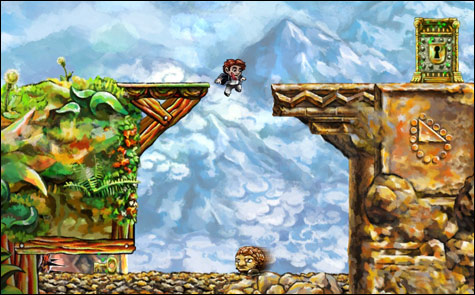
A fascinating conversation has developed over at
The Brainy Gamer in a post about
non-gamers' reactions to Braid. There are a couple of disparate strands running through it, one of which is the old debate about whether great art needs to be accessible to a wide audience, whether anything accessible to a wide audience is therefore
not art, and just whether the hell we're even supposed to be enjoying art in the first place.
I'd first say that, at bottom, accessibility is irrelevant to questions of quality. I say this as a vigorous defender of Michael Bay, clearly the most skillful filmmaker of his type working today. Great art shouldn't pander to the masses, but there's no reason the snootiest, most discerning critic can't also appreciate great trash. Once you start wondering what other people will think about the game you're playing, you've taken leave of your critical senses.
There seems to be a continuum of reactions to
Braid, from people who liked and admired it, to people who admired it but didn't like it, to people who thought it was pretentious piffle. All of these are legitimate stances to take. If anything, the range of reactions and the vigor of the conversations about the game are a positive development. Even if people didn't like the ideas, they're engaging the game on that higher level. They're not dismissing meta-textual considerations as they so often do. That's a big step.
Michael's concern is that when a game like
Braid comes along -- a game that seems unique and maybe even important -- it still alienates non-gamers. If you've played it, then you know how hard
Braid is. The problems it poses, and the solutions to those problems, all take advantage of the player's numerous built-in assumptions about how games work. Without those assumptions, you're sunk. This is what Nintendo has tapped into with the Wii. They've made games that people can pick up and understand immediately, without having to rely on a foundation of gaming knowledge that's taken decades to construct. But they're not really making games for those of us who
do know these things.
There's a good point raised in the thread by Jonathan Blow and others, who point out that we don't press the masterworks of literature into the hands of illiterates and demand that they learn to read right now, dammit! You learn to read by starting small. You recognize the shapes of letters and their associated sounds. You piece together basic words. After a decade or two, maybe you're ready to try James Joyce. (God knows I'm not there yet. Joyce makes me want to tear my hair out.)
In the Brainy Gamer thread, I argued that
Braid's time-altering techniques were much simpler than people seemed to be giving them credit for, comparing them to the similarly constrictive rules of movement that govern chess. I still think that's true. There's nothing overly complicated about a ring that slows down the timeline within a certain radius, or a doppelganger that repeats your movements. By the time you've cleared the first stage in any world, you understand the rules. What the level design does with those rules is astonishing, but it's always logical, fair, and consistent. The game doesn't cheat.
I missed something important, however. For a non-gamer, understanding the temporal mechanics of
Braid isn't the equivalent of learning how the pieces move in chess. A better analogy is learning to push the A button to make your character jump. Or that jumping on an enemy will kill it. Or that jumping on an enemy will bounce you as though you'd landed on a trampoline. The more you think about it, the more you start to notice all of the ingrained assumptions we have as gamers. It's even more basic than chess: for non-gamers, this is like learning the alphabet all over again.
Michael laments that his non-gaming friends feel shut out by the very process of playing a game. He wants them to appreciate the artistic and dramatic possibilities of the medium, but how can they do that when they can't even use the controller? Ultimately, they're going to have to work for it. Hey, it takes effort to read a great book. It takes careful attention to watch a subtle, nuanced -- maybe even subtitled! -- movie. Most of us couldn't do these things until we'd first read easier books and watched easier movies. We work to improve our appreciation for art because we know the results are worth it.
Let's not overlook what
did happen: these people gave it a try. I bet they wouldn't have done that a few years ago. What we're seeing here, I think, is just another sign that games have yet to achieve the level of cultural penetration people like Michael and I would like to see. That's okay. That's what we're doing this for. Give them a few more years.