Showing posts with label Wii. Show all posts

Wednesday, January 05, 2011

Lost in Shadow

Above: Cool shadow, bro

My review of Lost in Shadow is up at Joystiq. I'm trying to remember the last time my reaction to a game followed a similar trajectory to this one. Generally, after a couple of hours, my mind is 90% made up and the rest is a matter of details. Sometimes, games get better after you become more familiar with them, and that can take a long time. In this case, I felt like Lost in Shadow was flirting with greatness at the start, then settled into a trough of acceptable mediocrity, before, eventually, I wanted the damn thing over with.

The things that are good about Lost in Shadow never get better after they're introduced, while the things that are bad about it keep piling up. You can put up with rudimentary combat for a time, awful hit detection and all, but by hour 10, and your second sword upgrade, you ought at least to be able to make contact with your foes more than half the time. And there's very little variety in the enemy type, which wouldn't be a problem if the combat were more fun, but it gets to the point where you return to an area to find all the enemies have respawned and you can't help but sigh.

I'm a sucker for games that look pretty -- that may not have the most graphical horsepower under the hood, but that have interesting and inspired art direction -- and Lost in Shadow does. It definitely cribs from the Ico playbook, but I'll take that over another space-marine corridor shooter any day. And its beauty isn't skin-deep. Forcing your mind to understand the connection between the three-dimensional objects in the foreground, and the two-dimensional shadow in the background, is challenging and novel.

It's because this game started out so strongly that I ended up so disappointed. I really can't recommend Lost in Shadow, especially not at the retail price, but I'm not sorry I played it. An interesting failure can be the most valuable kind of game.

And, hey, it was better than Limbo.


Buy Lost in Shadow from Amazon (affiliate link)

Wednesday, December 08, 2010

Donkey Kong Country Returns

Above: A serious mine furor.

My review of Donkey Kong Country Returns is up now at thephoenix.com. I'm starting to feel like a broken record with these rebooted Nintendo games. I like them, and can't deny the quality, but don't feel especially compelled to keep playing them. Often it seems like my complaints come down to "this game is too hard," but that's not exactly right.

Honestly, DKCR isn't that hard. You die a lot, but it's not stingy with the 1-ups, and nothing in it is insurmountable provided you put in a reasonable effort. What bothered me was its old-school approach to recording my progress. Which is to say: it didn't. In any given level, there are several goals you might try to achieve. Several times I'd successful pick up the K-O-N-G pieces, but die before reaching the exit. Then, I'd complete the level but miss one of the pieces. Of course, I could go back and try again. The game is expressly designed that way. But it doesn't mean I wanted to do it.

In other words, I enjoyed DKCR well enough to play through it, but not well enough to shoot for 100% completion. In some games, that might not be a knock, but in this case I could tell that I was supposed to. So I'll put it in the "good but not great" category, with the caveat that it's not my kind of game anymore, but it's probably yours.

Yep, these are the hard-hitting videogame insights you come to this blog for. Say, have you heard about this Need for Speed: Hot Pursuit game?

Wednesday, November 10, 2010

Rock Band 3


My review of Rock Band 3 is up at thephoenix.com. This is one where I gave the game a high score, and then spent all my column inches talking about my reservations. And I didn't even get to all of them!

For instance: Did you know that lots of songs that have keyboard parts only have a few seconds of keyboard parts? Terribly deflating for the solo pianist. You bust out a couple arpeggios for the introduction, and then wait, fingers primed, for your chance to knock 'em dead with a solo. And you wait... And you wait a little more...

Or this: Some of the tracks that come on the Rock Band 3 disc don't even include a keyboard part. If you needed further proof that the keyboard player is the most uncool person in the band, there you have it. The improved drop-in and drop-out capabilities help, but it's still disappointing when you want to play the new instrument only to find that your singer wants to play something that doesn't support it.

Or this: Even though all the DLC you've previously downloaded will work in Rock Band 3 (a definite improvement over Beatles), it does not include keyboard support, even for songs that are crying out for it. Really? You're telling me the Killers have "no part" for keys? I understand why it has to be this way, but that doesn't mean I have to like it. This Joystiq story seems to indicate that it will never be possible to upgrade most of these past tracks, and if it is, you'll have to pay for it.

In fact, as a huge Rock Band fan, I'm starting to feel gouged. By the game's count, I've already downloaded 88 songs, which at about two bucks a pop is almost $180. The keyboard bundle was $129 (and no, I didn't get a free copy). If I want the pro guitar, that'll be $150. The Squier that comes out next year is $280, and you need the $30 adaptor for it to work. The notion of Rock-Band-as-platform was one I supported, but I didn't realize it was meant literally. Rock Band now costs more than Kinect.

But here I am, seriously considering buying one or more of these extra things. The reason is simple: this game is awesome. I have played so many lousy games this year, especially those which were supposed to be great, that I've started to wonder if I even like games anymore. Rock Band 3 puts my fears to rest. It's fun by yourself, keyboard lulls notwithstanding, and it's fun with others. And it has the genre's single biggest advance since Guitar Hero invented it.*

Pro mode changes everything. While I still pump my fist at the end of a song when I'm on guitar, and while I still prefer drumming to anything else, the idea that I am playing real music on the keyboard tickles a completely different region of my brain. Within an hour of starting the pro keys tutorial, I was successfully playing scales without looking at my hands. How long would that have taken without the aid of the game?

Playing pro mode is an order of magnitude more difficult than playing regular keys, and at this point I am still muddling through on easy or medium difficulty. I'm reminded of my difficulty learning to drum, but playing the keyboard is much more complex. The biggest obstacle isn't following the note chart onscreen, it's finding the correct key. If you're one of those people who think games aren't challenging enough anymore, here's the one for you.

*Let's not get pedantic here, people. You know what I mean.

Thursday, October 21, 2010

Boomshakalaka etc.

With about 30 triple-A games coming out this week and next, I imagine the thing you want to read most about right now is a review of NBA Jam for the Wii. Not exactly the most penetrating criticism you'll ever read, the review can be boiled down to one message: the price is too damn high.

When I expressed interest in playing the new NBA Jam, somehow it escaped me that it would come on a disc. I assumed it was a download. And even when I had it in my hands, it didn't occur to me for a couple of hours to check how much it cost. Fifty dollars! Good gravy.

Granted, I paid zero dollars for this game, so I can't say I had anything but a good time. And usually I strive to separate a game's cost from its true worth. But I'd be surprised to find that anybody thought this thing was priced right.

Wednesday, June 09, 2010

Galaxian

Above: Feeling dwarfed.

Every time a new Super Mario game comes out, I approach it breathlessly, and spend the first few hours in a reverie, jumping and climbing and squashing mushrooms with abandon. In 25 years and countless iterations, something core to the Super Mario experience hasn't changed. Playing Super Mario Galaxy 2, which I reviewed for this week's Phoenix, isn't a nostalgia trip as much as it seems to unify a lifetime of gaming into a single moment. It's like playing games was when I was a kid; it's like playing games will be when I am old. It almost exists outside the normal progression of games.

That sounds like high praise, doesn't it? And it is, in a sense, and probably the sort of sentiment that has earned Super Mario Galaxy 2 a Metacritic score of 98, one of the highest ever. I can't say the reviews are wrong, as though I feel like we'd played a different game. Galaxy 2 is a playground through which a few basic gameplay principles are applied rigorously and with increasing ingenuity. This is virtual play in its purest form. I get that.

I just don't want to play any more. After the first few hours, the sugar rush wears off. I find myself trying over and over to acquire new stars, failing over and over again until the fun is gone and it's become a grim sort of attrition. Galaxy 2 hands out extra lives like breath mints at a chain restaurant, so it's rare that a single challenge results in a game over screen. But, in a way, it's almost worse to have 20 tries or more to get something right, when it stopped being enjoyable after the fifth try. I can't give up now! I've got 15 more tries to get this star!

Why am I trying to get more stars? So I can get more stars, of course. Lots of games use feedback loops like this, successfully, but here it's unadorned. I have a hard time imagining the player who truly desires to save the princess. Finding her is secondary, maybe even tertiary, to the ultimate goal of mastering a hostile game world.

Galaxy 2 does have lots of sights and sounds that I want to experience, but I don't want to have to earn it in blood. Ultimately, I don't play games to be good at them. These days I can't imagine why else I would play a Super Mario game. It's not that Galaxy 2 is the hardest game I've ever played, it's that there's no other factor compelling me forward -- no story, no moments of serendipitous delight, nothing but the next looming challenge.

The biggest trick the devil ever pulled was convincing the world he didn't exist, and the biggest trick Nintendo ever pulled was convincing the world that Mario games were easy breezy fun. They are hardcore.

Wednesday, February 17, 2010

From heroes to zeroes

Above: Travis Touchdown goes for two.

My review of No More Heroes 2: Desperate Struggle is up now at thephoenix.com. You may recall that I loved the original, placing it on my top 10 for 2008, and writing numerous posts about it. Hell, let's just list 'em:

That is some glowing praise. As time went on, I even came to think that I had underrated the game, scoring it an 8.5 out of 10. Though I make it a point not to get too excited about upcoming games, a sequel to No More Heroes seemed like a no-brainer. And, well, it is a no-brainer, in the pejorative sense.

That's a little harsh, but I really didn't get that some sense of vitality and joy from Desperate Struggle that I did from the original. Even though the sequel has gotten better scores overall, 88 compared to the first game's 83, to me it didn't feel like it belonged in the same class. Oddly, I found myself making similar complaints about this game that reviewers did about the first one, and at the time I thought those reviewers were misguided.

But there's a fine line between campy and just plain bad in any medium, and in video games that line is razor-thin. Say what you will about the clunky and sparse overworld of the first game -- at least you could get where you were going. Desperate Struggle adds some of the crappiest jumping I've ever encountered, and it's not to make a point. It's because this is a sequel, and adding useless new features is what you do in a sequel. I think it's time for a new IP from Grasshopper Manufacture.

Tuesday, February 02, 2010

Playing disabled

I mentioned yesterday that I've still been able to play games despite my elbow injury. My hand is free and works just fine. The only real problem with an Xbox or PlayStation controller is that, because my elbow is immobilized, I have to sort of twist in my seat in order to bring my hands close enough to hold the controller. But it doesn't impact my ability to play the games, as far as I can tell.

Oddly, the only system I'm struggling with is the one allegedly for non-gamers, the Nintendo Wii. The Wiimote-nunchuk setup has one big advantage -- the cord that attaches them is long enough that I don't have to contort myself in order to hold everything. But it also has one big disadvantage, and that's motion control.

I've been playing No More Heroes 2, which controls like an ordinary third-person action-adventure in most respects: move with the analog stick, attack with the A button, target with the Z button. But because it's a Wii game, there are of course mandatory motion-controlled moves, and I'm finding them impossible to do. Specifically, Travis Touchdown can do pro-wrestling-style finishing moves to his opponents, which are both devastating and hilarious to watch. To do so requires quick movement of both the remote and the nunchuk -- move them both upward, say, or move them apart quickly.

Well, this is out of the question for me. I've always found the motion sensitivity of the nunchuk to be a little hinky anyway, and without the ability to really whip it in the right direction, it's all but useless. This has resulted, sadly, in Travis diving at his opponents, missing, and ending up sprawled on the ground. I can at least perform the more common, remote-only motion controls with my right hand.

I will eventually recover, but this has made me think about the plight of disabled gamers. Game inputs can be either complex and intricate, as on modern-gen game pads, or they might require strong, gross movements, as with the Wii or with peripheral-based games like Rock Band. Imagine being physically unable to play a game, or a whole genre, because the controllers don't account for your existence.

Has anybody out there had to cope with a physical disability in order to play games? I'd love to hear about it.

Wednesday, December 23, 2009

Games of the decade: Rock Band

Part of a series of subjective looks at my favorite games of the decade.


Rock Band
(2007, Xbox 360, PlayStation 2, and PlayStation 3; 2008, Wii)

Rock Band 2
(2008, Xbox 360, PlayStation 2, PlayStation 3, and Wii)

Forget the Wii. For mass appeal, nothing beats Rock Band. And it's got longevity, too, thanks to a forward-thinking business model that ensures several new tracks to download every week. Rock Band is so interesting from a technical and business standpoint that it would be easy to forget to mention the real reason it's such a phenomenon: it's the most fun freaking thing in the world.

Look, Guitar Hero was incredible. I will never forget what it felt like the first time I played that game. That's not the same sensation I got when I first tried Rock Band, where I knew what to expect. But Rock Band has so much more to offer. The satisfaction of reaching expert difficulty on the drums was much deeper than it was for guitar, because, damn it, it really was like playing the drums! The singing component opened the game up to players who felt uncomfortable trying to handle the game controllers, even as user-friendly as they were.

And the tracklists are just great. Money talks, and the massive commercial success of Guitar Hero paved the way for more songs and more master tracks. Here's another place where Rock Band and Guitar Hero diverge: while GH pursued chart-toppers, Rock Band went for quality, showing what Iroquois Pliskin called "a curatorial esteem for musicianship above other factors." I have gotten into more new bands thanks to Rock Band than at any time since college. The game has made me appreciate classic bands I'd overlooked, while introducing me to current artists I might never have heard of.

More important, it has made me a more active listener of music. Used to be that I mostly heard whatever was more prominent in the mix, the singer's voice or a guitar solo. Now I can pick out bass lines, and understand drum parts. In the course of listening to a song I can dissect it and put it back together again. This is an ability I've never had before. When I hear people warning that music games are eroding our appreciation of music, I have to laugh. It's exactly the opposite.

More on Rock Band:

Friday, December 18, 2009

Games of the decade: Okami

Part of a series of subjective looks at my favorite games of the decade.


Okami
(2006, PlayStation 2; 2008, Wii)

I have a hard time talking about Okami without sounding mushy. This is, after all, a game where you play as a god who takes the form of a white wolf in order to defend nature. If you're going to extol the virtues of a game in which you feed woodland animals, cause trees to bloom, and shrink to microscopic size to fight germs, then you are naturally going to come off like somebody who wears sweaters with images of kittens knitted on them.

Well, I don't care. I love this game. I love everything about it (okay, everything except for Issun's chattering). I love how unapologetically Eastern its philosophy is. I love how gentle it is, even as it pits Amaterasu against some pretty funky demonic foes. I love that it looks like a watercolor painting on rough parchment. I love that it's a game about life and regeneration rather than death and destruction. When I think about Okami, I feel like somebody's hugging me.

You could certainly point to some flaws: Issun's voice, button-mashing combat, three identical battles against Orochi. But though these are the things that make up the skeleton of the game, the meat of it is traveling across the massive gameworld, bringing a blighted land back to life with the power of your celestial brush. The brush is an inspired bit of design. Bringing it up freezes the action onscreen, whereupon it seems to tilt away from the screen, as though it's just paper wrapped around a wooden block. With a simple brushstroke, godlike, you alter the world in dramatic ways. You complete a broken bridge, or summon the sun, or strike at foes. The celestial brush ties everything together. (Although the Wii seemed like a perfect fit for this, I actually preferred using the brush with the PS2 controller).

Okami can most closely be compared to the Zelda series, but for my money it blows away any of the 3D Zelda games, which have been repeating themselves for over a decade now, and which always balance brilliance with boneheadness.* It lets us explore a rich and beautiful world, and to make that world even more rich and beautiful. It has humor and heart. It turns cranky critics into big ol' softies, who will surely regret this post in the morning.

*No, I'm not prepared to back this up right at the moment.

More on Okami:

Wednesday, December 09, 2009

Check out cranky pants over here

Above: Four characters having an adventure. (Not pictured: four players beating each other to a pulp.)

My review of New Super Mario Bros. Wii is up now at thephoenix.com. I did not like it. It has all of the frustration and none of the fun of past Super Mario Bros. games. Like many people, I have a Pavlovian response to the series, especially the sounds of Mario jumping and coins being collected and all that, but in this case I also had less pleasant flashbacks to childhood temper tantrums, usually triggered by a Hammer Brother.

I noticed that the manual tries to play up the unpredictable nature of the multiplayer, sort of jokingly suggesting that you might choose to grief your allies rather than help them. This would be all well and good if such a thing were optional, but instead the experience of playing this game with somebody else is an unbroken series of cheap, obnoxious deaths. For all the good that the bubble system does -- and it does do a lot of good -- you can't account for the many creative ways this game will find to screw you.

I'm getting angry just thinking about it.

Wednesday, September 09, 2009

It's not called "Rock Band: The Beatles" for a reason

My review of The Beatles: Rock Band is up now at thephoenix.com. This is probably Harmonix's strongest work in terms of presentation, and I understand that the music of the Beatles is highly regarded in some circles.

Still, it seems like there's no way to talk in a measured way about this game, or the band, without coming off like the proverbial turd in the punch bowl. When I say on Twitter that I'm not a huge fan of the Beatles, I mean exactly that. I'm not taking a veiled dig. I have a couple of their CDs. I find many of their songs to be terrific. And yet I don't make an emotional connection with almost anything they've done, not like I do with my very favorite bands. Therefore I say I like the Beatles. But I am not totally sold on a music game that features only them.

Maybe I buried the lede, too, because the real issue I see is that Rock Band has been the catalyst for introducing people to new bands, and new ways to experience music. This game is more about elevating the Beatles over the player. That's no small distinction. For example, I've developed a habit of delivering a drum solo at the beginning of every Rock Band track -- just a little wailing away while the song cues up. It's a way of making the songs mine. You can't do that in The Beatles. Hit a drum pad before the song starts, and nothing happens, because that sound isn't on the original recording. There goes your live performance feel. (I should say that they did a great job with the audio of shrieking teenaged girls, though.)

More important, it's the game's way of making sure that you don't dare mess with perfection! I'm not a huge fan of that attitude. Past -- and, technically, current -- Rock Band games are about engaging with the music on an equal level. This game, though, is a ball-washing of the highest order. Maybe the Beatles are more deserving of such treatment than any other band, but I don't think any band deserves that treatment. Not now that I've seen the alternatives.

There I go, sounding like I didn't like the game. I liked it a lot! I like the Beatles! I had a lot of fun with this game, and I look forward to playing it more in the future. I am just suspicious of claims of divine authority.

Monday, August 03, 2009

In defense of the gamepad


Above: The humble, hard-working gamepad.

Pity the poor gamepad. He's the least popular kid on the block. The ever-evolving controller has been the primary input for almost every game that's come out over the past 30 years. From the single-button Atari joystick to the precision-engineered machine you see above, the gamepad has been an integral part of the video game experience, even has the industry has grown into the multi-billion-dollar behemoth it is today.

And the console manufacturers can't kill it fast enough.

Last night, I was a guest for the recording of the Big Red Potion podcast (I'll post the link when the show is available). The topic was play control: the state of it, how it's evolved, where it's going. We spent some time talking about specialty controllers, like the Guitar Hero guitar, and the future of motion control, especially with regards to Wii MotionPlus, Project Natal, and the PlayStation motion controller. To look at the direction the hardware is going, you'd think that the gamepad has become obsolete.

Anyone would agree that game controls are more complex than they used to be. Game designers can go overboard with button combinations and functions, sometimes with hilarious results. It's not immediately clear, from looking at a gamepad, what each button and stick does. Non-gamers can be frustrated or intimidated by these bulky, multi-functional devices. This is all true.

But look at what else the gamepad does. It stands in for a steering wheel in a driving game. It replaces a stick and pedals in a flight sim. It eliminates the need for a keyboard and mouse in a first-person shooter. It supports the split-second reflexes you need to play Street Fighter or Devil May Cry, and it credibly stands in for all the sporting equipment you can think of. This thing does it all -- no bold new paradigms needed.

Gamepad design has progressed in a steady, upward fashion. Thanks to years of iterations, dozens of good ideas have become standard, while bad ideas have been phased out. Gamepads today are ergonomic, with sleek, comfortable curves (not like the pointy-cornered NES controller at all), and triggers positioned just so. Rumble is standard. Pressure-sensitive triggers have made vehicle control miles better than it used to be. For all the talk of Wii/Natal/PSMotion being a revolutionary way to play, I'd argue that nothing has fundamentally altered the way we play as much as the move from digital to analog thumbsticks. At the time, it seemed like such a small thing, but playing in three dimensions would be impossible without it.

I'm not saying the gamepad is perfect, and I'm not saying it's a good thing when overly complex control schemes put people off. Simplicity is a virtue in game design, and hardware design. What I am saying, though, is that the gamepad sometimes goes unappreciated. It's not enough for any of these brand-new control methods to have one killer app with which they work perfectly. Natal and Sony Motion are going to have to prove that they can be as versatile as traditional methods when playing traditional games. Otherwise, I'll stick with the gamepad.

Thursday, July 30, 2009

The Bigs 2 comes up small

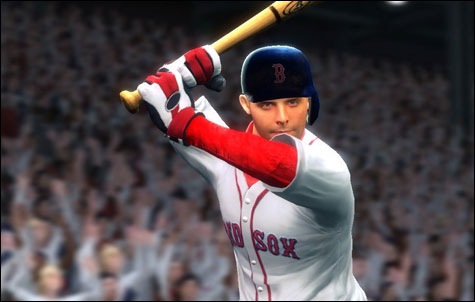
Above: Dustin Pedroia, looking somehow even less human than usual.

My review of The Bigs 2 is up now at thephoenix.com.

I am by no means an expert on sports games. The reason I wanted to play The Bigs 2 is that I expected it to be unlike most sports games. And it is, to some degree, but a big part of the reason I didn't like it turned out to be the extent to which it betrayed the game of baseball.

In my life, I've been fortunate to attend a couple of significant baseball games. My favorite memory is game 3 of the 2003 ALDS, the Boston Red Sox against the Oakland Athletics. The Sox had dropped the first two games in Oakland, and were facing elimination at home. After the game went into extra innings, the Red Sox brought in pinch-hitter Trot Nixon, a fan favorite and a lefty who'd been on the bench to start the game. Trot launched the game-winning bomb into the center-field seats. You know what, I could almost feel the shockwave from that blast.

The Bigs 2 does a good job of rendering that type of thing. When a "big blast" home run bursts into flame, streaks across the sky like a comet, smashes into a building, and shatters all the windows, I'd say that's faithful to the spirit of the sport. It's exaggerated and cartoonish, sure, but it captures something true about the way a game-changing home run feels. It takes something real and pushes it to the extreme.

Most of the rest of the game does not do this, usually for less obvious reasons. The fielding animations are just terrible -- there are hardly any of them, and the transition from a fielder's picking up the ball and actually throwing it is cumbersome. Fielding at all is bizarrely difficult, because your fielders stop running well before you have a chance to tell where the ball is in relation to them. These fielders are actually slower than their real-life counterparts.

As for the mini-games that mark every dramatic catch, they're not only insanely difficult (for you, not for the computer), but they bear no resemblance to what the player onscreen is actually doing. It's as though another game entirely parachuted in for just those sequences.

Batting is a little weird too. I understand that the pace needs to be quicker than in a faithful sim. Yet I can't really understand why The Bigs 2 punishes you for taking a pitch. If you see a pitch coming that's not in your batter's wheelhouse, you'd think the smart move would be take the strike. But doing so fills up the other team's turbo meter, so you have to just flail away at every throw. That's stupid. In all the time I spent with this game -- which, I'll grant you, was not a lifetime, because I disliked it so much -- I never once saw a batter walk.

I mentioned this in the review, but perhaps not strongly enough: I hate, hate, hate the way this game portrays the players. To a man, they are depicted as mean, joyless, roided-up idiots. When the art isn't inadvertently comic (Jonathan Papelbon's head looks like Charlie Brown's), it's just frightening (Joe Mauer does not, in real life, walk around looking like he's spoiling for a fight). I'm only half-joking in the review when I say they should have made J.D. Drew into a literal robot. A great way to make a cartoon-like baseball game that still showed love and respect for the sport would have been to try to represent the players' personalities in an outlandish way.

But that's not what The Bigs 2 is about. It's about turning baseball into just another violent, stupid, adolescent power trip.

(Did I just do the thing where the blog post is more interesting than the published review?)

Wednesday, July 22, 2009

Monkey business

Above: Guybrush drinks in the beauty of Flotsam Island.

My review of Tales of Monkey Island episode 1 is up now at thephoenix.com. There's a brief mention of the voice acting, although not to the degree that I talked about it yesterday. Instead, I spend more time in the review talking about what works in this game, because on the whole it's a pretty entertaining way to spend a few hours.

Still, it feels pretty insubstantial on its own, and depending on your play style it may be worth waiting for the entire series so you can play through all at once. That was the case I found with the Sam and Max revival, anyway. But there I go scooping myself again. It's all in the review!

Tuesday, June 30, 2009

Breakdown

I'll not bore you with the details of my PlayStation 3's long, grueling journey toward health, except to note that I still haven't sent it in yet. This is going to take awhile.

I was in the middle of griping to myself about how they just don't make consoles like they used to, when I realized that hardware failures are just a fact of life. The Xbox 360 has gotten all the bad press, but my systems have historically had about a 50% failure rate, no matter who made them. A look back:

Console: Atari 2600
Year Acquired: 1984 (?)
Serviced or Replaced: No.
Diagnosis: A solid performer, although we never touched the damn thing once we got the NES, so who knows how long it might have lasted.

Console: Nintendo Entertainment System
Year Acquired: 1988
Serviced or Replaced: Replaced.
Reason: I can't recall the specific reason why our original NES bit the dust after only a couple years of service. It must have been that warranty-busting Game Genie. Damn you, Galoob!

Console: Sega Genesis
Year Acquired: 1992
Serviced or Replaced: No.
Diagnosis: The first star performer of any console I ever had. As of the last time I plugged it in, probably 2004 or so, it still worked. Can't say the same for the controllers, though. It's hard to play NBA Jam when you can't shoot.

Console: 32X
Year Acquired: 1994
Serviced or Replaced: Junked.
Diagnosis: I uninstalled the 32X to play Virtua Racing for the Genesis, which was incompatible, and after that the 32X never worked again. You may remember that hooking it up involved metal plates and about ten yards of cables, so I think this was actually for the best.

Console: Sega Saturn
Year Acquired: 1995
Serviced or Replaced: Serviced.
Diagnosis: A simple lens error was easy to fix, although dealing with customer service was a nightmare. (Me: "I think it's a disc read error." Them: "Try wiping the memory." Me: "It says 'cannot read disc.'" Them: "Try placing it on the floor, lighting some incense, and dancing around it in a circle.")

Console: N64
Year Acquired: 1996
Serviced or Replaced: No.
Diagnosis: Another solid performer, the N64 was in fine working order as of the last time I hooked it up, probably five years ago or so.

Console: PlayStation
Year Acquired: 1997
Serviced or Replaced: No.
Diagnosis: The first and last time Sony would not disappoint me.

Console: Super NES
Year Acquired: 1998
Serviced or Replaced: No.
Diagnosis: This was the smaller, redesigned SNES, which may have helped, but this thing even survived several weeks in the common room of a dorm, getting stuff spilled on it.

Console: PlayStation 2
Year Acquired: 2000
Serviced or Replaced: Replaced.
Diagnosis: Some kind of massive mechanical failure. The disc tray stopped working, and the whole system took to emitting a loud grinding noise. I attempted to fix it myself, following instructions on the Internet, and ripped an important-looking cable. Ended up buying the newer, smaller PS2.

Console: GameCube
Year Acquired: 2004
Serviced or Replaced: No.
Diagnosis: Like the 2600, this one was obsolete before it had a chance to crap out. Still, a win's a win.

Console: Xbox 360
Year Acquired: 2006
Serviced or Replaced: No.
Diagnosis: Knock on fucking wood.

Console: Wii
Year Acquired: 2006
Serviced or Replaced: Serviced.
Diagnosis: The reason it went in for service was because it couldn't read Smash Bros, for which Nintendo tried to blame me, but was really because the system is cheap and dinky. At least it was free to fix. The bigger problem with the Wii is the graphical artificating, which occurred as a result of my leaving it in standby mode for six straight months, because there was nothing to play.

Console: PlayStation 3
Year Acquired: 2007
Serviced or Replaced: Serviced.
Diagnosis: Pending. I'm not entirely sure what happened. It might just have overheated. Hopefully they'll say what the problem was when they return it.

There you go. 13 systems overall, and 6 died a premature death. I guess they make them exactly like they used to.

Note: This post has been updated since it was originally published, to include the GameCube.

Wednesday, May 27, 2009

Punch drunk love

Above: It's the rye or the Kaiser.

My review of Punch-Out!! is up at thephoenix.com. Updates, re-launches, and re-imaginings of old games are nothing new, but Punch-Out!! barely tinkers with the formula. Nintendo has been successful in translating Mario, Zelda, and Metroid into 3D, but in each case that has resulted in something new -- something that has fundamentally transformed each game, while still retaining the feel of the original. Punch-Out!!, though, is the same as it ever was. It plays exactly like Mike Tyson's Punch-Out!! did, more than 20 years ago. What's surprising is how fresh it still feels.

I wish other game makers had the secret formula for difficulty that Nintendo alone seems to possess (even when they farm out development duties, as was the case here). Nintendo games always seem to live at the outer edge of my competence. They always seem difficult but not impossible. The difficulty ramps up so well in Punch-Out!!. No matter how hard an opponent may seem, it's also hard not to try again after losing. You always feel this close to getting it right.

I'm not even sure what's left in Nintendo's stable at this point, but if this is where the bar is going to be set, I say bring on the Kid Icarus remake.

Tuesday, May 19, 2009

Gettin' punchy; or, Insult Swordfighting, ruining your fun since 2006

Above: Little Mac finds Glass Joe insufficiently grateful for us saving his ass in WWII.

N'Gai's famous quote about the Resident Evil 5 trailer was, "Wow, clearly no one black worked on this game." My thought after winning the minor circuit belt in the new Punch-Out!! was, "Wow, clearly no one French, German, gay, or Pacific Islander worked on this game."

I don't want to get too deep into the weeds on this. Still, it's odd that RE5 could provoke such a firestorm of controversy starting almost two years before its release, and Punch-Out!!, which similarly relies on questionable and outdated images as shortcuts for characterization, has so far been given a pass everywhere I've seen.

Let's just run them down. In Punch-Out!!, you face:*
  • A cowardly, effete Frenchman
  • A stern, militaristic German
  • A fabulous, lisping gay man
  • A fat Pacific Islander
  • A womanizing Spaniard
  • A drunken Russian
  • A magical Indian
  • Others

On one hand, it's nice to see this kind of diversity in a game. On the other hand, how much would it have blown your mind if King Hippo were the womanizer, Soda Popinski the homosexual, and Glass Joe the mysterious sorceror? But that would be ridiculous, you say.

Nobody's playing Punch-Out!! for deep characterization, granted. And the game seems to do a good job of giving Little Mac's opponents flashes of personality during the fights. Their facial expressions and body language are portrayed in a classic cartoon style, exaggerated and expressive. That's why it's so disappointing to see such lazy stereotypes providing the characters' foundations -- ironically, the fighters' very design shows that the designers could have done better. (Still doesn't explain why a defeated Glass Joe falls onto a bed of croissants, or why King Hippo collapses amid a buffet of tropical island fruits.)

Anticipating the objections: Yes, most of these characters have been in the series from the beginning. If tradition were a good reason to perpetuate this stuff, you'd still see the Confederate flag flying from state houses in the South.**

And, sure, this is all in good fun. It's supposed to be funny! Not like Resident Evil 5 at all, which was all booga-booga. That's exactly the problem. Much as some observers thought that RE5 was using loaded racial imagery as a replacement for creating new horror ideas, Punch-Out!! employs stereotypes for humor, without commenting on them, or even seeming to consider them. The joke is that the French guy is a pussy. The joke is that the Disco Kid is a flaming queer. These are not good jokes.

I'm not saying Punch-Out!! would be improved with realistic opponents. But there is one character in the game who shows how you can have silly, cartoonish characters without dredging the bottom of the barrel: Doc Louis. He's a good trainer, and he often gives Mac good tactical advice between rounds. But his inspirational speeches make no sense, and even though his job is to keep Little Mac in shape, he himself is overweight. Doc may still be assembled from off-the-shelf parts, but unlike the other characters in the game, his parts come from different shelves.

*Punch-Out!! roster provided by Wikipedia.

**Oh... wait.

Thursday, April 23, 2009

Who really holds casual gamers in contempt

Above: Driving a wedge into the puck of friendship.

Despite some attempts to move past it, the "casual vs. hardcore" mindset still seems to hold sway among gamers and publishers. We tend to think of any conflicts between the groups as a result of the provincialism of the hardcore gamer -- the kind of person who wants everyone to value his hobby as highly as he does, but doesn't want to have to share it with them. But really, these are intra-group squabbles. A Halo vet trashing a noob is a case of a hardcore player defending his alpha male status against another member of the same tribe. The prototypical casual player is not the target, any more than a silverback gorilla's chest beating is directed at the orangutan on another continent.

Publishers, though, do seem to hold the casual gamer in contempt. Whenever I play a casual game, I am struck at how little effort seems to have been made to polish and playtest. Case in point: Last weekend, I played the Wii version of Trivial Pursuit with some friends. I'm not here to trash the whole product. Any time trivia questions are being asked, I'm in. And Trivial Pursuit Wii has some nice ideas -- bonus spaces let you compete with opponents heads-up for wedges, timed questions add some competitive intensity, and it ends with a showdown between every player.

The ragged edges concern me. Interaction design is one of the most crucial parts of any video game. Nintendo understands this. That's why the Wii remote is designed the way it is, with one big, friendly button right where your thumb rests. The A button should perform almost every action. In Trivial Pursuit, it performs most of them. Most questions, you answer by pointing your cursor at your choice and hitting A. There's a clear and logical connection between your action and the effect onscreen.

But because Trivial Pursuit introduces a few different question types, the control scheme occasionally changes. For example, you might be asked what year an historical event took place, and be presented a slider representing a 50-year range. Nail the exact year, and earn a full wedge. Come within a few years, and earn a partial wedge. What's the instinctive move here? You're probably thinking that you'll point your cursor at the correct year and press A.

In fact, the game wants you to hold the B button to grab and position the slider, and then hit A to submit your answer. This instruction pops up onscreen the first time the question type appears, but if it's not your turn, it's likely that you aren't paying attention. If you point the cursor and hit A, then you've just answered whatever the initial value was on the answer scale. More than one of us made this same mistake.

Not a huge deal, right? (I'd argue that it's a huge deal when it causes me to lose points, and brilliant design when it happens to others.) Actually, these little interface decisions can have an outsized effect. People who have played lots of games come to have certain expectations of what each button on the controller does. And people who rarely play games can't be bothered to master intricate control schemes because they want to play Trivial Pursuit for an hour. The nexus of player and game is where success or failure happens.

Given that it didn't take much time for us to uncover some of these issues, you have to wonder how much playtesting was done. I get the impression that keeping the production budget low was the number-one prority. And why not? There's no accountability. No one is taking to blogs and message boards with virtual torches and pitchforks when a casual game seems half-finished. When a game directed at the "hardcore" makes a silly design decision, we let the publisher know about it. Sure, we go overboard sometimes, but at least we're enforcing standards. The size of the casual pie keeps growing, but the ingredients are still funky.

Related:

Wednesday, April 15, 2009

Brothers in metal

Above: Yes, believe it or not, less horrifying than Video Aerosmith.

My review of Guitar Hero: Metallica is up now at thephoenix.com. If you read last week's Guitar Hero post, then you already know the verdict. It's good. Quite good, in fact. That's why I'm now going to do what I do best: gripe about something insignificant.

Toward the end of the review, I mention one way in which Guitar Hero is still falling short. It still sometimes shows a bias toward a more primitive video game mindset, when it could stand to be more enlightened. Many of Metallica's songs have long, quiet stretches in which guitar is the only instrument to be heard. During these sequences, the programmers have given the drummer the chance to pad his score with drum fills. The fills are scored simply, by assigning one point per hit. That means that the incentive is to wail away on the pads, concerned only with hitting as many of them as quickly as possible. That's fully at odds with what the song is portraying.

My man Clint Hocking might even call it ludonarrative dissonance.

Still, damn good game.

Wednesday, April 01, 2009

Kind of funny, kind of sad

Above: The dreams in which I'm killin' are the best I've ever had.

My review of MadWorld is up now at thephoenix.com. I predict this one will not attract as many literate comments as the Resident Evil 5 review did. (By the way, defcon, wherever you are, I appreciate your efforts.)

I don't know if anybody else feels this way, but over the past five years I've played so many video games that they've all started to blend together. Any time something comes along that seems new or different, I'm interested. Even if, in the case of MadWorld, the gameplay really isn't that new or different -- just the packaging is.

As a beat-em-up, it's not much to write home about: it's fairly easy, the enemies mostly stand around waiting to be slaughtered, and the lock-on targeting system is awful. As for the promised buffet of sumptuous murder options, well, it's there, but mostly you just slam people into spikes over and over again.

MadWorld was developed by Platinum Games, the reconstituted Clover Studio. They're the same people who made Okami, my 2006 game of the year, and God Hand, the campy brawler that was either way beneath me or way above me. (I didn't play any of the Viewtiful Joe games.) MadWorld shares some traits of both games. It's more immediately playable than God Hand, and shares the same attitude and sense of humor. And it's got the striking aesthetic of Okami, without, let's say, any of that game's considerable virtues.

Still, there's a lot to like here. I'm a little surprised I haven't yet read raves of it. This seems destined to gain a cult following. Maybe the swift dismissal would be to say that we already played a satirical, lowbrow adventure game on the Wii, when it was called No More Heroes. Which wouldn't be totally unfair. But it could be taken as a compliment.

Related: The Sega strategy