Friday, October 16, 2009

Friday afternoon tidbits

Don't know what it's like for folks in the rest of the country and the world, but here in New England we're having a spell of winter-like weather. It even snowed a bit last night. People are weeping and wailing about it, but as the proud owner of a brand-new snowboard, I couldn't be happier. If you haven't been able to tell from my Twitter feed, I'm itching to hit the slopes. It's been 7 months at this point! No man should have to suffer so.

Let's get to some links.

-Ben Richardson wrote a great article about Tim Schafer in the San Francisco Bay Guardian, and I'm not just saying that because he quoted me in it. Although I didn't like Brütal Legend, Schafer is an awesome guy with some fascinating insights and a real love for metal. In some ways, I'm happy to see the wide-ranging reactions to this game. I feel like truly interesting and inspiring games will divide people. They will challenge us to think about them, both while we're playing and afterwards. Brütal Legend seems to do that.

-The Boston Globe reports on new research that indicates that playing games may be good for your brain. In the same way that lifting weights and running laps can improve your body's physical abilities, the challenges of interpreting virtual space can help your brain with a variety of tasks: "Fast-paced, action-packed video games have been shown, in separate studies, to boost visual acuity, spatial perception, and the ability to pick out objects in a scene. Complex, strategy-based games can improve other cognitive skills, including working memory and reasoning." This won't surprise many gamers, nor does it put to rest arguments about the effects of violent games on kids, but it's heartening nonetheless.

By the way, Steven Johnson covered similar ground, more readably but less scientifically, in his book Everything Bad is Good for You.

-Shawn Elliott appears, Bigfoot-like, to share with us the one and only right review. It's an aggregation of all the inane, venomous comments that readers like to post on game reviews. I love this line in particular: "Now the credibility I never had is as good as gone. "

I've been fortunate not to have to deal too much with this stuff. It's always surprising the tone that such comments take when they do show up. Disagreement is a healthy thing, but often commenters will ignore the substance of the review entirely and just slam the reviewer. The commenter acts as though he is in possession of some divine truth, and therefore it's not even worth engaging actual arguments to the contrary. (Do reviewers sometimes do this to games? Probably.)

It's kind of like the abortion issue.

-Today, October 16, is National Bosses Day, so it's appropriate to once again revisit a feature that Ryan Stewart and I collaborated on for the Phoenix: The 20 Greatest Bosses in Video Game History. It's not a particularly surprising list, but I was happy with the blurbs we wrote about each boss. Reading them now, I still am.

We wrote this in 2006, and I wonder if anyone has shown up since then who deserves a spot. No one immediately springs to mind. Maybe GLaDOS, or maybe the Joker in Arkham Asylum. Not sure. Many of the best games I've played over the past few years have not been distinguished by their bosses. Many don't even have bosses as we used to know them.

Thursday, October 15, 2009

Quiz: The year in swooning

Match each of these games with the breathless excerpt from its review.

1. The Beatles: Rock Band
2. Batman: Arkham Asylum
3. Killzone 2
4. Resident Evil 5
5. Red Faction: Guerrilla
6. Street Fighter IV
7. inFamous
8. Brütal Legend
9. Uncharted 2: Among Thieves

A. "...one of the most memorable video games ever created. Not because it is particularly innovative, but because the mixture of shooting, climbing, creeping, thinking, laughing and simple astonishment works perfectly."

B. "There are very, very few games which truly make me sit back and go 'wow'. Among the slew of games that I’ve reviewed this year, there are only a couple that I really enjoyed playing, and continue to do so. [This] is one such game – even though I aced my Public Speaking and English Literature classes, words only slur together when I try to describe this game."

C. "This is simply a superb genre defining experience with two unforgettable endings."

D. "This action-adventure is so smart, so well-written, and delivered with such an obvious love for its source material, I daresay it is both the best licensed game ever made, and arguably the best game of its kind in our current console generation."

E. "...provides a transformative entertainment experience. In that sense it may be the most important video game yet made."

F. "The gorgeous graphics, the superb sound, the great (if sometimes twitchy) AI of your partner and the jaw-dropping gameplay take everything that was brilliant about [its predecessor] and ramp it up to the next level, making for one of the best gaming experiences ever!"

G. "This game deserves a place on everyone's shelf, from the most casual fan... to the most hardcore. No matter your personal skill level, you owe it to yourself to buy this game. [Its] incredible art style, rock solid gameplay, and infinitely compelling multiplayer make it stand out as one of best games of this generation."

H. "A fantastic game that sucks you in and doesn't let go... a seamless merger of technology and story telling that raises the bar for the industry."

I. "...the best console first person shooter ever. It will be bested one day, and that is as it should be, but this game has set the proverbial bar so high we reckon it'll be the king for a good long while... Hail to the king, baby."

1. E (New York Times)
2. D (Gamespy)
3. I (Playstation Official Magazine Australia)
4. F (AceGamez)
5. H (Gaming Nexus)
6. G (ZTGameDomain)
7. C (Play)
8. B (MEGamers)
9. A (Cynamite)

Wednesday, October 14, 2009

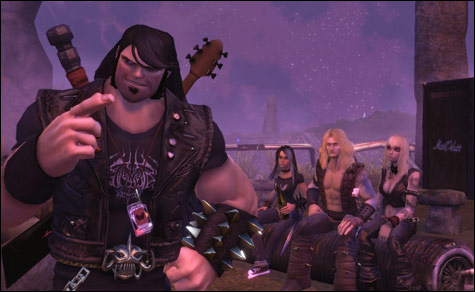
Brutal Legend shreds

Above: A common screenshot from Brütal Legend.

My review of Brütal Legend is up now at thephoenix.com. Now that I've read several other reviews, it seems like everybody's on the same page with this one. For me, that means a two-star rating, or 5.0/10 in the paper, although many other people thought the story and dialogue redeemed the lackluster gameplay. I just can't agree with that. Maybe if you spent more time with the story and dialogue than you do with the gameplay, it'd make sense. Not the case.

Writing negative reviews bums me out. I get no joy from it. Sure, there's a part of me that delights in coming up with a wicked burn, but that's the writer and not the gamer talking. I want every game to be good. I especially want a game by Tim Schafer to be good. I am not thankful for the opportunity to rip somebody else's hard work. But what choice do I have? This game is not good. There are lots of little things wrong with it; there are lots of big things wrong with it.

No time to dwell on it. We're in the thick of things now. Why, I've got a copy of Uncharted 2 right here. Onward!

Thursday, October 08, 2009

Scribblenauts? More like scribble not.

Above: Exploring scribbles.

I have a review of Scribblenauts up at thephoenix.com. Innovative or not, it is not a very good game. It's fun to mess around with, and my wife wants me to tell everyone that she really liked it. (That's not as minor a footnote as it may sound -- this may be the first time that's ever happened. You wouldn't believe the number of supposedly casual-friendly Wii games she hasn't liked. The list of games she likes now stands at two: this, and Rock Band.) But there's little more here than promise that a later game might be better.

I find I'm losing patience with games that don't work well to begin with. Everybody made so much out of how everything you summon in Scribblenauts acts correctly -- bears are hungry, helicopters fly, and so on -- but I found that not to be the case. Things rarely did what I expected them to. Maxwell hardly ever went where I wanted him to. And perfectly logical solutions didn't pan out, because the governing logic naturally can't be all that different from one type of thing to another.

There was a time when I'd put up with a game's foibles, because it was the only one I had on hand, and what the hell else was I supposed to do? These days I feel more like I can't be bothered with a game that hasn't put in the effort to smooth out the edges. I love the idea of Scribblenauts. I really do. I also love the idea of world peace. Sometimes you bump up against reality.

Friday, October 02, 2009

Friday afternoon tidbits

I'm looking forward to playing the new Left 4 Dead campaign tonight. I also intend to play more Dead Space: Extraction this weekend, after being pleasantly surprised by the first two chapters. Will report back!

-A while back, I posted a list of songs I'd like to see in Rock Band. In that post, I predicted a zero-percent chance of one of those songs ever being released. Shows what I know: "Gay Bar" by Electric Six will be released as DLC next Tuesday. This is very exciting. And it's also another reason why I'll take the open Rock Band platform over the more hermetic Beatles installment. You're just not gonna get surprises like this from the Beatles game.

-In this week's Experience Points podcast, Jorge and Scott talk about downer endings in games, or, more specifically, a lack of them (inspired by Manveer's post on the subject). I think the issue really isn't one of "happy" or "sad" endings, it's one of thoughtful, mature endings that carry a character's arc through to a conclusion, or that contain elements of both happiness and sadness. I mentioned The Darkness in comments as a game that gets it right. The final sequence is viewable on YouTube, although I'm not sure it would make much sense if you hadn't played the rest of the game. The point is that it provokes conflicting emotions, while completing the protagonist's fall. It's brilliant.

-At Press Pause to Reflect, C.T. Hutt weighs in on something that's one of my pet peeves: overly helpful helper characters. Navi is the worst, and Issun clearly wasn't much better. Having an NPC partner isn't inherently a bad idea -- it's been done well in Half-Life 2, for example. It's when the partner is overbearing and impossible to ignore that you get into trouble. How hard would it have been to have to ask Navi for hints when you wanted them? Or better still, design the game in such a way that her particular brand of help isn't needed? Just more reasons why Ocarina is the Most Overrated Game of All Time.

-This one's a little older, but I didn't do a links post last week so I'll write it now. Michael Abbott wondered whether we praise innovation at the expense of execution, specifically talking about the difference in critical buzz between Scribblenauts and Mario & Luigi: Bowser's Inside Story. I recall that last year Leigh Alexander observed an opposite problem -- that we condemn innovation when the execution isn't quite there. They can't both be right, and I'd venture to say that it's not so simple as either of those formulations makes it seem.

Innovation is useful for a great many things, but it is not the endpoint. It's the beginning. Gaming history is littered with examples of games that innovated and failed, but whose ideas were subsequently improved upon. In his next post, Michael praised the value of iteration, which is a point I fully agree with. But if you trace these refinements back far enough, you'll eventually get to something that was brand-new, and which didn't work as well. You can't really separate innovation and execution.

As for why so many writers in the brainysphere are talking about Scribblenauts, it might be as simple as this: it's a game about words. We're the target audience!

Thursday, October 01, 2009

Current events

Hello, Insult Swordfighting readers! You may have noticed that things have been quiet on the ranch lately. This is for three reasons, two of them mundane and one fairly exciting. I'll give them to you in that order.

1. I haven't been playing anything for the past couple weeks.

These days, when I don't have to review anything, I find myself playing nothing at all. And when you're not playing anything, it's hard to write much. This should be changing in the weeks to come. Look for a Scribblenauts review soon, plus stuff about Dead Space: Extraction and, in all likelihood, Uncharted 2.

2. I got sick for a bit.

God that is so boring. You don't care. I don't care either.

3. Starting next week, I'll be contributing to a more professional-looking blog.

Yes! I'll be publishing reviews and other game-related posts at tor.com, a sci-fi/fantasy blog owned by Macmillan publishers. The site mostly focuses on fiction, but its bloggers also cover comics, movies, anime, and lots of other great stuff. It's a very cool site. I'm excited to get started.

How will that impact this blog? In all likelihood, it won't. I've never really published straight reviews here, anyway, and given that InSword's primary purpose has always been to give me a place to talk about stuff I find interesting without having to worry about playing to an audience, it's likely to stay that way. I have also found that writing begets more writing -- it's possible that blogging for tor.com will only spur me to write more for this site.

That's the scoop. Thank you for reading.

Tuesday, September 29, 2009

What video games have in common with fantasy sports

Above: The new high-score list. And also some straight-up bragging on my part.

Two video game genres I've never gotten into are sports and strategy. The finer details of sports sims elude me (unlike, say, Bill Harris, who times his virtual running backs with a stopwatch). I can't tell if a sports game is realistic or not, and even if it were, that wouldn't help me play it. In a strategy game, or a strategy-heavy RPG, the top-level thinking -- resource management, planning ahead, multi-tasking -- doesn't track with the way my mind works. Yet for several years now, I've been hooked on a game that combines the most challenging traits of both of these genres: fantasy baseball.

We don't tend to think of fantasy sports as video games, not even as a part of the increasingly misnamed "casual" realm. Yet it's hard to imagine how else you could classify them. In the same way that pen-and-paper role-playing games have informed generations of electronic RPGs, old-time rotisserie baseball provides the basis for an electronic version that millions of people play. All the complicated stuff is automated, like updating players' statistics and trips to the disabled list, just as Final Fantasy keeps track of hit points and status ailments. The player needs only to set his lineups, and give himself the most favorable matchups possible.

Creating a balanced fantasy baseball team is a lot like putting together a successful party in an RPG. You can't overload your roster with too much of one kind of player. Imagine trying to plug through the first Final Fantasy with four fighters and no mages. It would be impossible. The same is true of fantasy baseball. If you load up on beefy sluggers with high strikeout rates, you might lead the league in homeruns, but you'll almost certainly be near the bottom in batting average and stolen bases. Both the player draft that starts the season, and later roster moves and trades, require this sort of give-and-take.

As with video games, you can put as much or as little effort into fantasy sports as you want, and still have a good time. There are the obsessives, who are intimately familiar with their pitchers' splits. (You may have a pitcher who throws well during the day and in his home park, for example, but serves up meatballs during nighttime away games.) There are the active players, who make sure all the spots in their lineups are filled each night, and none of their starters are spending any time on the DL. And then there are the people who check in once in awhile, just to make sure their team still exists. Everyone can do it their own way -- though it's generally more fun to play with people of similar ability.

Fantasy baseball has a little more in common with games. If you enlarge the graphic atop this post, you won't just see the stats from my historically dominant season, although I certainly encourage you to look at those. You'll also see several offensive team names. If you were to visit the main league page, you'd also find reams of trash talk, an area in which, again, I have had an historically dominant season. In that respect, fantasy baseball is not so different from Halo.

(And, yes, Penny Arcade did tackle this subject last week.)

Friday, September 18, 2009

Friday afternoon tidbits

I haven't played any video games this week, and I've had no problem falling asleep at night. I hope these two facts are not related.

-Some very smart people are trying to get a new gaming magazine called Kill Screen off the ground. They're trying to raise $3,500 to publish the thing. As of this writing, they're over halfway there. Take a look and see what you think.

-Congratulations to Denis Farr of Vorpal Bunny Ranch, who is the newest writer for GayGamer.net. Here's his first article, "NieR's Gender Confusion."

-Michael Abbott says it's time we paid more attention to the Sims. It's a point he also made persuasively about sports games: lots of non-"core" games actually have incredibly deep role-playing and storytelling elements, if we'd bother to look for them.

I don't know, though. All I ever did when I played the Sims was make a bathroom with glass walls, and then I named two Sims after my friends and got them to kiss.

-This is only marginally related to video games: (former?) NBA player Paul Shirley writes in his ESPN.com column that the Beatles don't hold up. I am glad to see somebody make the anti-Beatles case in this ham-handed a fashion, because it deflects attention from my much milder criticisms of the band. Among Shirley's silly, self-evidently false statements are things like "We were not around for The Beatles. Therefore, we cannot judge their impact on popular music," and "The arrangements used by Oasis are more complex, the sound is denser, the production is better."

Shirley also claims that Dean Koontz is superior to Bram Stoker.

-Hey, since we're not even talking about video games at this point, why not also take a look at Dan Brown's 20 worst sentences? Sometimes I think that I should read one of Brown's books before declaring him a shitty writer, but I really don't think it's necessary.

Wednesday, September 16, 2009

Fall games preview

Above: A game whose promotion you are already sick of.

It's September, so it must be time for my fall video games preview in the Phoenix. Given that you use the Internet, I imagine there is not much news in this piece for you. It's a snapshot of the biggest games coming out this fall, at least as I interpret them from looking at Gamespot's "new releases" section. That means it's tilted more toward big-budgeted titles whose art will look good in the paper. I'm not passing any kind of value judgment here; I'm just telling you what it is.

The fun for me is finding out which game gets delayed immediately after the preview goes to press. One year it was Bully, and one year it was Super Paper Mario. It's also enjoyable to see what game I overlook that ends up knocking my socks off. In 2007, I failed to mention Call of Duty 4; last year, I couldn't spare the column inches for Far Cry 2.

There's no doubt that this year is lighter on big names than some past years, but I've been doing these previews since... 2005, I think, and only in 2007 was I genuinely enthused about the selections. (With good cause, as it turned out.) I still think it's a blessing in disguise that so many games have been delayed, giving us more time with the games that do come out this fall. There's plenty to be excited about, too. I'm always up for first-party Sony titles, Valve has never stepped wrong, and it's an Infinity Ward Call of Duty. I mean, come on.

Still, I look forward to the real work, which will be playing and reviewing these games. That'll be much more fun.

Friday, September 11, 2009

Friday afternoon tidbits

It's hard to believe it's been 8 years since 9/11. I don't have any commentary, sincere or snarky, nor do I want to say anything about it in relation to video games. Not even, "Really puts it all in perspective!" Just a terrible anniversary to have to mark every year.

-I mentioned in my review of The Beatles: Rock Band that the future of the franchise lies with the Rock Band Network, and not tributes to past bands. Why do I think so? Because of things like this: local rockers the Bon Savants are beta testing the RBN, and video-blogging their efforts. Tell me this isn't going to be an incredible way to hear new music.

The Bon Savants, by the way, are very good and you should listen to them.

-I also really enjoyed Ian Bogost's trenchant, contrarian take on Beatles Rock Band. The comments show what can happen when you take aim at a sacred cow (though it should be said that most are thoughtful in their own right, which is what happens when you've got dudes like Iroquois Pliskin calling you out). I think a lot of people disagreed with the broad brush Ian used to paint the older generation, which is fair, but his point was sound: it is precisely this older generation that pivoted from peace and love to grabbing everything for themselves at the expense of others (giving us gems such as "Get your government hands off my Medicare!"). Is it everybody in that generation? Of course not. But who else is highjacking social progress in this country?

Okay, so the argument does pertain only slightly to the Beatles. Fair enough.

-Two last links about The Beatles: Rock Band. First, John Teti's perceptive takedown of Seth Schiesel's New York Times review. I am very happy to see game reviews getting column inches in the Times, but I am less happy when they are as silly as Seth's was. He means well, I know, but Teti correctly notes that the tack he took in this review was to denigrate the entire medium of video games in order to convince his readers that this one really is good.

Beyond which, whenever I find myself typing in a review that a game is "one of the most," "one of the best," or "important," I delete it and write something else. That way lies madness, not to mention looking like an idiot in retrospect. Sean Sands at Gamers with Jobs notes that, at the time, no one predicted the impact that Guitar Hero would have: "...in November of 2005... No one in our forums was even talking about this odd and expensive game full of cover bands and fairly simplistic gameplay. On the cusp of a cultural phenomenon, no one saw it coming."

And now that everybody knows how important and popular music games are, now we're going to anoint the 800th music game as the most important of all time? It's never that easy. This is selling low and buying high.

-Although she doesn't mention me, I'd like to think I had something to do with moving the gears that resulted in Meghan Watt weighing in on Game Informer's Metacritic article. For the record, although I didn't contact Meghan for comment when I wrote my piece, I did ask OXM editor-in-chief Francesca Reyes to respond. Though she agreed to get back to me, it never happened, and ultimately I felt I had to run the piece as it was, especially after Kevin Gifford's "Game Mag Weaseling" column remarked positively upon the same GI piece.

-In Crispy Gamer, Kyle Orland answers a question I've had for a long time: how PR companies decide what outlets get which games to review. It explains quite a lot about the difficulties we've had in the past getting some companies to respond. PR people from Boston, or with Boston ties, are almost always excited to get covered in the Phoenix. Others may need some convincing.

There does seem to be a quid pro quo involved, too. I understand not wanting to send a first-person shooter to a reviewer who's previously said he hates the genre, sure, but it's infuriating that PR companies may decide to punish reviewers who run negative reviews. I've said it before and I'll say it again: ultimately everybody is better served with honest and tough reviews. If an outlet has a reputation for being hard on games, then wouldn't a positive review from them mean that much more? Won't the median quality of games go up if critics and gamers are demanding more of them? It seems basic to me.

Of course, it takes just one influential publication to trade scores for early access to throw that out the window. And there's more than one.

Hey, that was the longest links post ever. Maybe I should start cutting these into individual posts.

Wednesday, September 09, 2009

It's not called "Rock Band: The Beatles" for a reason

My review of The Beatles: Rock Band is up now at thephoenix.com. This is probably Harmonix's strongest work in terms of presentation, and I understand that the music of the Beatles is highly regarded in some circles.

Still, it seems like there's no way to talk in a measured way about this game, or the band, without coming off like the proverbial turd in the punch bowl. When I say on Twitter that I'm not a huge fan of the Beatles, I mean exactly that. I'm not taking a veiled dig. I have a couple of their CDs. I find many of their songs to be terrific. And yet I don't make an emotional connection with almost anything they've done, not like I do with my very favorite bands. Therefore I say I like the Beatles. But I am not totally sold on a music game that features only them.

Maybe I buried the lede, too, because the real issue I see is that Rock Band has been the catalyst for introducing people to new bands, and new ways to experience music. This game is more about elevating the Beatles over the player. That's no small distinction. For example, I've developed a habit of delivering a drum solo at the beginning of every Rock Band track -- just a little wailing away while the song cues up. It's a way of making the songs mine. You can't do that in The Beatles. Hit a drum pad before the song starts, and nothing happens, because that sound isn't on the original recording. There goes your live performance feel. (I should say that they did a great job with the audio of shrieking teenaged girls, though.)

More important, it's the game's way of making sure that you don't dare mess with perfection! I'm not a huge fan of that attitude. Past -- and, technically, current -- Rock Band games are about engaging with the music on an equal level. This game, though, is a ball-washing of the highest order. Maybe the Beatles are more deserving of such treatment than any other band, but I don't think any band deserves that treatment. Not now that I've seen the alternatives.

There I go, sounding like I didn't like the game. I liked it a lot! I like the Beatles! I had a lot of fun with this game, and I look forward to playing it more in the future. I am just suspicious of claims of divine authority.

Friday, September 04, 2009

Friday afternoon tidbits

Ah, Labor Day weekend -- that special time when we celebrate the industriousness of the American worker by taking Monday off, sleeping until noon, and getting drunk before dinner. What a great holiday.

-The Beatles: Rock Band is the big story next week. CNN Money ran an interview with the founders of Harmonix, who explain how years of failure set them up for big-time success when the right opportunity arose. They could never have planned for Guitar Hero and Rock Band, but those games have allowed them to realize their original goals in an unexpected way. I'd bet many of the employees -- rockers all -- feel the same way.

-Speaking of The Beatles: Rock Band, we are not allowed to speak of The Beatles: Rock Band. There's a strict embargo in place until tomorrow night, to the point where I'm afraid to even speak the group's name out loud, as though they were Bloody Mary or something. Yet somehow the New York Times went ahead and posted their review, with a September 6 dateline. Crafty. Sadly, I can say nothing more at this point, lest you find my corpse floating in the Charles River, a microphone cord wrapped tightly around my neck.

-Two very interesting takes on Batman: Arkham Asylum from Travis Megill and Justin Keverne. Both are concerned with the game's portrayal of mental illness as something to be stigmatized, instead of the health problem it actually is. Although I did take note of the shrieking "Lunatic" enemy type, none of this occurred to me while I was playing. It's a fair point. Even though the majority of the foes are garden-variety criminals, Batman does lay a beating on a good number of inmates who've committed no crime, and may understandably be freaked out by a six-foot bat in their midst.

The argument you could make in defense of the game is this. Many writers in the Batman universe have explored the idea that Batman himself helps to foment the crime that he fights. Gotham City is often seen to be feeding on itself. Arkham, too, can be interpreted to be creating the dangerous, criminally insane element that it's ostensibly there to cure. In all likelihood, these inmates were less dangerous before they arrived there. This doesn't exactly play out in the course of the game, and I wouldn't hold it up as a bulletproof argument. But there is something to it.

-Another good critical compilation at Critical Distance, this time with a look at the strange saga of PixelVixen707. Part 1 is by L.B. Jeffries (himself writing under a pseudonym!), and part 2 is by Michel McBride-Charpentier. As an ARG, PV707 was undeniably well executed, although it was strange that this was not an opt-in game. Pen names are one thing, but misrepresenting oneself is another, even when it's not malicious. It still makes me feel a little weird. No one can deny that "Rachael Webster" was a valuable voice in the games blogosphere. Whether she was written by J.C. Hutchins or someone else, it's too bad that her contributions ran out when the marketing budget did.

-Chris Dahlen's awesome weekly Edge column continues with Dr. Demento's take on Kind of Bloop, the cover of Kind of Blue done entirely in chiptune. You read that right: Dr. Demento is still alive.

-Finally, Simon Ferrari created a very cool tool: a game bloggers search engine, which exclusively searches "independent, non-commercial game bloggers." You'll never guess who's the top result for "Fairway Solitaire."

Labor away, my friends.

Wednesday, September 02, 2009

Serious house on serious earth

Above: More evidence that the fans love performance-enhancing drugs.

My review of Batman: Arkham Asylum is up at thephoenix.com.

Some leftover thoughts from the cutting room floor:

With the short space I have in the paper, I don't like to do token complaints when a game is great, just to prove my critical distance. Still, I do have a couple of token complaints, and I may as well get them out. The combat works quite well, with a streamlined interface and beautifully animated battles. The only problem is when enemies start to get stronger, and entire boss battles become about trapping you in a room with wave after wave of them. It's not too hard on the default setting -- it's just boring. Fortunately, this only happens two or three times.

Additionally, although the stealth aspect of the game works great, the reliance on gargoyles as your only means of escape starts to feel strange after awhile. Why do gunmen only populate rooms that have gargoyles? Why is Batman unable to hide on any other structure besides gargoyles? And why does every building in Arkham, while sharing few other common design elements, all prominently feature gargoyles? Yep, this is the level you have to stoop to in order to criticize this game.

One thought kept coming up while I was playing: "This is the game Metal Gear Solid 4 should have been." I don't say that just because of the heavy stealth element. In fact, the stealth gameplay was probably a little stronger in MGS4, although not much. There just wasn't very much of it. And whenever that game diverted from its core strength, it suffered, and sometimes badly.

Arkham Asylum
, by contrast, varies its gameplay nicely, and it all feels of a piece. Stealth sequences and beat-em-ups come in equal measure, without anything silly happening like a Batmobile driving level. Sometimes Batman needs to do some light problem-solving to navigate the prison, and sometimes he needs to use his detective skills to track key NPCs.

The real reason I made the comparison, though, was one particular sequence that happens late in Arkham Asylum. At several points during the game, Batman ingests the Scarecrow's fear toxin, which leads into clever and frightening nightmare scenarios. The third of these is the kind of brilliant fourth-wall breaking that Kojima used to do so well, but only intermittently in MGS4. Granted, I'd been playing Arkham Asylum for several hours at that point and it was well past midnight, but I honestly questioned my sanity for a minute.

Oh, and Arkham is also shorter and has no filler. So there's that.

Friday, August 28, 2009

Friday afternoon tidbits

I am in lovely St. Louis, MO, for the weekend. We're going to visit the Gateway Arch, catch a Cardinals game, and barbecue. Oh God, how we will barbecue. Unless my plane crashes, that is.

What a morbid way to start a links post.

-Hardcasual is always good, but every once in awhile they really knock it out of the park. Such is the case with "Professor Layton Solves Brain Teaser, Grisly Prostitute Murder." Amazing.

-Leigh Alexander makes a good point about how the leisurely exploration gameplay of Shadow Complex seems to be at odds with its ticking-timebomb storyline. There is a point, at least, at which your character determines that he's going to go back in, which I took to mean that he was planning to arm himself to the teeth before taking on the bad guys. Still, I did follow the blue line most of the time, and I was more than satisfied with how things played out.

-Nels Anderson makes a point I often try, and fail, to make: that "fun" is the wrong word for most video games. For some people, fun clearly is the objective, and there's nothing wrong with that. But many people are seeking more meaningful interactions with games, and for those people, fun's got nothing to do with it. The more kinds of experiences games can give us, the better.

-The passage of time has enabled some more sober looks at Grand Theft Auto IV. Still a great game, but it's hard to argue with the kinds of criticisms Sparky Clarkson makes. "For me, this is the defining flaw of GTA IV — so many of the missions, cutscenes, and incidental moments actively undermine the propositions the game is trying to sell you on." Paradoxically, the more choices a game gives you, the more obvious it is when the game makes decisions for you. I've never felt constrained in a Half-Life game, for instance, even though I'm just a puppet on a string.

All right, time to party with the St. Lunatics.

Wednesday, August 26, 2009

In praise of shade, complexity

Above: A different screenshot from Shadow Complex.

My review of Shadow Complex is up now at thephoenix.com. Despite yesterday's comments about Metacritic, you will not be surprised to learn that my score, and my sentiment, lands squarely in the mainstream. As a longtime Super Metroid fan, I'm quite happy to play a game that doesn't diverge too much -- okay, at all -- from that formula.

If this had come out between 1995 and 1999, it would have been a ripoff. If it had come out between 2000 and 2005, it would have been a relic. Today, it's retro!

Tuesday, August 25, 2009

Game Informer works for Gamestop, not for you

I keep telling myself to quit criticizing Game Informer. There's not one person alive who's confused about this magazine's mission. For me to sit here beating the dead horse probably says more about me than it does about the publication.

Except, well, this is the most widely published video game magazine in the country, and the only one that still gets scoops with regularity. GI is going to be a part of the conversation as long as things stay the way they are. And as long as that's the case, it will continue to be necessary to point out the numerous ways in which this magazine fails to serve its readers.

Case in point, in the September 2009 issue: an unsigned "feature," which is really more of an op-ed, about the influence of Metacritic scores on game development. This is fertile ground for debate. I've said before that I think Metacritic is generally a useful tool, because it does a good job of providing a snapshot of the critical landscape. It's still incumbent upon gamers to dig deeper, of course, and in many cases I think a game that creates less of a critical consensus is likely to be more interesting than one that is universally beloved or condemned. But that's my opinion as a player.

GI's feature, titled "Critical Mass," is a look at it from the developers' perspective. It extensively quotes Glen Schofield, the executive producer of Dead Space, who is open about his company's relationship with Metacritic. As Schofield tells it, one outlying negative review was the difference between his game receiving an aggregate score of 90, and its eventual score of 89. (Oddly, the accompanying screenshot of Dead Space's Metacritic page shows it as an 88 -- turns out that the PS3 version got an 88, while the Xbox 360 version earned an 89.) We don't get any details about what the brass said, but Schofield says that the psychological difference between an 89 and a 90 makes getting the lower score "a big ass deal."

Schofield seems to have been referring to the 6.5 assigned to Dead Space by Official Xbox Magazine, under the byline of one Meghan Watt. According to the visceral comments on the review (pardon the pun), it seems Watt was not a freelancer but an intern. How this invalidates her review, nobody can quite say. Apparently, one intern can single-handedly ravage the fortunes of a well-funded software developer. That this is seen as an indictment of her work, and not Metacritic's, is beyond reason.

To be clear, I'm not condemning Schofield for being upset about the way the system works. He has every incentive to try to inflate his game's Metacritic score. But besides giving him space to dismiss Watt's work, this article is frustratingly light on how the scores impact business decisions. "Some believe there is a tight relationship between [Metacritic scores and sales]," says the copy, "but that isn't always the case."

Er, some data might have been nice there. What are some games that sold well despite poor scores? What are some games that scored highly and tanked at retail? They don't say. But it's critically important in determining the real-world impact of the Metacritic score. Either there's a causative relationship or there isn't. If there isn't, as the article implies, then all Game Informer has done is smear a competitor by proxy, while providing no actual insight into the gears of the Metacritic machine.

For his complaints, Schofield also acknowledges how satisfying it is to receive accolades. "You've been working two years or whatever on the game, and you want someone to tell you that you did a good job." I can understand this. It's why we're all in this business. We want good video games to be rewarded. Frankly, the fact that one aberrant review can sink a score from the 90s into the 80s ought to give that much more weight to the games that do score in the 90s. The point is to separate the wheat from the chaff. It's a good thing that not every game is scoring that highly.

That's not how Game Informer sees it.

Having conducted an interview with their buddy Schofield, and mindful of the need to ensure editorial access to future Visceral Games projects, they close with this tut-tutting:
With the importance of aggregate scoring a constant for the foreseeable future, perhaps all that can be done is for companies to get smarter about reading the Metacritic tea leaves, and media outlets to publish quality reviews so that the hard work of developers like Schofield is not in vain.

I had to read that twice to make sure I didn't hallucinate it. It threw everything that had come before it into new light. The thought of not feeding the beast, and discarding scores altogether, has apparently not crossed anybody's mind. A challenge to myopic executives is clearly out of the question, so the mild rebuke about "reading the Metacritic tea leaves" is immediately followed up with a condemnation of writers who don't see the world the way Game Informer does, and who obviously haven't spent enough time going out for drinks with developers.

"Quality reviews" is such a loaded term in this context, especially since it is so transparently directed at OXM's review. It was not, apparently, up to Game Informer's standards. But why? Because it was (mildly) negative? Nothing is factually incorrect, and all of Watt's points are fully supported by the gameplay. I happened to like the game more than she did. Still, she's absolutely right that the mission objectives are garden variety fetch quests, in which your character blindly obeys the orders given by characters over a radio. Dead Space can rightly be praised for its execution, and criticized for a lack of imagination. Balancing these two is what critics do, and they won't always agree on where the fulcrum is. That's what makes different critical voices valuable.

And so the question is: How are we defining a quality review? Is Game Informer advocating independent-minded criticism? Obviously not. This is a magazine whose ownership is in the retail business. They would prefer that critics march in lockstep, assigning top scores to the games most likely to draw customers into their stores. (Coincidentally, in this same issue, GI reviewers assign two separate 9.5 scores to Batman: Arkham Asylum, more than a week before most other places are allowed to post their reviews.* There's still time to pre-order your copy!)

Readers and gamers -- and, yes, developers and publishers -- are all going to be better off with honest and tough reviews. Nobody is well served when we elevate every decent game to instant-classic status. Putting too much stock in Metacritic scores is a surefire way to keep game development looking backward, and not forward. Games need room to experiment, and even to fail, if they are to progress. Gamers need to look harder for quirky, idiosyncratic games that may not please everybody. And reviewers need to be the ones who make all of this happen. If we decide that our job is to praise every game just because somebody worked hard on it, then we may as well give up now.

*Full disclosure here: I want this game to be a 9.5 so bad.

Friday, August 21, 2009

Friday afternoon tidbits

Not sure how much time I'll have for games this weekend, but I plan to head back into the Shadow Complex and try to pad my completion stats a bit. I need infinite foam, damn it!

-Christian Nutt wrote a lengthy editorial about Shadow Complex and the Orson Scott Card question for Gamasutra, which is well worth your time to read, even though it doesn't have as many jokes as mine did. Take note of the comment by Peter David, the game's writer, who, understandably, is against a boycott:
I believe the answer to free speech is always more free speech. If you believe that Orson Scott Card is saying things that are wrong at the top of his lungs, then you say so at the top of yours. If he's donating money to organizations dedicated to infringing gay rights, you donate money to organizations that support them.

A society that embraces free expression depends on an unimpeded exchange of ideas.

The disconnect comes from those people who believe that boycotts are likewise a form of free expression. They're not. Boycotts are the opposite: They are designed to be punitive. To hurt someone financially.

I agree with the first part, but not so much with the second. I did not have a problem paying for this game. But choosing which companies you want to give your money to is a valuable tool in a citizen's arsenal, considering the structure of the society we live in. This almost gets close to suggesting that people should have to buy the game in order to express an opinion on Card's politics.

In fact, I do think that the conversation that has come up thanks to Shadow Complex has been a productive one, and that nobody at Chair or Epic is going be smarting financially, either.

-At Offworld, Jim Rossignol conducted a long interview with Valve's Chet Faliszek, mostly about Left 4 Dead 2, but also about the company, DLC, Steam, and much more. I appreciated how straightforward Faliszek was in responding to questions about topics like the fan boycott. He also sums up why Valve's games are always so good with this statment:

I've said this before, but when you first get people in to play your game you think: "Who are these morons? Can't they just see that's how it is supposed to work?" But you quickly learn: ten people in a row didn't figure that out, so the problem lies with us.

Creators of all types of content, not just video games, should consider the wisdom of that statement.

-While not a Madden guy myself, I really appreciate that the current generation of games includes free roster updates for things that happen after the game ships. For instance, you can download Brett Favre for the Vikings, and Michael Vick for the Eagles. The sports blog Deadspin has a little fun talking about Favre's player ratings.

-Speaking of Madden, Bill Harris's description of adjusting the game's sliders for maximum realism is essential reading. This is what engaging with a video game looks like.

-I was a bit surprised to read Matt Sakey call Far Cry 2 "a crime against gaming" in his monthly "Culture Clash" column. Sakey is a good writer who makes some excellent points here. Even in his original trashing of FC2, I can't argue with the factual accuracy of his observations. Yet his description of the game doesn't comport with my own experience at all.

When I think about Far Cry 2, I remember how dynamic and unpredictable every encounter was. I remember roaring across the savannah in a Jeep, taking my eyes off the road to consult the map on my knees as I bounced over hills and scraped against rocks. I remember scouting an outpost for five minutes, planning my assault with precision and care, only to have my weapon misfire and drop a hissing, smoking grenade at my feet. I remember these as things that I actually did, not as something that happened in a game. That's all I can ever ask.

-Lots of people, myself included, often complain about how game writing is missing its Lester Bangs. And while it's true that no game critic I'm aware of has achieved any mainstream recognition, this complaint does a disservice to the many writers who routinely produce excellent work. One of these is Jeremy Parish, whose Shadow Complex review is just fantastic: funny, insightful, surprising. If he's not getting the attention he deserves, it's not the mainstream's fault. It's ours, for not showing them what they're missing.

Thursday, August 20, 2009

The violent hate speech of Shadow Complex

Above: Hateful, anti-robot bigotry.

Just kidding. There is no violent hate speech in Shadow Complex. But there has been some minor controversy around the game, due to its affiliation with science-fiction author Orson Scott Card. I should say up front that what little I know about Card is based on hearsay. I know Ender's Game is considered a classic in some circles. I know that he wrote some or all of the Insult Swordfighting lines in The Secret of Monkey Island, a debt I will never be able to repay. And I know that an awful lot of people I respect consider him a crackpot.

Card apparently has a history of borderline insane comments about homosexuality, abortion, and the dangers of liberalism. I have not read his book Empire, which created the universe in which Shadow Complex takes place, but my understanding is that it tells the tale of a second American civil war, in which the un-American bad guys are a far-left group called the Progressive Restoration. I got that from the Wikipedia entry, and am not qualified to comment further, except to note the irony of a conservative warning about the dangers of politically motivated violence from the left, considering the past 20 years or so of American history.

Shadow Complex sidesteps most of these concerns. Yes, the bad guys are still the Progressive Restoration, and probably want to institute mandatory abortion and recycling laws, but in practice they're your usual video game foes: faceless drones whose only talent seems to be dying in dramatic ways. We hear bits and pieces about their grand plan, usually as our hero, Jason Fleming, is sneaking through vents and overhearing their conversations. The dialogue is boilerplate evildoer stuff, no more plausible than the rantings of an old-school Bond villain. Despite the creators' use of Card as a publicity tool, his involvement was minimal.

The actual plot goes something like this:
-Boy loses girl
-Boy rescues girl, but
-Boy finds true love with high-tech armor and weaponry

Which is basically the same as every other video game ever made.

The Progressive Restoration plans to nuke the gay-friendly city of San Francisco first -- an odd choice for such a left-wing group, so long as Houston, Texas still stands. But if that's the extent of Card's homophobia coming to the fore, then I think I can live with that. Every city deserves a chance to be the terrorist target in a book, movie, or video game.

The content of Shadow Complex itself may not be the main concern. The real issue, as eloquently laid out by GayGamer's Dawdle, is whether we ought to be rewarding Card with our money. It's a tough one. We should be rewarding the people who made Shadow Complex, because it is fantastic. Plenty of people worked on this game who don't share his beliefs, including the game's real writer, Peter David.

If some fraction of our dollars ends up in Card's bank account, that may be the cost of doing business. I could try to stop patronizing any business that employed people whose politics I disagreed with, but then I would have to drop out of civilization altogether, move to a cabin in the woods, and write angry but lucid tracts about industrial society and its future.*

Dawdle's solution is pretty simple: If you're against what Card stands for, but for awesome video games, consider tossing a few bucks in the till of your favorite LGBT charity when you buy the game. Not a bad idea. But I'd like to think that we can have it both ways. We can use the sweetness of Shadow Complex as an opportunity to discuss great game design, and to remind the world that Orson Scott Card is a hateful homophobe. It's the best of both worlds.

The progressive restoration begins now, my brothers and sisters!

*In case you thought that I thought that there was no such thing as left-wing violence.

Tuesday, August 18, 2009

Fat Princess: Low stakes, tasty cakes

Above: Just more of her to love.

Video games are supposed to be fun, but with some notable exceptions, this does not conform to my experiences with them. Playing video games is tense, hectic, and draining. Video games make me angry. They make my heart beat fast. They frighten and excite me. They seem, while I'm playing them, like the most important thing that anybody in the world is doing right at the moment. But fun? I don't know. It's hard to have fun when the stakes are so high.

That's why Fat Princess is so much fun, and also why I'm not finding myself called back to it despite my enjoyment. The rules are standard capture-the-flag fare: You need to rescue your own princess from the opposing team's castle, and prevent them from retrieving theirs. Once you hold both princesses in your castle for a short period of time, you win. But this isn't the fast-paced CTF style I remember from my obsessive Quake 2 period. There is combat, which is mostly automated. You lock on to a nearby enemy with the left trigger, and press one of two attack buttons. Little skill seems to be involved.

Where Fat Princess diverges is in its jobs system. At any time, your elf can pick up a particular hat to change his class. Not all classes are suited for storming the opposing castle. At the beginning of every match, most people on the team grab the engineer hat, then head out into the forest to cut down trees for the lumber they need to upgrade the castle and equipment. These upgrades eventually result in each hat granting its wearer more powers: the archer gets a musket, the warrior's strength increases, and so on.

It doesn't take long for everything to be fully upgraded, and at that point the game opens up a bit. And unlike more tactical FPSes, Fat Princess seems to encourage players to go their own way. You can pick a job to do, and keep at it regardless of whatever else is happening on the game board. But -- and here's the key -- doing so still helps your team. Bringing the Princess cake will cause her to gain weight, making her harder to carry out of your castle. If you want to spend an entire round humping slices of cake across the board, instead of taking a traditional attack or defense role, you can do that.

There is something satisfying about working behind the scenes in a team-based game such as this. Let everyone else take the glory -- I'm quite happy to repair the castle door. Still, that does eliminate those one-in-a-million moments that mark the best multiplayer games, when you bank a grenade just right, or capture the flag with a sliver of health remaining. The quotidian flavor of Fat Princess makes it an easy game to dive into and enjoy, without ever forcing you to take notice.

Friday, August 14, 2009

Friday afternoon tidbits

By the time you read this post, I will be watching District 9. I am expecting it to be awesome. While I'm doing that, why not check out these links?

-The big story this week was the New York Times' massive article about The Beatles: Rock Band. It's an extensively reported piece with quotes from all the big players, plus some insightful commentary about the value of music games (some of which echo what I wrote about earlier this year, here and here). Excellent reading. I also realized just now that it's The Beatles: Rock Band, and not Rock Band: The Beatles, in contrast to Guitar Hero: Aerosmith and Guitar Hero: Metallica. Not that there's much to take away from that, but it's interesting.

-A rather bizarre conversation developed earlier this week, between Penny Arcade's Gabe and Tycho, on the subject of pick-up artists. Amanda Marcotte wrote a perceptive response to their exchange, with which I agree almost fully. I just want to say this: I know Gabe isn't some cretinous, cave-dwelling woman hater, but perhaps because of that, his comments go far toward illuminating the unfortunate mindset that many in our community seem to have about male-female relationships (which we also talked about a bit last week). Still, this isn't a problem exclusive to the gaming community, for better or worse.

-Since we're getting all political here, take a gander at L.B. Jeffries' explication of TIE Fighter as a post-9/11 parable. It's a fascinating and educated take on the nature of empire, which also reminded me that TIE Fighter was freaking sweet.

-Bill Harris's running series about playing through the NHL playoffs with his son nearly melted the ice around my cold, cold heart. I recommend you start from the beginning, because otherwise you probably won't be quite as mushy as I was when you get to the end.

(As I said to Dan Bruno on Twitter, this whole experiment -- in which Bill actually made a playoff schedule for him and Eli to follow -- reminded me of Ben Abraham's Far Cry 2 perma-death experiment, which is still ongoing.)

-Congratulations to Simon Parkin for his Games Media Award nomination. He's one of the best, and in very good company.

Wednesday, August 12, 2009

Mr. Boomtastic

Above: 'splodin'.

My review of 'Splosion Man is up now at thephoenix.com. This is a nice example of game design. It's not too fancy, but very well put together. I don't even have much to say about it beyond what's in the review! That never happens.

More generally, over the past few years I've come to appreciate the opportunity to step back from AAA titles and explore downloadable games. Although my favorite games still tend to be beefy, narrative adventures with good graphics and all that, these days games for Xbox Live Arcade and the PlayStation Network are doing an excellent job of filling the "hardcasual" role. It is nice to pay a few bucks for a game, spend a couple of hours with it, and feel like you've gotten your money's worth. It may not be as rewarding as sinking your teeth into a 40-hour blockbuster, but these days it's much more practicable.

Tuesday, August 11, 2009

Gamestop.com User-Submitted Previews: Batman: Arkham Asylum

Above: Mitch Krpata after reading user-submitted previews of Batman: Arkham Asylum on Gamestop.com.

After a fairly dry summer for AAA titles, the fall season kicks off with the release of Batman: Arkham Asylum on August 25. As a lifelong Batfan, I'm looking forward to this one despite my better judgment. But you don't come here to find out what I think about upcoming games. You come here to find out what Gamestop.com users think about upcoming games. Although in the case of Arkham Asylum, "think" may not be the right word.

BEST GAMER summarizes the storyline:
So far from all the previews and stuff this game looks really good and the storyline is really cool the story begin as batman bring the joker to arkham but than batman felt something was wrong because joker just surrender without a fight when really it was trap set by the joker and that's when the story begin this game is really great i can't for it to come out this i hope this is the batman game we've all been waiting for.

You may look at that and simply see a garbled mess of words, with run-on sentences, disagreeing verb tenses, and nary a punctuation mark to be seen. You neanderthal. I see a linguistic gumbo that's practically Faulknerian in its depiction of sexual repression and mental retardation in the deep south.

Maybe I'm extrapolating a bit.

DLM won't take the fans' word for the quality of Arkham Asylum. He goes straight to the experts:

I can't wait for this game! Game Informer even featured it in one of their issues with really positive things to say about it. Not only game informer but gamespot.com and IGN.com gave this game some face time. Rarely does a superhero game get this much credit from video game press.

It's true: The only surefire way to know if a game is good is to see if it has ever been previewed in the rarefied pages of Game Informer. This is like saying the Royals are a great baseball team because they get coverage in the Kansas City Star.

(Actually, I am willing to bet that this game's Metacritic average will be at least 30 points higher than the Royals' winning percentage at the end of the year, which is somehow more an indictment of the Royals than of Metacritic. Why am I talking about baseball right now.)

It wouldn't be Gamestop.com user-submitted previews without a head-scratching factual inaccuracy. Take it away, pmilleroly27:

Well Batman is the greatest fictional character ever to who wouldn't want to try this game out. Not to mention you got Rocksteady who made Bioshock. And the writer or Batman the Animated Series making the story line oh and the voice actors from the show as well.

According to MobyGames, Rocksteady's sole shipped game to this point is Urban Chaos: Riot Response. Nothing wrong with padding the ol' resume, I suppose. No harm done. That's one of the many lessons I learned when I wrote for Kotaku.

doctor do games2 is looking ahead to the year-end lists:

i played the demo for this game and the graphics are great, the fighting style is superb, and the jokers voice and demented comedy is friggin awesome. throughout the challenge mode joker dissed batman, his own goons, and himself. i wont be suprised if this game is in the top ten in game informer.

Pfft, like a superhero game would get that kind of credit from the games press! We're talking about Game Informer here, not some hackish fanboy 'zine.

Speaking of hackish fanboys, here's batman arkham asylum rules!!!:

Batman Arkham Asylum is going to be better than COD: Modern Warfare 2 and Left For Dead 2 Combined. People think that New Super Mario Bros. Wii will get the game of the year, but they have no brains at all.

You'd have to be some kind of an idiot to think that New Super Mario Bros. will be the game of the year before you've even had a chance to play it. Obviously Batman is the best game of 2009. That's just science.

We'll leave the final word to Cuddles Von Snugglesworth:

Looks like Splinter Cell in the Batman universe!!!!!! The game looks so incredible it makes me want to stop feeding my cats and punch them in their adorable faces. The very thought of their little mouths meowing and whining for cat food drives me to a level of angry that can only be subdued by this awesome game. In fact I'm glad I'm a human and not a cat so that I can play this game and swoop down and BAM! enemies in the face! If I was a cat I'd be a Maine Coon.

At least that one was intentionally funny. Right? Now if you'll excuse me, I'm feeling a powerful urge to lock all my doors and windows.

Friday, August 07, 2009

Friday afternoon tidbits

This weekend, I'll be nominating 25 games for a master ballot of the best games of the decade. It's harder than I would have expected. For one thing, there's a lot I haven't played. Looking through some lists on the interweb, I see possible contenders like Silent Hill 2, Eternal Darkness, and Beyond Good and Evil, and feel like I dropped the ball. (To be fair: I was dead broke during those years.) What's even crazier is how long a decade is. They were still releasing N64 games in the year 2000! That's also the year Deus Ex came out. Seems wrong, doesn't it?

-As a farewell to Hit Self-Destruct, Ben Abraham rounded up some tributes to Duncan Fyfe and posted them on Critical Distance. Part 1 has entries from L.B. Jeffries, Matthew Gallant, and me; part 2 features Nels Anderson, Eric Swain, and Ben Abraham; part 3 has Michel McBride-Charpentier, Michael Abbott, and Alexander Peterhans. Some wonderful observations here about Duncan's work. It's too bad that he died. (Oh, he only quit blogging?)

-Simon Parkin has written the definitive piece on Tim Langdell, the litigious head of alleged software publisher The Edge, a company that hasn't released a new game in almost 20 years but has made a healthy business in suing other people who use the word "edge" in their products.

Ironically, Langdell has a seat on the board of the International Game Developers Association. Corvus Elrod has been leading a charge to have him removed. The extent of my knowledge of the entire situation is limited to what you're reading right here, but it certainly seems like a hell of a drama. I'll be interested to see how it unfolds.

-Elysium at Gamers with Jobs makes a point I sometimes try and fail to: good graphics are an important part of a game. The issue isn't technology, it's imagination. Creative and inventive art direction is an asset for any game. As Elysium says, "Dazzle me, game developers and art designers. Show me something I’ve never seen before, whether set in the scale of the galactic or mundane. Stop wasting time seeing if you can pack a few dozen more polygons into the architecture of a bus stop and instead paint the unexpected." Games can show us new worlds in a way that books and movies never could. Why don't they?

-There's a bonus track for fans of the Big Red Potion podcast I was on earlier this week, in which we muse about the rigorous standards of secrecy regarding upcoming video games. It is pretty surprising -- video game companies guard their secrets better than the government does.

-Given the news of a gunman targeting women at a Pennsylvania gym, Brinstar's post about misogyny in gamer culture was especially timely. For reasons I don't understand, a large number of people in this country believe that there's no such thing as bigotry in any form, but if there is, the only victims are white men. (Many of these people are United States senators.) The level of hostility toward women and minorities in this country is shockingly high, all the more so because the perpetrators act so aggrieved. They actually get mad at the real victims of discrimination.

You know what else is bullshit? I go to the Huffington Post, where they've been following the Pennsylvania shooting pretty closely: "PA gunman targeted women," "PA gunman left behind online diary detailing hatred of women," etc. They helpfully linked his diary, too, in which he discussed in detail his desire to bed 20-somethings, and his frustration that he couldn't, which logically meant that he had to kill them. (And then ended up killing a few 40-somethings instead.)

To the right on the HuffPo homepage, in the "most popular" box, was a headline trumpting "Vanessa Hudgens NUDE pictures!" Vanessa Hudgens is the 20-year-old star of Disney's High School Musical films. No, we're not sending mixed messages or anything.

Do I have a solution? No. This world is completely fucked. If I ever have a daughter, I'm going to feel so goddamn guilty for what she'll have to go through. [/soapbox]

Wednesday, August 05, 2009

How PopCap blew a sale of Bookworm Adventures 2

Above: The scene of the crime, in grisly detail.

Bookworm Adventures 2 sounded right up my alley. You spell words in order to attack monsters. That's what my dreams are like every night. How could this game fail?

I decided to give the demo a spin. PopCap promised 60 minutes of gameplay, which, coincidentally, is exactly the same model that hooked me on Fairway Solitaire about a year and a half ago. I started playing, and Bookworm Adventures seemed to be delivering. With each lovingly crafted word, my little worm transformed into hammers, wrecking balls, and other instruments of death, as he lay waste to one folkloric foe after another. Even better, the killing blow sometimes came in the form of hilariously inappropriate words, like "taint." Truly, this was a game for me.

Suddenly, and without warning, I was kicked out to the desktop. I'd been enjoying myself, but I didn't think I'd gone the full hour yet. By my estimation, looking at my computer's clock, it was more like 32 minutes. Even according to the game's own count, I was correct. It's right there in the screen capture atop this post: "Trial Version -- 28 minutes Left."

Somehow, right beneath that, it also says "Game trial expired!" That's just not true. I can't imagine why it would give me contradictory information, for one thing, or why it would flat-out lie about the length of time I'd spent with the demo. All I know is that I've tried to launch it again, and it tells me I've got to pay to play.

Bookworm Adventures 2 is only $19.95. This is not a lot to spend in order to bash in the Big Bad Wolf's brains with my taint hammer. I'd estimate that, had the demo run the full 60 minutes, the odds of my purchasing the full game were running around 90%. But because PopCap couldn't even deliver the demo they'd promised, I lost faith in a full-length game justifying any purchase price. The whole thing left a bad taste in my mouth.

So that's why I'm not buying Bookworm Adventures 2, and why PopCap is out my twenty bucks. I'm sure they will be crying themselves to sleep about this, on top of a pile of money.

Tuesday, August 04, 2009

Big Red Potion

I mentioned it in passing yesterday, and now I'm happy to post the link to Big Red Potion Episode 20, "Out of Our Hands."

I joined hosts Sinan Kubba and Joe DeLia, along with guest and friend of Insult Swordfighting, Michael Abbott, to discuss game controls. As N'Gai Croal has said, we see games with our hands. The controller is the nexus of intention and action. Yet most discussions of games skip right over this topic, or approach it with no more insight than "the control was good or bad." Or maybe we make a snarky comment about waggle.

With that in mind, we tried to take a broad view of play control. We talked about notable successes and failures in the history of peripherals (somehow without mentioning either the U-Force or the Sega Activator in the latter category), what effect the Wiimote has had on game design, and what the future holds for Project Natal and Sony Motion. And we wondered whether standard control inputs are limiting gameplay possibilities, or whether new controller types will lead to a bunch of shallow gimmickry.

It's always hard to judge one's own performance on these things (plus, the sound of my own voice gives me hives), but I can say with confidence that Sinan, Joe, and Michael all said fascinating things about this most important of videogame topics. Have a listen!

Monday, August 03, 2009

In defense of the gamepad


Above: The humble, hard-working gamepad.

Pity the poor gamepad. He's the least popular kid on the block. The ever-evolving controller has been the primary input for almost every game that's come out over the past 30 years. From the single-button Atari joystick to the precision-engineered machine you see above, the gamepad has been an integral part of the video game experience, even has the industry has grown into the multi-billion-dollar behemoth it is today.

And the console manufacturers can't kill it fast enough.

Last night, I was a guest for the recording of the Big Red Potion podcast (I'll post the link when the show is available). The topic was play control: the state of it, how it's evolved, where it's going. We spent some time talking about specialty controllers, like the Guitar Hero guitar, and the future of motion control, especially with regards to Wii MotionPlus, Project Natal, and the PlayStation motion controller. To look at the direction the hardware is going, you'd think that the gamepad has become obsolete.

Anyone would agree that game controls are more complex than they used to be. Game designers can go overboard with button combinations and functions, sometimes with hilarious results. It's not immediately clear, from looking at a gamepad, what each button and stick does. Non-gamers can be frustrated or intimidated by these bulky, multi-functional devices. This is all true.

But look at what else the gamepad does. It stands in for a steering wheel in a driving game. It replaces a stick and pedals in a flight sim. It eliminates the need for a keyboard and mouse in a first-person shooter. It supports the split-second reflexes you need to play Street Fighter or Devil May Cry, and it credibly stands in for all the sporting equipment you can think of. This thing does it all -- no bold new paradigms needed.

Gamepad design has progressed in a steady, upward fashion. Thanks to years of iterations, dozens of good ideas have become standard, while bad ideas have been phased out. Gamepads today are ergonomic, with sleek, comfortable curves (not like the pointy-cornered NES controller at all), and triggers positioned just so. Rumble is standard. Pressure-sensitive triggers have made vehicle control miles better than it used to be. For all the talk of Wii/Natal/PSMotion being a revolutionary way to play, I'd argue that nothing has fundamentally altered the way we play as much as the move from digital to analog thumbsticks. At the time, it seemed like such a small thing, but playing in three dimensions would be impossible without it.

I'm not saying the gamepad is perfect, and I'm not saying it's a good thing when overly complex control schemes put people off. Simplicity is a virtue in game design, and hardware design. What I am saying, though, is that the gamepad sometimes goes unappreciated. It's not enough for any of these brand-new control methods to have one killer app with which they work perfectly. Natal and Sony Motion are going to have to prove that they can be as versatile as traditional methods when playing traditional games. Otherwise, I'll stick with the gamepad.

Friday, July 31, 2009

Friday afternoon tidbits

Whoa, quick week. Can't believe it's time for the links already. Let's get to it!

-Hit Self-Destruct is no more. The last post went up this morning. I highly recommend you read it, along with the archives. Duncan is one of the best game writers out there -- maybe the best. It's a shame to see him move on. There may be more to say about this later.

-Recently, Edge's "Time Extend" feature took a look back at the superb Prince of Persia: The Sands of Time, one of my very favorite games from the PS2 generation. I'm glad to see that they didn't merely focus on the gameplay, as terrific as it was. They're correct in observing that the storyline and characters were atypical for the genre, smarter and more heartfelt. The Prince of that game was cunning and roguish, and his inner monologues were genuinely funny -- not at all like the angst-ridden prefab Prince of Warrior Within. No wonder it didn't sell very well.

-Newsflash: Video games are not recession-proof. Is this a surprise? Not really. But it does help to explain why so many publishers are pushing games into 2010. It's not about polishing or revamping. They're afraid nobody will be buying. They may be right. I still think this fall represents a golden opportunity for gamers.

-On the Fall 2010 front, Bill Harris's console posts are always worth reading, especially when he drops in a fact like this: This fall, there are five music games coming out in the span of eleven weeks. We reached saturation point on these things long ago, didn't we? Especially with news that Rock Band revenue has been dropping precipitously, you have to wonder who they're still marketing the instruments to. Consumers would be much better off if they released this new games as digital downloads, as well as physical media.

-Sparky Clarkson does one of my favorite things a writer can do: takes a video game seriously. He looks at the storyline versus the mechanics of Red Faction: Guerrilla. I admired this game quite a bit, as you may remember, but it's hard to do anything but smile sheepishly when I read a criticism like this:
Although 'guerillas' often show up when you need a hand, nobody ever attacks a convoy or hijacks a truck without your assistance, this despite the EDF's tactic of regularly sending lightly-protected, high-value convoys to destroyed bases in territories it no longer controls.

That's dead-on. It's the sort of thing you can ignore when the gameplay succeeds on its own terms, as this game's does. But Sparky is right that the world of Red Faction is not one that is believable in its own right, not in the way that something like Far Cry 2 or Fallout 3 was (my comparisons, not his). Still a blast, though!