Tuesday, June 02, 2009

The Secret of Monkey Island

(The following piece was originally published on bostonphoenix.com on November 19, 2004. With news of an HD remake for Xbox Live Arcade and PC, it seemed appropriate to revisit it. Reading it now, I'm pretty sure the game continues to be more popular than I gave it credit for.)

Above: The start of it all.

The only problem with The Secret of Monkey Island was that it arrived about 10 years too early. As Pirates of the Caribbean proved, America loves comic buccaneers. I'm not sure whether Monkey Island lacked marketing muscle, whether audiences weren't happy with its dialogue-heavy gameplay, or if the nascent PC market in 1990 simply didn't have the sort of mass-market appeal it does today, but it seems tragically few people have played this game. The name of its hero, Guybrush Threepwood, should be as ingrained in the American consciousness as Mario and Sonic.

Monkey Island's greatness lay in its writing. While most games of the era were simple shoot-'em-ups and platform games, Monkey Island presaged the advent of software that was more about story and character than about high scores. And it was funny as hell.

At the beginning of the game, you arrive on Melee Island and track down the pirate bar to declare your intentions. "My name is Guybrush Threepwood, and I want to be a pirate," you say.

The pirate you're speaking to starts laughing. "That's the most ridiculous name I've ever heard!"

"Well, what's YOUR name?"

He adopts a grim expression. "My name is Mancomb Seepgood."

Guybrush wants to be a pirate for no reason other than that it sure sounds neat, but as he proceeds through the three trials necessary to becoming a pirate, he quickly becomes involved in a love triangle between Melee Governor Elaine Marley and the ghost pirate LeChuck, and eventually finds himself on the mythical Monkey Island. Along the way, he hobnobs with a menagerie of ne'er-do-wells and malcontents, gets shot out of not one, but two cannons, and discovers the uses of a rubber chicken with a pulley in the middle. And these are some of the less bizarre things that happen.

Much of the game progresses through dialogue trees. When speaking to a new character, you're given the choice of about five statements, each one resulting in an often-hilarious response. Usually the majority of the conversation has nothing to do with progressing through the game, but who cares? Pleasures like these are rare to find in video games.

Even swordfights proceed through dialogue rather than action. As your swordfighting instructor informs you, "Swordfighting is a little like making love. It's not always what you do, but what you say." And he's right. The only way to win is to out-insult your opponent, and it's a shame that Monkey Island's witty repartee has never caught on. Finding someone who knows the correct retort to "You fight like a dairy farmer!" is one of life's little pleasures.

The puzzles are just as unique. The door to LeChuck's underground headquarters is – what else? – a giant monkey head, and the key is a six-foot Q-tip. I'm sure you can figure out how that one works. But how, exactly, does one get "a head" in navigating?

Add to this a quirky Caribbean score and you have something that's never been duplicated – hell, no one's even tried. And though LucasArts has released three Monkey Island sequels, all of which have been pretty good, none has disproved the lesson Guybrush learns by the end of The Secret of Monkey Island: "Never spend more than 20 bucks on a computer game."

Friday, May 29, 2009

Friday afternoon tidbits

I've been playing inFamous, and will continue to do so this weekend. So far, I'm not terribly impressed, more for reasons of concept rather than execution. But that will all have to wait for the review! Let's get to some links.

-Seth Schiesel had a nice write-up about Dan Aykroyd and the new Ghostbusters game in the New York Times. What I liked about this piece was that it wasn't just about the video game: it covered Aykroyd's biography, the history of the Ghostbusters franchise, and the new game, and made it all of a piece. Just a good piece of journalism here, and not specifically "games" journalism.

-Matthew Gallant takes a look at the approaches some games take toward guiding the player's eye, and focuses on the masters of the craft, Valve Software. I always knew I liked that aspect of the Half-Life games, but I never knew why until I played through Half-Life 2: Episode 1 with the commentary on. One of the developers explained how they put an enemy on a platform who started shooting at you, so you'd turn in his direction just in time to see some kind of massive ship fly up out of the water. They play you like a fiddle, Valve Software, but their real trick is convincing you that you're the one who makes everything happen.

-Another week, another great read from Jeremy Parish. He reminisces about the "noble failure" of the horizontal pan in Super Mario World. As usual, Jeremy's scholarship is immediately challenged by pedantic commenters. It's true, though -- the shoulder buttons were a great idea, even if it took people a little while to realize why. The same thing happened with the Nintendo DS. For the first year, no one -- gamers or developers -- knew what to make of the touchscreen. These days it's hard to imagine how we ever played portable games without one.

-Gamers with Jobs is looking for writers. They're one of those sites that often gets overlooked when we decry the lack of an outlet that consistently publishes thoughtful, mature game writing. They've been doing it for years! I can think of several bloggers who'd fit in well there.

-Yep, I'm skeptical about Tony Hawk's Ride, too. It's easy to point to the success of peripheral-based games like Guitar Hero, Rock Band, and Wii Fit, but I don't think the lesson to be drawn from those games is that consumers like expensive software that requires extra hardware to play. I would love for this game to work, though.

Thursday, May 28, 2009

FOR IMMEDIATE RELEASE

(Bob: This template has always worked for me in the past. Call me if you have any questions. x4219.)

To: Our friends in the press
From: Your friends at Acme PR
Subject: [Publisher] announces [new game]!

Gamers everywhere are about to be [violent metaphor] when [publisher] releases [new game], exclusively for [video game system].

Set in the open world of [brown-and-gray city], [new game] stars [monosyllabic name], a grim antihero with the power to [violent ability that differs only cosmetically from shooting a gun]. When the evil [corporation or government agency] unleashes a plot to enslave the residents of [brown-and-gray city], only [monosyllabic name] can stop them.

"We're thrilled to bring [new game] to the masses," says [spokesman for publisher]. "Gamers will love to ["explore," "destroy," or "explore and destroy"] [brown-and-gray city]. And with our proven strength in building brands, we think that [new game] will be a successful franchise for us for years to come."

[New game] is being developed by [developer], known to gamers for past hits such as [identical older game] and [previous game in series]. [New game] uses the [third-party graphics or physics engine] to create a game world unlike any you've seen before.

"In [new game], players will experience unprecedented freedom and immersion," promises [spokesman for developer]. "[New game] has photorealistic graphics, a cinematic storyline, and a brand-new feature we call [catchy name for feature that is not brand-new]."

"It will [violent metaphor] you," he adds.

For review copies or interview requests, contact Acme PR at (555) 555-4200. And prepare to be [violent or sexual metaphor]!

Wednesday, May 27, 2009

Punch drunk love

Above: It's the rye or the Kaiser.

My review of Punch-Out!! is up at thephoenix.com. Updates, re-launches, and re-imaginings of old games are nothing new, but Punch-Out!! barely tinkers with the formula. Nintendo has been successful in translating Mario, Zelda, and Metroid into 3D, but in each case that has resulted in something new -- something that has fundamentally transformed each game, while still retaining the feel of the original. Punch-Out!!, though, is the same as it ever was. It plays exactly like Mike Tyson's Punch-Out!! did, more than 20 years ago. What's surprising is how fresh it still feels.

I wish other game makers had the secret formula for difficulty that Nintendo alone seems to possess (even when they farm out development duties, as was the case here). Nintendo games always seem to live at the outer edge of my competence. They always seem difficult but not impossible. The difficulty ramps up so well in Punch-Out!!. No matter how hard an opponent may seem, it's also hard not to try again after losing. You always feel this close to getting it right.

I'm not even sure what's left in Nintendo's stable at this point, but if this is where the bar is going to be set, I say bring on the Kid Icarus remake.

Friday, May 22, 2009

Friday afternoon tidbits

This weekend is Memorial Day, that somber holiday when Americans honor those who died in combat to guarantee our right to barbecue. And barbecue we will. Glory, glory hallelujah!

-Jim Rossignol contributed a guest post to BLDG BLOG, an architecture blog, called "Evil Lair: On the Architecture of the Enemy in Videogame Worlds." Rossignol is one of the best writers we have, and this is a penetrating, surprising, and funny look at the design of various enemy strongholds in games. Great stuff. I am a little surprised at how awful System Shock 2 is looking these days. Hard to believe that game once scared the crap out of me.

-Maximum PC's retrospective of 3D graphics cards is a wonderful nostalgia trip. It brought back fond memories of my first "3D accelerator." The Canopus Pure3D had the Voodoo1 chipset, but sported 50% more video RAM than was standard at the time -- a mammoth 6 megs of memory. I followed that up with a Voodoo2 that powered, estimating conservatively, about 300,000 hours of Quake 2 CTF. Then the Alienware system I got as a high school graduation gift was rocking the Nvidia Riva TNT2, and now I have some goddamn thing or another. I don't even know anymore.

-About halfway through this Game|Life article about whether gamers prefer violent games, I thought to myself, "Geez, this is really well written." Then I looked at the byline: Clive Thompson. Well, no wonder. Thompson's central point -- that people don't even notice a game's gore once they get immersed in the play mechanics -- rings true. I find it's true of graphics, too. I'll often gawk at new games upon booting them up, but before long I stop noticing the visuals at all, because I've gotten down to business. But that's also why I tend to appreciate games that make the effort to show me new and interesting things. They can shake me out of the stupor.

-Finally, with Punch-Out!! receiving positive notices all over the place (and rightly), I was reminded of the Perry Bible Fellowship's "Punch Bout" strip. The PBF was gone far too soon. Pure genius. If you've never read it before, I'd recommend clicking through them all.

Have a great weekend, everyone!

Tuesday, May 19, 2009

Gettin' punchy; or, Insult Swordfighting, ruining your fun since 2006

Above: Little Mac finds Glass Joe insufficiently grateful for us saving his ass in WWII.

N'Gai's famous quote about the Resident Evil 5 trailer was, "Wow, clearly no one black worked on this game." My thought after winning the minor circuit belt in the new Punch-Out!! was, "Wow, clearly no one French, German, gay, or Pacific Islander worked on this game."

I don't want to get too deep into the weeds on this. Still, it's odd that RE5 could provoke such a firestorm of controversy starting almost two years before its release, and Punch-Out!!, which similarly relies on questionable and outdated images as shortcuts for characterization, has so far been given a pass everywhere I've seen.

Let's just run them down. In Punch-Out!!, you face:*
  • A cowardly, effete Frenchman
  • A stern, militaristic German
  • A fabulous, lisping gay man
  • A fat Pacific Islander
  • A womanizing Spaniard
  • A drunken Russian
  • A magical Indian
  • Others

On one hand, it's nice to see this kind of diversity in a game. On the other hand, how much would it have blown your mind if King Hippo were the womanizer, Soda Popinski the homosexual, and Glass Joe the mysterious sorceror? But that would be ridiculous, you say.

Nobody's playing Punch-Out!! for deep characterization, granted. And the game seems to do a good job of giving Little Mac's opponents flashes of personality during the fights. Their facial expressions and body language are portrayed in a classic cartoon style, exaggerated and expressive. That's why it's so disappointing to see such lazy stereotypes providing the characters' foundations -- ironically, the fighters' very design shows that the designers could have done better. (Still doesn't explain why a defeated Glass Joe falls onto a bed of croissants, or why King Hippo collapses amid a buffet of tropical island fruits.)

Anticipating the objections: Yes, most of these characters have been in the series from the beginning. If tradition were a good reason to perpetuate this stuff, you'd still see the Confederate flag flying from state houses in the South.**

And, sure, this is all in good fun. It's supposed to be funny! Not like Resident Evil 5 at all, which was all booga-booga. That's exactly the problem. Much as some observers thought that RE5 was using loaded racial imagery as a replacement for creating new horror ideas, Punch-Out!! employs stereotypes for humor, without commenting on them, or even seeming to consider them. The joke is that the French guy is a pussy. The joke is that the Disco Kid is a flaming queer. These are not good jokes.

I'm not saying Punch-Out!! would be improved with realistic opponents. But there is one character in the game who shows how you can have silly, cartoonish characters without dredging the bottom of the barrel: Doc Louis. He's a good trainer, and he often gives Mac good tactical advice between rounds. But his inspirational speeches make no sense, and even though his job is to keep Little Mac in shape, he himself is overweight. Doc may still be assembled from off-the-shelf parts, but unlike the other characters in the game, his parts come from different shelves.

*Punch-Out!! roster provided by Wikipedia.

**Oh... wait.

Friday, May 15, 2009

Friday afternoon tidbits

I've had a two-week layoff from reviewing games, and in that time I have played... nothing. Didn't pick up an old favorite, or finish off something that had been lingering. Haven't even turned on a console. Weird. But I've still been reading lots of blogs!

-There were a couple of good editorials at Game|Life this week. Earnest Cavalli said good riddance to Duke Nukem, calling him a relic with no place in 2009. It's true that Duke is an anachronism today, but it's possible that a solidly executed Duke Nukem Forever would have made that seem like a good thing. After all, who doesn't get sucked into watching Commando on AMC every time it's on? Even though the character might still have his place, it's probably for the best that we close the book on Duke Nukem, forever. This game would have had too much baggage, regardless of how it turned out.

(As an aside: Remember when Daikatana was an oft-delayed, much-maligned punchline? It's still got nothing on DNF, right?)

-Also at Game|Life, Chris Kohler decried the looming possibility of an English-only audio track for Final Fantasy XIII. Although I think it would be nice for players to have the option of Japanese audio, I disagree with his premise. Movies and games are not a fair comparison when discussing the merits of dubbing and subtitles. The reason for this is simple: all video games are dubbed.

Sure, I'd rather watch a live-action movie in the original language, with the voices belonging to the actors onscreen. It's jarring when the movement of someone's lips don't match the words coming out of their mouth. And, quite often, inferior actors are used for the voiceover. In a film, the dialogue, the actor's voice, and his movements are equal parts of the performance. You can't reconstitute it from its many parts and make it work. I doubt anyone would argue that.

But in the majority of animated films and video games, the voice actor in the studio is providing only one element of the performance, whether he's the "original" performer or not. He's not doing motion-capture in most cases, nor is the movement of the characters' mouths so precise that you can tell when the lip-synching fails. There is no inherent drawback to dubbing animated characters. The process for giving them voice is exactly the same. (It may be the case that the Japanese voice actors are better than their American counterparts, but that's confusing the issue. The solution to that problem would be to hire better American actors.)

Kohler's larger point about not scrubbing the "cultural odor" from the Japanese-made game is one that I sympathize with a little more, but that's not the reality of the market. If Square Enix wants to sell millions of copies of Final Fantasy XIII to Western audiences, they have no choice. Maybe it's a shame, but you may as well complain about the sun always coming up in the East.

-Michael Abbott makes a great point about what video games are really sending the wrong messages to kids. Certain culture warriors get hung up on depictions of violence, sex, and profanity in games, but one thing they never seem to do is consider the context. Often, violent games make an effort not to reward indiscriminate bloodshed. Even the notorious Grand Theft Auto series sends the cops after you when you break the law. Believe me, I'm not giving a pass to GTA or anybody else, but at least they implement some kind of recognizable morality system in their games (usually too simplistic a one, in fact).

Marketing games specifically to kids that emphasize rabid consumerism, materialism, and social climbing -- that's just as bad. Now, I don't think playing a first-person shooter will make a kid shoot up his school, and I don't think playing Style Up for Prom will make a kid max out her parents' credit cards. But I've called for everyone, from publishers to players, to take the messages of their games more seriously, and what's bad about the games Michael mentions is how innocuous they seem to be. Lots of parents look at Grand Theft Auto and say, "Not appropriate for my kid." What parent would say the same about these?

-Finally, Gary Hodges bids farewell to Joystick Division, and, apparently, to freelance game reviews. Can't say I blame him. It's very hard to do this for the love of the game, especially when there's so much about the game that makes it hard to love. In his reviews for Village Voice Media, and his posts on JD, Gary's always shown thoughtfulness, integrity, and a real ability to get to the core of a game in just a few words. We'll miss him.

Monday, May 11, 2009

Racing the Beam

The Atari Video Computer System was built to play Combat. That's it. Every piece of its hardware -- each chip, the iconic joystick, and the half-dozen toggles on the console -- was designed to run Combat perfectly. And Combat was an impressive game for 1977. It featured 27 different game types, each with single- and two-player options, and even with the option to handicap the better player. The story of the Atari VCS (later re-named the 2600), as told in Nick Montfort and Ian Bogost's Racing the Beam, begins there.

The book, part of a proposed series of "platform studies," tells the tale of the VCS by examining several important games throughout its life cycle. As the authors tell it, the console's defining hardware characteristic was the Television Interface Adaptor, which displayed the software's visual information at the same pace as the electron gun that draws the picture on a standard CRT television. It was a solution that made perfect sense for Combat, whose playing field was exactly one screen in size, and whose only moving elements were two vehicles and one or two projectiles.

But the more interesting story of the VCS is all the things it wasn't designed to do, and how programmers made it do those things anyway. There were no hardware shortcuts to create the multi-screen dungeon of Warren Robinett's Adventure. (In fact, one of my favorite bits of trivia in Racing the Beam is how the instruction manual for Adventure had to explain to players how to navigate between screens. It was that novel a concept.) The colorful neutral zone of Yars' Revenge was an innovative bit of programming trickery without precedent on the system. And until the advent of Activision, the first big third-party publisher, it was usually a lone programmer hashing out these games in a period of months or even weeks.

One of the most oft-cited examples of VCS failure is Tod Frye's adaptation of Pac Man. As Racing the Beam tells it, it's amazing that the game turned out as well as it did. In contrast to Combat, nothing about the VCS's design was suited to Pac Man. The intricate, asymmetrical pathways of the arcade version were too cumbersome for the system memory. The system wasn't supposed to be able to compute the movements of so many sprites at once. Most troubling for Pac Man, the TIA didn't even allow the display of circular objects. Frye's solutions to the challenges that faced him (in a timespan of only six weeks), frankly, seem like ingenuity at its finest.

Racing the Beam can be a bit technical in parts, but it requires no expertise to enjoy the stories of programmers finding new ways to squeeze more performance out of increasingly antiquated hardware. The jump from Combat to Yars' Revenge to Pitfall is so pronounced that it's almost like moving onto a different platform altogether. Turns out that programming isn't so different from playing games. First you learn the rules, and then you learn how to break them.

Friday, May 08, 2009

Friday afternoon tidbits

Let's hit the links before the weekend.

-At Gamasutra, Ian Fisch details 10 game design pitfalls. It seems to me that almost everything he lists comes down to the same lesson: playtesting, playtesting, playtesting. I was also interested in pitfall number 8, "Entering production without something fun." Consider how much fun it is to jump from building to building in Crackdown, or how Horde mode was the way to play Gears 2. If a game doesn't absolutely nail one core mechanic, it doesn't matter what else the developers add to it.

-So, not a day after I do a faceplant trying to tell the world that PC gaming is broken, I see that Electronic Arts thinks the PC is the biggest platform of all, thanks to digital distribution. The lesson, as always: I'm an idiot. Let's just move on.

-Speaking of which, if you want to read somebody who knows what he's talking about, Ed Borden explains why digital convergence is a myth. His core observation: we thought that PCs would take on the functionality of the rest of our consumer electronics, but instead, the rest of our consumer electronics have taken on the functionality of our PCs. And that might be the worst possible news for Microsoft.

-I don't have anything to add to reports of 3D Realms' closure, but it strikes me as huge news all the same. Somehow, that this would be the final word written on Duke Nukem Forever -- that it would go out not with a bang, but a whimper -- is more tragic and more appropriate than any ending I could have imagined. I'd been prepared for anything from a monumental success to a Daikatana-level catastrophe. But I still thought they'd eventually release something. As is usually the case, if you want the smartest take on an important story, read what Jeremy Parish has to say.

-Ben Fritz leaves the Cut Scene for the Los Angeles Times. He'll continue to do great work no matter what he covers, but I hope they're planning to put him on the games beat at least part time.

-Still trying to summon outrage about major league baseball players using performance enhancing drugs. Frankly, there's no one who would surprise me at this point. And if everyone's doing it, then it's a level playing field. This is the world we live in.

Wednesday, May 06, 2009

Demigod y'all

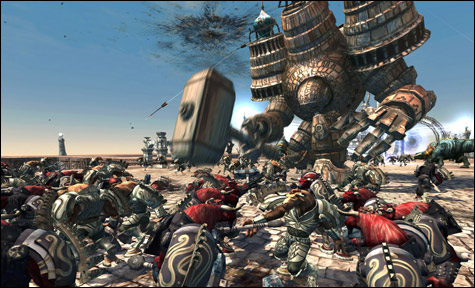
Above: Didn't look like this on my computer, that's for sure.

My review of Demigod is up at thephoenix.com. I'm linking to it here, because that's just a thing that I do, but honestly it's among the worst work I've ever done. I don't recommend reading it. It's not that I don't know better than to review PC games with heavy strategic elements, it's that sometimes there's no other choice. And when that choice gives me minimal time to play a game on a PC that's not up to the task, with multiplayer servers that are fickle at best, well, this is what you get.

So, I'm sorry about that. Some things never change.

Friday, May 01, 2009

Friday afternoon tidbits

I can't remember the last time I've been to a show, but that all changes tonight when the Electric Six comes to town. I have no idea what to expect from those lunatics. Frankly, I'm a little frightened.

-Jeremy Parish has been writing a great series for 1up's RPG blog about Final Fantasy XIII. Everybody who just regurgitates press releases and screenshots ought to look at this series for how to make talking about an upcoming game interesting. Parish brings a lot of knowledge and insight to bear. It's all good, but unfortunately he hasn't tagged the series in a way that would let me link to every part at once. So here, check out part 10, "Sword Beats Gun."

-Important news: You can get Fairway Solitaire for free. Wait, let me amend that. You must get Fairway Solitaire for free. I've written about this game many times before before, and I still play it. It's that good. (h/t Dubious Quality)

-At Offworld, Tom Armitage posted an insightful piece about The Chronicles of Riddick: Escape from Butcher Bay. His main point, which I agree with, is that the game's success is due to its convincing portrayal of its setting and characters as physical entities. Prowling the halls of Butcher Bay as Riddick feels authentic, especially when it comes time to take somebody on in hand-to-hand content. There's heft and weight to Riddick, his surroundings feel sturdy, and the forcefulness of his attacks is surprising.

One more thing I'd note: last year, I was impressed by the physicality of the characters in Far Cry 2, Dead Space, and Mirror's Edge. Riddick beat them to the punch by four years.

-This is awesome. A YouTube user named Underworld23 has posted a ton of classic RPG music, sorted by category: town themes, overworld themes, battle themes, and a lot more. Yes, I spent far too much time listening to these last night.

-I've never read anything more blatantly whorish than Harry Knowles' explanation for why he wouldn't review X-Men Origins: Wolverine. The problem isn't so much that he wasn't planning to write a review. That's his choice. But just read that first paragraph: he recommends that his readers skip the movie, because none of his editors were invited to a press screening! Astonishing.

Further still, Harry says:
I'm more eager to spend my money on a film I do support, which is why I have bought tickets for my third watching of STAR TREK next week, and if I were you - I'd save up to see it twice, rather than have a bad experience this weekend.

Star Trek -- that's the movie that Harry watched at a surprise screening, where he hung out with the film's screenwriters and producer. The one where Leonard Nimoy showed up and his very presence made Harry cry. Look, AICN is a fan site, and it's never really pretended to be anything else. But since we've been talking this week about a lack of scruples in the games press, it's nice to see, at least, that we're not the only ones who deal with it.

Thursday, April 30, 2009

Game stenography

In last Friday's links roundup, cpe said something about Kotaku that I thought was right on the money:
...the best stuff they do gets buried in seconds under the torrent of never-ending, never-important press releases and rumors pulled off NeoGAF. I do wish there was a more granular way to subscribe to Kotaku's RSS feed, at least -- I absolutely do not care about new Red Faction screenshots, but there they are in Google Reader nonetheless.

In Google Reader, I subscribe to a number of video game feeds. Most are smaller, niche blogs that provide original insight and analysis about games new and old. But the majority of posts that pop up in my games folder come from just a handful of big sites, like Kotaku, Joystiq, Game|Life, and Giant Bomb. All these sites do their share of worthwhile, original work, but they're much more likely to all, within moments of one another, start pimping screenshots for some new game.

I don't mean to suggest that I think every site should serve me and only me. cpe and I may agree that new Red Faction screens aren't interesting, but for many people they're probably fascinating. And it's good that anybody looking for screenshots of upcoming games knows where to go. The problem here is who's directing the conversation.

These sites aren't publishing new screenshots and commenting hilariously on bulleted lists of gameplay features because of any editorial decisions on their part. They're doing it because the game publishers have given them the assets and told them when to post them. That's it.

They're not checking to see if the visuals are un-retouched, in-game graphics, or if they're bullshots. They're not putting in the legwork to give their readers new and important information. They are, literally, taking what the publisher gives them, then turning around and giving it to you, without insight or analysis. Instead of acting as gatekeepers, they're the town criers.

To reiterate, I'm not saying that these things shouldn't be made available. And I wouldn't be at all surprised to learn that these kinds of posts generate more traffic than think pieces and originals. But it's discouraging to realize that game publishers are steering the entire conversation, and both readers and writers are happy to let them take the wheel.

Wednesday, April 29, 2009

The chronic-what-cles of Riddick

My review of The Chronicles of Riddick: Assault on Dark Athena is up now at thephoenix.com. I had not had the good fortune to play Escape from Butcher Bay before now, and I think you can tell that I focused on it a little bit more in the review than the new game. Assault on Dark Athena is damn good in its own right, though. I've read a few reviews that seem to think it's weaker than Butcher Bay, which may be true, but it's a little more tightly focused with regards to the stealth element, and, I think, a little more successful on that score. Either way, you can't go wrong with the whole package. Highly recommended.

I want to expand a bit on one point in the review, which I think gets at the real reason why Starbreeze has been so successful with the Riddick games, and with The Darkness. It's simply this: Their plots make sense. You always understand what your character is doing, and why. Riddick has to accomplish fetch missions, but they're not burdened with a bunch of useless filler.

For example, in Butcher Bay, you meet a character named Pope Joe, who will do you a favor if you retrieve his "blessed voice box," which is really a radio. In most games, this would be the perfect opportunity to throw a bunch of enemies at you, toss in some gratuitous puzzles, and make you walk down one identical hallway after another. Instead, you go down a ladder, walk around a corner, blasting some mutants along the way, and there it is. The whole thing takes about two minutes. I seem to recall, when Butcher Bay came out, that the biggest strike against it was its alleged brevity. But it's so well paced, and so smartly designed, that I think the worst thing Starbreeze could have done would be to artificially inflate the playtime.

While playing both Chronicles of Riddick games, I was reminded, yet again, what a marvel The Darkness was. There was a game that clearly conveyed what the stakes were, and what motivations were driving its characters. I can think of few games that progressed so logically, and so tragically, toward a conclusion. The plot wasn't about saving the world or anything like that. It was about two guys who hated each other, and whose aggression escalated beyond all reason. I can think of few games in which I cared so much about what happened to the people in it. Maybe that's the biggest compliment I can give -- that I thought of them as people.

Friday, April 24, 2009

Friday afternoon tidbits

A small milestone to mark: Sometime today, if it hasn't happened already, this blog will serve up its 200,000th page view. That's not a large number by most blogs' standards, but it seems like a big one to me. Thanks for reading.

-It's the best thing I've seen this week -- Matthew Gallant's mash-up of "I'm on a Boat" with Wind Waker:


-News of Stephen Totilo's move to Kotaku seems strange to me, for reasons I haven't quite been able to put my finger on. Kotaku is good, but MTV Multiplayer is often great. While Totilo will unquestionably be reaching a larger audience, which he deserves, I am hoping that he brings Multiplayer's sensibility to Kotaku, and not the other way around. Kyle Orland interviewed Totilo for Crispy Gamer, and he says all the right things. I just hope that Totilo's reporting doesn't get lost in the hourly press-release snarking.

-Critical Distance is a new group blog dedicated to highfalutin' discussion of games. So far it's a mix of original thinkpieces, well considered links, and a brand-new podcast. They've gathered a good collection of writers. Can't wait to see how the site develops over the coming months.

-Finally, I've deleted a couple of comments this week, so I wanted to take a second to discuss this blog's commenting policy. Simply put: I will only delete comments that are pure spam, or that link to something that seems illegal. That's it.

I won't delete comments for disagreeing with me, even if it's vulgar or just plain stupid. I trust that the tone set by me and by the regular commenters here is enough to dissuade people whose only interest is starting a flame war. Comments provide much of a blog's value, especially when the commenters are as passionate and as intelligent as you guys are. I'd rather err on the side of more reader participation, not less.

Thursday, April 23, 2009

Who really holds casual gamers in contempt

Above: Driving a wedge into the puck of friendship.

Despite some attempts to move past it, the "casual vs. hardcore" mindset still seems to hold sway among gamers and publishers. We tend to think of any conflicts between the groups as a result of the provincialism of the hardcore gamer -- the kind of person who wants everyone to value his hobby as highly as he does, but doesn't want to have to share it with them. But really, these are intra-group squabbles. A Halo vet trashing a noob is a case of a hardcore player defending his alpha male status against another member of the same tribe. The prototypical casual player is not the target, any more than a silverback gorilla's chest beating is directed at the orangutan on another continent.

Publishers, though, do seem to hold the casual gamer in contempt. Whenever I play a casual game, I am struck at how little effort seems to have been made to polish and playtest. Case in point: Last weekend, I played the Wii version of Trivial Pursuit with some friends. I'm not here to trash the whole product. Any time trivia questions are being asked, I'm in. And Trivial Pursuit Wii has some nice ideas -- bonus spaces let you compete with opponents heads-up for wedges, timed questions add some competitive intensity, and it ends with a showdown between every player.

The ragged edges concern me. Interaction design is one of the most crucial parts of any video game. Nintendo understands this. That's why the Wii remote is designed the way it is, with one big, friendly button right where your thumb rests. The A button should perform almost every action. In Trivial Pursuit, it performs most of them. Most questions, you answer by pointing your cursor at your choice and hitting A. There's a clear and logical connection between your action and the effect onscreen.

But because Trivial Pursuit introduces a few different question types, the control scheme occasionally changes. For example, you might be asked what year an historical event took place, and be presented a slider representing a 50-year range. Nail the exact year, and earn a full wedge. Come within a few years, and earn a partial wedge. What's the instinctive move here? You're probably thinking that you'll point your cursor at the correct year and press A.

In fact, the game wants you to hold the B button to grab and position the slider, and then hit A to submit your answer. This instruction pops up onscreen the first time the question type appears, but if it's not your turn, it's likely that you aren't paying attention. If you point the cursor and hit A, then you've just answered whatever the initial value was on the answer scale. More than one of us made this same mistake.

Not a huge deal, right? (I'd argue that it's a huge deal when it causes me to lose points, and brilliant design when it happens to others.) Actually, these little interface decisions can have an outsized effect. People who have played lots of games come to have certain expectations of what each button on the controller does. And people who rarely play games can't be bothered to master intricate control schemes because they want to play Trivial Pursuit for an hour. The nexus of player and game is where success or failure happens.

Given that it didn't take much time for us to uncover some of these issues, you have to wonder how much playtesting was done. I get the impression that keeping the production budget low was the number-one prority. And why not? There's no accountability. No one is taking to blogs and message boards with virtual torches and pitchforks when a casual game seems half-finished. When a game directed at the "hardcore" makes a silly design decision, we let the publisher know about it. Sure, we go overboard sometimes, but at least we're enforcing standards. The size of the casual pie keeps growing, but the ingredients are still funky.

Related:

Wednesday, April 22, 2009

Every time I think I'm in, they push me back out

Above: My guy did not look like this.

My review of The Godfather II is up now at thephoenix.com. Let's just say that any game that has to live up to a movie like The Godfather Part II, and tries so desperately to play like Grand Theft Auto IV, is behind the 8-ball from the start.

What I found strange, not having played the first Godfather game, wasn't the big-picture stuff. The strategic level was pretty neat, and even the idea of storming rival fronts was a decent idea, if not exactly new and thrilling. No, the problem with this game was a constant failure to present the little details that matter so much in pulling a player into the game world.

For example, you can't just walk around with your gun out, because people panic. That's a decent idea. But then when you earn bulletproof vests for you and your crew, you can walk around wearing those. You're telling me nobody would find that suspicious? Worse still, the vests look silly, superimposed over the character models in an unnatural way.

There's also a way to communicate with NPCs that's similar to what happens in GTAIV, except this game takes place around 1960, so instead of your cell phone ringing, every single pay phone in the city rings when somebody wants to talk to you. I can't be the only person who struggles with these kinds of things.

It goes on and on. Sometimes you'll see a bunch of people hanging around with the same character models and outfits. If a game is really fun to play, these sorts of things can be forgivable. If it isn't, well, you get a game like this.

One more thing chapped my hide. Not that I want to keep comparing The Godfather II to Grand Theft Auto IV, but they asked for it. One of the best things about GTA was how many different ways there were to accomplish each objective. The designers may have had a particular method in mind, but a clever player could explore almost infinite options. Some of my fondest memories of that game involve improbable escapes, out windows or into the water. I don't think I was supposed to play it that way, but that's why it felt so empowering.

The Godfather constrains you by design. When you're tasked with killing a made man in a rival family, only one method of execution will kill him. Anything else will merely hospitalize him temporarily. If you're supposed to garrote a guy, say, but instead plug him in the face with a sniper rifle, he'll just be back the next day. I'm pretty sure that's stupid.

Friday, April 17, 2009

Friday afternoon tidbits

One of the great things about living in Massachusetts is Patriot's Day, a statewide holiday on the third Monday of April. That's the day they run the Boston Marathon, and most people have the day off to grill meat and watch the race. It's like a dress rehearsal for Memorial Day.

-Six Days in Fallujah is the kind of thing that's usually right in my wheelhouse, but I'm having a difficult time getting my head around it. Nick Breckon's take, posted at Shacknews, does a good job of laying out the concerns. On a gut level, this game strikes me as a bad idea. It seems tasteless at best, and offensive at worst -- maybe not to the Marines, but to the people of Iraq. This game essentially says to them that we see the destruction of their country as entertainment.

Still, I can't answer one simple question: why is it okay to play games that glorify World War II, but not the Iraq War? The sanitized WWII that we see in movies and games is a fiction -- I know that, and it doesn't bother me. If one war is okay and the other is unacceptable only because one happened 70 years ago, that's not, to my mind, a convincing reason. Either it's okay to portray real-life wars in video games, or it isn't. Obviously a game's treatment of its subject will go a long way toward determing that, but Six Days seems, by all accounts, like just another military shooter.

The more I think about this, the more I think that it would be easier to talk myself into rejecting other games based on real-life wars than accepting Six Days in Fallujah.

-Insult Swordfighting went international recently, when it was namechecked on the Australian TV show Good Game. In a segment titled "Digital Essay: Casual vs. Hardcore," host Junglist pondered the divide between certain types of players, and referenced the New Taxonomy of Gamers. You can read the text of the segment, or watch the video (scroll to the "Digital Essay" link in the righthand box). Very cool stuff.

-Matthew Wasteland wrote a very funny bit of satire for Game Developer magazine, which was reprinted on GameSetWatch. It's a collection of Onion-style news briefs (or maybe I should say Hardcasual.net-style news briefs), which begins with the hilarious piece titled "Game Journalist Totally Hung Out with Yuji Naka." You need to read this.

-BJ Stewart wrote to share his website Flakwolf, which is a local game-swapping service. Sounds like a very neat idea, and anything that can replace trading in games at Gamestop is all right by me (he said, with a backpack full of games to trade in for The Chronicles of Riddick). If anyone has tried this service, I'd love to know what your experience was like.

-Finally, don't miss part 2 of Doug Perry's article, "Nintendo's Fall."

Wednesday, April 15, 2009

Brothers in metal

Above: Yes, believe it or not, less horrifying than Video Aerosmith.

My review of Guitar Hero: Metallica is up now at thephoenix.com. If you read last week's Guitar Hero post, then you already know the verdict. It's good. Quite good, in fact. That's why I'm now going to do what I do best: gripe about something insignificant.

Toward the end of the review, I mention one way in which Guitar Hero is still falling short. It still sometimes shows a bias toward a more primitive video game mindset, when it could stand to be more enlightened. Many of Metallica's songs have long, quiet stretches in which guitar is the only instrument to be heard. During these sequences, the programmers have given the drummer the chance to pad his score with drum fills. The fills are scored simply, by assigning one point per hit. That means that the incentive is to wail away on the pads, concerned only with hitting as many of them as quickly as possible. That's fully at odds with what the song is portraying.

My man Clint Hocking might even call it ludonarrative dissonance.

Still, damn good game.

Tuesday, April 14, 2009

Video games: The Twitter timeline

FontaineintheMembrane Free plasmids in Fort Frolic tonite only!!! would u kindly retweet
2 years ago from web

FrankWestPhoto.com http://www.twitpic.com/bhsj3gh #zombies
3 years ago from TweetDeck

InTheNavi @HyperLink HEY! LISTEN!
11 years ago from txt

GetYrGordOn 1) got to office late 2) triggered resonance cascade 3) hev suit is chappin mah nutz #workfail
11 years ago from web

samusiteverwas Killed mom brain. All good. OMG SELF-DESTRUCT WTF?!?!
15 years ago from TwitterFox

OhNoGoGo RT @Locke @Sabin @Terra @Edgar @Celes @Terra @Cyan @Umaro @Gau @Strago @Mog @Relm @Setzer http://www.ultima.com
15 years ago from TweetDeck

b4d_d00d Out with @striker 4 a burger. @RonniePrez is buyin haha
21 years ago from HootSuite

BillofMights Destroyed vile Red Falcon & saved universe. Consider myself a hero. @Lance-a-lot no help.
20 years ago from web

MoltoMario got stood up again... at what point should u finally accept that someone is leading u on...
23 years ago from txt

Friday, April 10, 2009

Friday Afternoon Tidbits

Happy Easter weekend, to all you Christians out there. To the Jews, happy Passover. To everyone else: hey, what's up?

-Have you played 2009's first game of the year candidate, Close Range? Like Tetris, it distills its mechanics to their essence. Compulsively playable, with a gripping storyline told through some of the highest-quality cutscenes since the original Ninja Gaiden.

(Okay, it's actually a satire brought to you by the folks at the Onion. "Incredible!" says IGN. You know what? It's funny because it's true.)

-Longtime game journo Douglass Perry takes a look back at Nintendo's low period, starting with the launch of the N64. It's an excellent read, with a veteran's depth of perspective. Perry, by the way, has started his own blog, GameInsano.com. Glad to have him in the blogosphere, even if it wasn't entirely voluntary.

Story time: When I was in high school, Perry worked for IGN, in particular N64.com, later IGN64.com. The site had a nightly mailbag feature that went up around 9 PM Eastern time. I wrote to them every day, and they published my letters often, which were always signed "Big Mitch Krpata." People wrote letters about me in response. It was a lot of fun.

My finest hour was when the IGN team had a short-story contest, and my winning entry told the tale of Doug Perry getting kidnapped by Kabuki Joe, the much-maligned character from War Gods. They ended up sending me a copy of Quarterback Club 98 for the N64, which even at the time seemed like a boobie prize. But hey, they published my fiction, and so far nobody else has done that, except for Emerson College's literary journal. So thanks, Doug Perry, and welcome to the fold.

-Speaking of traveling back in time, a 30-minute video called "A Visit to id Software" is making the rounds. I mean... times really have changed.

-On a related note, if you miss John Carmack's .plan files, take a look at his story of developing for the iPhone. Maybe it's because I'm not as tuned into the PC gaming scene these days, but I feel like I don't hear much from Carmack anymore. This post makes me wish I did.

No, I'm not going to play Rage when it comes out, I'm sure. Not unless there's an Xbox 360 port in the offing.

-Ben Fritz has a level-headed take on the controversy about alleged DLC being included on the game disc. He's sensible as always, but something about it still feels wrong on a gut level. I mean, you paid for the disc. You own it. The notion of paying more in order to play what's already there is a troubling one. Moreover, one of the things I've always liked about console games is that you buy them, and they work. Everything's there.

Granted, we've come a long way from having to custom-code batch files in order to correctly run the DOS version of TIE Fighter on your PC, but there's still a DIY aspect of PC gaming that I find distasteful, compared to the plug-and-play of a console. But this console generation has done away with that. Now, console publishers ship a game that isn't done, knowing that they can simply issue a patch on launch day. It's great when a publisher or a dev can improve a game that you've already paid for (Burnout Paradise is a great example of this). It's problematic when they use downloadable content as a reason not to ship a completed game.

Another week down the hatch. As always, thank you for reading.

Thursday, April 09, 2009

A brief history of Guitar Hero

It's hard to believe, but Guitar Hero is only a few years old -- closer to 3 years than 4. In that short time, it's changed the landscape of video games. I doubt anybody even thought we needed a pretend-music genre, but here it is, along with Rock Band, luring gamers and non-gamers alike, and raking in billions of dollars in revenue.

The Guitar Hero journey hasn't been all sunshine and rainbows. The brand has grown so quickly that we might have forgotten what it took to get here.

Guitar Hero (2005)

Can you even remember a time when noodling around with a small plastic guitar seemed like a ridiculous thing to do? Seems crazy now, but it's true: people were skeptical of Guitar Hero. The original game was made on a shoestring budget, on an accelerated schedule, and featured only cover versions of its songs. No one knew if it would work -- except, I suspect, the team at Harmonix that put it together. They had to know. Something happened when you picked up that little SG for the first time. It just made sense.

I remember vividly the night I first played Guitar Hero. I wasn't reviewing it. In fact, a staff writer at the paper had written a feature on Harmonix, and didn't want the promo copy they gave her. So she gave it to my roommate at the time, another Phoenix staffer, and he brought it home. We each felt a little silly when we first slung that guitar over our shoulders, but that lasted for about one note. We spent the rest of the night trading off songs, working our way through most of the setlist. It was just as I remember playing games as a kid. We weren't scrutinizing anything. We were just enjoying ourselves, jumping up from the couch as soon as the other person had finished a track.

It was awesome.

Guitar Hero II (2006)

When Guitar Hero II came out a year later, more people were interested. Almost everyone I knew, in fact, wanted to know if I'd be getting it. They offered to help out with the review. And I needed help, because the sequel included a feature that had been sorely lacking from the original: cooperative play. It wasn't much, at the time. One person played the guitar part, and the other person played either the bass or the second guitar. But it added a completely new dimension to the game, presaging the eventual triumph of Rock Band.

Otherwise, the game was a spit and polish. An expanded tracklist and snazzier graphics were welcome, even if nothing else seemed as revolutionary as the co-op. An Xbox 360 port in the spring of 2007 added HD graphics, downloadable content, and a new guitar peripheral.

It was so awesome.

Guitar Hero Encore: Rocks the 80s (2007)

Harmonix's final Guitar Hero had "contractual obligation" written all over it. The idea was decent: to tailor the look and sound solely to one era. The tracklist seemed decent in concept, but few of the songs made the transition to the video-game world intact. Whether it was poor song selection or simply bad execution by Harmonix, none of them provided that rush of nailing a beloved lick perfectly. Even Dio's "Holy Diver" turned out to be a dog. Nothing about this game worked. Clearly, Harmonix's brainspace was occupied by Rock Band, which was to launch a few months later.

It pretty much sucked.


Guitar Hero III: Legends of Rock (2007)

Guitar Hero III marked the official handoff from Harmonix to Neversoft, who previously had been known best for working on the Tony Hawk series, another terrific franchise that was starting to get long in the tooth. Legends of Rock was perfectly playable, and featured the series' strongest track listing to that point -- that is, if you're measuring a song's quality by the popularity of its performers, and not its suitability for a rhythm game.

Legends also made a few critical missteps, which called into question Neversoft's judgment. What had always distinguished the Guitar Hero series in the world of video games was how unlike most other games it seemed. It could be brutally difficult, yes, and demanded much of your hand-eye coordination. But it was accessible in a way that most game genres aren't, and its system of rewards and punishment appealing to non-gamers.

That's why it was so troubling that Neversoft added boss battles, wherein you played dueling guitar parts against Tom Morello, Slash, and even Satan, deploying Mario Kart-style powerups along the way. You can forgive them for trying something new, even if it didn't work, but the battles seemed to violate the spirit that had made Guitar Hero such a phenemoneon. They traded the joy of performance for the capricious challenge of ordinary video games.

It was good, but troubling.

Guitar Hero: On Tour (2008)

Here's where the wheels started falling off. Possibly as the result of a drunken bet, developer Vicarious Visions shipped for Activision a handheld version of Guitar Hero for the Nintendo DS. On one hand, it was sort of impressive that they managed the feat at all. A four-button peripheral plugged into the Game Boy Advance port on the bottom of the DS, and players could strum by scraping a pick-shaped stylus across the screen.

On the other hand -- the hand that you used to press the fret buttons -- the peripheral was painful to use. I mean that literally. 20 minutes of Guitar Hero: On Tour was enough to send shockwaves from my wrist up to my elbow. I recently opted not to click on a link where somebody from the dev team explained how they went through several iterations before settling on the final design of the peripheral. They should have iterated more.

Even more painful: the tracklist included songs by Maroon 5 and Smash Mouth.

Holy shit was it bad.

Guitar Hero: Aerosmith (2008)

The Aerosmith edition of Guitar Hero was weak sauce for a couple of reasons: one, because Aerosmith is a lousy band, and two, because the paltry tracklist couldn't make up for their terribleness even with a couple of other decent cuts. Plus, Video Steven Tyler was somehow even more horrifying to behold than Actual Steven Tyler. That's no mean feat.

The real problem with Guitar Hero: Aerosmith, though, was that it came out a good 6 months after Rock Band, and a guitar-only music game no longer seemed sufficient. Where were the drums? The vocals? The robust multiplayer that, thanks to Harmonix's new game, had come to define music and rhythm games? Aerosmith seemed like a cash-in at best.

It was terrible.

Guitar Hero: World Tour (2008)

World Tour showcased the best and the worst of what had become of the Guitar Hero brand. Activision's deep pockets ensured another monster set list, including Ozzy's "Crazy Train," which really should have been in Guitar Hero from the beginning. World Tour got on board with what Rock Band was doing, with its own drum and vocal parts, and then did the competition one better by adding a create-a-song feature (which may have been better in theory than in actuality). Neversoft still seemed to lack Harmonix's instinctual understanding of how to construct a note charts, and even their ability to nail the feel of the music, but overall it was a decent time.

It was all right, but the drum kit didn't work very well.

Guitar Hero: Metallica (2009)

This may be the point at which Neversoft has reached equilibrium. Metallica is not, on the surface, much different from the Aerosmith edition, except for the all-important support for a four-piece band. But it's much better, and for a simple reason. It's the inverse of the "Garbage In, Garbage Out" principle: this tracklist is sweet.

The songs cover the breadth of Metallica's career, from their early thrash metal to the soulful power ballads of the black album. (And, yes, the band's entire 1996-2009 output is also well represented. I avoided it then, and I'm avoiding now.) The non-Metallica tracks are up to that standard, as well. Alice in Chains, Mastodon, Queen, Slayer, Thin Lizzy -- there's a range of styles and eras on offer, and all sterling examples of their type.

I still prefer Rock Band, for a couple of reasons. For one thing, when MTV released an AC/DC track pack, they also allowed you export the songs to your hard drive and play them in Rock Band proper. Harmonix's game still feels better to me, devoid of extraneous graphical flourishes and attempts to sex up the act of matching notes onscreen. But Metallica is probably the best Guitar Hero product to come down the pike at least since Legends of Rock, if not Guitar Hero II.

It's good! But maybe they ought to quit while they're ahead.

Related:

Wednesday, April 08, 2009

Short, still a little sweet

Above: The whole game, pretty much.

If you needed more evidence that I lack principles, I invite you to read my review of Wanted: Weapons of Fate at thephoenix.com. I believe I've said on at least one podcast that I don't care what a game costs, and this review clearly puts the lie to that claim. But come on: $60 for a 4-hour game? I would be ripshit if I had paid that much money for this.

It's always a little bit tricky to translate the review in the paper (x.x out of 10) to the review online (1-4 stars). The web version goes with 2 stars, which sounds about right. In the paper, I gave it a 5.5 out of 10. Go ahead and add half a point for every $10 this game drops in price. At $20, I'd give it a solid 7.5. That's a recommendation in my book.

Friday, April 03, 2009

Friday afternoon tidbits

There's so much great reading this week, I can't even come up with an introductory paragraph! Let's just get right to it.

-Simon Parkin, one of the class of superb British game journos working right now, wrote an excellent piece about the thought process that goes into a game review. The takeaway, with which I wholeheartedly agree, is that it would be possible for an honest reviewer to write both a positive and a negative review of the same game. In my experience, most games have good and bad traits that are worthy of discussion. But I've never seen the point of including the token complaint in a review of a game that you otherwise love. Who cares if the merchant's voice gets annoying in Resident Evil 4? Part of being a good critic is remembering why you love games in the first place.

-Jeremy Parish has penned the first reasonable look at GoldenEye 64 that I think I've ever seen. The nut: "...what made GoldenEye so good was a fleeting, transient quality that can never be grasped again: it's not that the game was especially brilliant by modern standards, but rather that it utterly eclipsed its contemporaries." I've been trying to say this for years, but people get really angry when they hear it. I don't mean it to sound as dismissive as it does, but when GoldenEye hit, I was deep into Quake, and GoldenEye didn't seem to come close. I had good times with it. It was definitely the best console shooter around. But it just couldn't compare to what was happening on the PC at the time, not on any level. I think the reason why it's so beloved is because most people didn't have that frame of reference.

(I feel like Ed Borden right now.)

-Clive Thompson is talking about The Maw when he praises short games, but he could almost be talking about Wanted: Weapons of Fate. The difference, of course, is that one is a $10 downloadable title, while the other is selling for $60 and is being pitched as a blockbuster. Still, I agree with his central point. Nobody walks out of a four-hour movie feeling like they got their money's worth, or poo-poos The Great Gatsby because it's too short. Only video games have to deal with Consumer Reports-style criticism. It should stop.

By the way, I capped off my Wanted review with some Consumer Reports-style criticism.

-I'd like to get my hands on a copy of the current Game Developer magazine, which features a Far Cry 2 postmorterm with CLINT HOCKING. I can think of few games that deserve such treatment more. In the meantime, GameSetWatch ran a condensed version, which is illuminating in its own right.

-But L.B. Jeffries wrote an even better critical analysis of Far Cry 2 for PopMatters. It's great. Read it.

-Iroquois Pliskin shared his experience at CLINT HOCKING's presentation at GDC. (Hocking, by the way, has conveniently posted his slides online for your viewing pleasure. I hope to get to it myself in the near future). Far Cry 2 was a game that succeeded on more than one level. Iroquois comes as close as anyone to explaining why the gameplay was so great when he says "
the developers found that the game was at its best when the players carefully-laid-out plans went haywire and they were forced to reformulate a strategy on the fly."

It's so true. One of the best dynamics about the game was how you'd spend 10 minutes scouting a compound, stalking through the tall grass like a lion, and map out in your head exactly how the assault was going to go. That always lasted about five seconds, until a weapon misfired, or something blew up and you caught on fire, or some dude drove up behind you in a Jeep. One of my fondest FC2 memories was taking aim at a fuel tanker with a rocket launcher, feeling very satisfied with myself, only to watch the rocket flop onto the grass a few feet in front of me, sputtering like a Fourth of July sparkler. I kind of had to improvise after that.

Like Iroquois says, you had to be there.

Thursday, April 02, 2009

Gamestop.com User-Submitted Previews: The Chronicles of Riddick

Above: Vin thinks these commenters are riddick-ulous!

I am excited about next week's release of The Chronicles of Riddick: Assault on Dark Athena, and not just because I can't resist Vin Diesel's smooth, gleaming scalp. Starbreeze earned a lifetime pass from me with The Darkness, one of my favorite games of 2007, and one of the few video games that ever truly moved me. Whatever they do next, I'm into it. But do the commenters at Gamestop.com agree?

"RedCell Lives!" gets things started with this dispatch from Bizarro World:
I mean, if it's as awesome as the 3rd and final movie in the trilogy it'll be amazing, I mean it's freaking Riddick, but if its like escape from butcher bay (Terrible Game) then i'll be disappointed, because I would really like to c a great game about one of the most amazing Psychotic killers of the movie genre.

Not to form an opinion before I even play the game, but I have this sneaking suspicion that Assault on Dark Athena will, somehow, top the non-existent third Riddick movie. Unless RedCell Lives! is making the ironic comment that even nothing would be better than another game like Escape from Butcher Bay, in which case don't I feel dumb. (And not to form an opinion about another game I haven't played, but "terrible?" Really?)

(Italics!)

"A Customer" is often wrong but never in doubt:

...at first I saw that there was going to be a new riddick game then I saw it is being published and developed by Atari...so The Chronicles of Riddick: Assault on Dark Athena will probably be nothing like The Chronicles of Riddick: Escape from Butcher's Bay..why you ask? The latter was developed by Vivendi Universal and published by Microsoft. Such a shame to see a great title like Riddick be sold off to the highest bidder.

Usually these previews are chock full of people's better judgment getting overwhelmed by their enthusiasm. But this is different. These guys are just making shit up. I haven't seen anybody lie with so much confidence since Bill Kristol had a column in The New York Times.

Alternate endings to the sentence "I haven't seen anybody lie with so much confidence since __________":

  • Colin Powell's presentation to the UN about Iraqi WMDs.
  • Denis Dyack posted about Too Human on NeoGAF.
  • I explained to my wife that spending all my free time writing a blog about video games was a sure path to financial freedom.

"Master Ninja 84" provides some semblance of normalcy:

Before i played the original on xbox, I never heard of Starbreeze. Now, after that game and The Darkness to me personally they are a household name. I'm always impressed with what these guys do, and will always be impressed. To put it simply (too late), I can' t wait for this game to be released on the masses. Once again, the guys at Starbreeze are proving to us again why their games are always worth the wait.

Okay, I have a confession: I am Master Ninja 84. I can't wait until Starbreeze releases this game all over me.

"Newnew008" feels the same way:

This is a really great game gonna pre-order right now. If you haven't already seen the demo for this on xbox live you NEED to check it out this will be in my top 10 for 2009 i just know it. Only thing to do now is. wait for release :(

I'm told the release is more satisfying if you make yourself wait for it. Doing math problems in your head might do the trick.

Sometimes it takes a Gamestop.com user to cut through the bullshit. This time it's "starking," who knows exactly what the people want:

i loved the movie and this is definitely going to be one of the most action packed head bashing games of all time.... i mean come on... shoving a tea cup into a guys head is pretty freaking awesome.....

As always, there's nothing else I could say.

Wednesday, April 01, 2009

Kind of funny, kind of sad

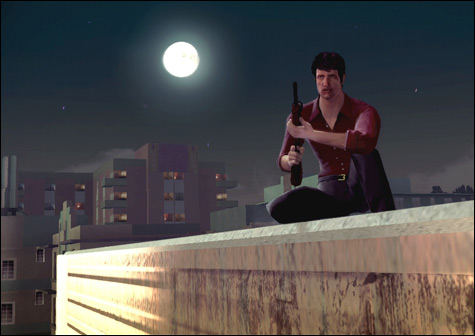
Above: The dreams in which I'm killin' are the best I've ever had.

My review of MadWorld is up now at thephoenix.com. I predict this one will not attract as many literate comments as the Resident Evil 5 review did. (By the way, defcon, wherever you are, I appreciate your efforts.)

I don't know if anybody else feels this way, but over the past five years I've played so many video games that they've all started to blend together. Any time something comes along that seems new or different, I'm interested. Even if, in the case of MadWorld, the gameplay really isn't that new or different -- just the packaging is.

As a beat-em-up, it's not much to write home about: it's fairly easy, the enemies mostly stand around waiting to be slaughtered, and the lock-on targeting system is awful. As for the promised buffet of sumptuous murder options, well, it's there, but mostly you just slam people into spikes over and over again.

MadWorld was developed by Platinum Games, the reconstituted Clover Studio. They're the same people who made Okami, my 2006 game of the year, and God Hand, the campy brawler that was either way beneath me or way above me. (I didn't play any of the Viewtiful Joe games.) MadWorld shares some traits of both games. It's more immediately playable than God Hand, and shares the same attitude and sense of humor. And it's got the striking aesthetic of Okami, without, let's say, any of that game's considerable virtues.

Still, there's a lot to like here. I'm a little surprised I haven't yet read raves of it. This seems destined to gain a cult following. Maybe the swift dismissal would be to say that we already played a satirical, lowbrow adventure game on the Wii, when it was called No More Heroes. Which wouldn't be totally unfair. But it could be taken as a compliment.

Related: The Sega strategy