Showing posts with label PlayStation 2. Show all posts

Wednesday, December 23, 2009

Games of the decade: Rock Band

Part of a series of subjective looks at my favorite games of the decade.


Rock Band
(2007, Xbox 360, PlayStation 2, and PlayStation 3; 2008, Wii)

Rock Band 2
(2008, Xbox 360, PlayStation 2, PlayStation 3, and Wii)

Forget the Wii. For mass appeal, nothing beats Rock Band. And it's got longevity, too, thanks to a forward-thinking business model that ensures several new tracks to download every week. Rock Band is so interesting from a technical and business standpoint that it would be easy to forget to mention the real reason it's such a phenomenon: it's the most fun freaking thing in the world.

Look, Guitar Hero was incredible. I will never forget what it felt like the first time I played that game. That's not the same sensation I got when I first tried Rock Band, where I knew what to expect. But Rock Band has so much more to offer. The satisfaction of reaching expert difficulty on the drums was much deeper than it was for guitar, because, damn it, it really was like playing the drums! The singing component opened the game up to players who felt uncomfortable trying to handle the game controllers, even as user-friendly as they were.

And the tracklists are just great. Money talks, and the massive commercial success of Guitar Hero paved the way for more songs and more master tracks. Here's another place where Rock Band and Guitar Hero diverge: while GH pursued chart-toppers, Rock Band went for quality, showing what Iroquois Pliskin called "a curatorial esteem for musicianship above other factors." I have gotten into more new bands thanks to Rock Band than at any time since college. The game has made me appreciate classic bands I'd overlooked, while introducing me to current artists I might never have heard of.

More important, it has made me a more active listener of music. Used to be that I mostly heard whatever was more prominent in the mix, the singer's voice or a guitar solo. Now I can pick out bass lines, and understand drum parts. In the course of listening to a song I can dissect it and put it back together again. This is an ability I've never had before. When I hear people warning that music games are eroding our appreciation of music, I have to laugh. It's exactly the opposite.

More on Rock Band:

Monday, December 21, 2009

Games of the decade: Prince of Persia: The Sands of Time

Part of a series of subjective looks at my favorite games of the decade.


Prince of Persia: The Sands of Time
(2003, PlayStation 2, Xbox, GameCube, and PC)

I can't be sure, but I think Prince of Persia: The Sands of Time was the last game I played without the aim of writing about it. There may have been others, but it was right near the end. It was definitely the last game I fell in love with and played repeatedly, content not to rush on to the next big thing (or not so big thing).

A common theme on this list, among the games predating 2004, are games I got for Christmas, because that was the way I got them for the first part of the decade. This was no different. In 2003, I remember seeing TV commercials for two games: this, and Castlevania: Lament of Innocence. When either ad came on, I'd comment about wanting to play them, but when Christmastime arrived and my girlfriend handed me a suspiciously game-shaped box, I found myself desperately hoping it would be Prince of Persia and not Castlevania. I'm not sure why. I don't think I'd read any reviews. I'd been a Castlevania fan in the past, especially Super Castlevania IV and Symphony of the Night, but held no particular affinity for anything PoP. Still, when I unwrapped that gift and saw a sword-wielding Prince leaping out at me, I felt relief more than anything.

As I delved into the game, my relief turned quickly to excitement. Sands of Time is nominally similar to Tomb Raider, a franchise I have never liked because of its unforgiving and slow-paced platforming, but it solves every problem that Tomb Raider had, including some I didn't realize existed. The acrobatic Prince performs one impossible stunt after another, and the beauty of the game is that you don't often have to stop and line up your next move exactly right. Using only two buttons, you can wall-run over a gap, then spring onto a bar, flip around it once before leaping to a pole, then shimmy up it and disembark for a perfect landing, all in one smooth and unbroken sequence. Navigating the game's physical space is thrilling. I had never felt such freedom of movement in a game before.

Smarter still is that magical sand. I can't believe it took until 2003 for somebody to come up with the idea to let you rewind upon making a mistake. There's no such thing as a cheap death in this game. Instead, you learn what you've done wrong and can immediately correct it. That doesn't make the game too easy or simplistic. It makes it fun.

The sand is the linchpin of a surprisingly powerful story. From the beginning, the game is cast as a flashback, with the Prince narrating his incredible story to someone whose identity we don't learn until the end. The writing is fantastic, and so is the acting. Yuri Lowenthal, as the Prince, strikes exactly the right note of raffish charm. His sarcastic asides to himself as he progresses through the game are funny, and his gradual acceptance of responsibility for having unleashed the Sands of Time is both believable and affecting.

(Why Lowenthal was replaced in Warrior Within by some generic gravelly voiced dude, I have no idea. Nolan North did all right in last year's Prince of Persia by playing, as he always does, Nolan North, but Lowenthal is the definitive Prince.)

It's the game's finale that pulls the rug out from under you. Throughout the game, the Prince has been slowly developing a relationship with the Princess Farah, at the end of which they are well and truly in love. Standard stuff. Then, after the Prince topples the evil Vizier and rewinds time, back to before the Sands destroyed everything, it's as though they've never met. When we realize that the Prince has been talking to Farah all along, and not to us, it is a perfect storytelling moment: funny, surprising, achingly romantic. I don't remember if Farah falls in love with the Prince after that, but I did.

Saturday, December 19, 2009

Games of the decade: Final Fantasy X

Part of a series of subjective looks at my favorite games of the decade.


Final Fantasy X
(2001, PlayStation 2)

When I played Final Fantasy X, the earth moved. I mean that literally.

In the spring of 2002, I was itching for a new game. I'd played Grand Theft Auto III to completion, had maxed out my Tony Hawk skills, and, after three agonizing months of one brief and unsatisfying play session after another, I'd finally beaten Metal Gear Solid 2. Being broke at the time, it was important to me to buy something that I could sink some serious hours into, and get my money's worth. FFX seemed to fit the bill, but I was hesitant.

I'd tried and failed to get into some Final Fantasy games in the past. When we were kids, my brother and I had made it as far as the Earth Fiend in the original game before giving up. I sailed right through the SNES era. In high school, I borrowed Final Fantasy VII from a friend and made it as far as the world map before declaring the game boring and dumb. A breakthrough came during my sophomore year of college when, in an attempt to avoid doing anything productive, I downloaded an NES emulator and a Final Fantasy ROM. With the emulator running in one window, and a walkthrough open in another, I breezed my way through the game, gradually learning the systems and tactics that had eluded me in previous attempts. This led to some all-night play sessions, after which I would arrive to class, bleary-eyed, and try to follow along with some lecture about Jane Austen.

So Final Fantasy X was a bit of a gamble, but when you've got nothing, you've got nothing to lose. From the unexpectedly sad piano overture, I was hooked. This game wore its heart on its sleeve, and while that seems silly now, at the time I could relate to Tidus's feelings of alienation and angst. Even his whiny voice didn't bother me.

And while I've read plenty of complaints about this game from RPG purists, I loved all the things they hated. I was glad that most of the game was on rails, or close to it, so that it kept me moving. The sphere grid was a simple way to seem like I had control over my character builds, without really giving me too many options. And the storyline, in all its silly and melodramatic glory, connected with me.

One Friday night, I settled in for a long play session starting around 10 o'clock. At almost 7 the next morning, the bed shifted beneath me. From somewhere in my dorm, an old building in Boston's Back Bay, I heard a loud crack. For a few seconds, everything was wobbling ever so slightly. I was so tired from a nine-hour play session that I thought I must have been hallucinating. Next to my TV was a tall and rickety CD tower. I rubbed my eyes. It was swaying back and forth like a drunk person.

Sometimes you play the right game at the right time. If not for Final Fantasy X, I never would have been awake at the time. That's not all I have to thank it for. Although I never became a full-bore RPG guy, that was the springboard to successful playthroughs of Final Fantasy VI, Final Fantasy VII, and Chrono Trigger -- all great games in their own rights. And it reminded me that games do have the capacity to make you feel something, even if it's a 5.1 magnitude earthquake.

Friday, December 18, 2009

Games of the decade: Okami

Part of a series of subjective looks at my favorite games of the decade.


Okami
(2006, PlayStation 2; 2008, Wii)

I have a hard time talking about Okami without sounding mushy. This is, after all, a game where you play as a god who takes the form of a white wolf in order to defend nature. If you're going to extol the virtues of a game in which you feed woodland animals, cause trees to bloom, and shrink to microscopic size to fight germs, then you are naturally going to come off like somebody who wears sweaters with images of kittens knitted on them.

Well, I don't care. I love this game. I love everything about it (okay, everything except for Issun's chattering). I love how unapologetically Eastern its philosophy is. I love how gentle it is, even as it pits Amaterasu against some pretty funky demonic foes. I love that it looks like a watercolor painting on rough parchment. I love that it's a game about life and regeneration rather than death and destruction. When I think about Okami, I feel like somebody's hugging me.

You could certainly point to some flaws: Issun's voice, button-mashing combat, three identical battles against Orochi. But though these are the things that make up the skeleton of the game, the meat of it is traveling across the massive gameworld, bringing a blighted land back to life with the power of your celestial brush. The brush is an inspired bit of design. Bringing it up freezes the action onscreen, whereupon it seems to tilt away from the screen, as though it's just paper wrapped around a wooden block. With a simple brushstroke, godlike, you alter the world in dramatic ways. You complete a broken bridge, or summon the sun, or strike at foes. The celestial brush ties everything together. (Although the Wii seemed like a perfect fit for this, I actually preferred using the brush with the PS2 controller).

Okami can most closely be compared to the Zelda series, but for my money it blows away any of the 3D Zelda games, which have been repeating themselves for over a decade now, and which always balance brilliance with boneheadness.* It lets us explore a rich and beautiful world, and to make that world even more rich and beautiful. It has humor and heart. It turns cranky critics into big ol' softies, who will surely regret this post in the morning.

*No, I'm not prepared to back this up right at the moment.

More on Okami:

Thursday, December 17, 2009

Games of the decade: Burnout 3: Takedown

Part of a series of subjective looks at my favorite games of the decade.


Burnout 3: Takedown
(2004, PlayStation 2 and Xbox)

One of the first games I reviewed for the Phoenix was Burnout 3: Takedown (ignore the dateline; it actually went up in the late summer of 2004). It was also the first time I would experience what is, hands down, the worst part of this job: having to immediately move on from a great game to whatever the hell is next. Since I had rented the game from Blockbuster rather than get a review copy, I couldn't even run a race or three in my spare time. For the next three months, I kept talking about how great Burnout had been, and how much I wished I was playing Burnout right now.

Providing me with yet another reason to eventually marry her, or maybe just to shut me up, my girlfriend got me Burnout 3 for Christmas. Since then, circumstances have evolved to the point where the last thing I need for Christmas is another video game, but at the time it was the best present I could have gotten. I poured myself into that game, playing for hours at a time. I've come to think it's the best racing game I've ever played. It has everything: the dizzying speed of F-Zero, the intuitive handling of Daytona, the over-the-top carnage of Twisted Metal. Spectacular, clear graphics. Tons of tracks. Numerous game modes. On and on.

The inclusion of aftertouch control, which lets you steer the flaming wreckage of your car into the paths of oncoming racers for a takedown, is one of the smartest game design decisions I've ever seen. It transforms crashes from a simple failure state into an integral part of the gameplay. Between the speed and the road rage, it's very easy to crash in this game, but it's almost never annoying, because aftertouch keeps the race moving forward. That's important.

Everything here is about making you go faster. You won't win without using boost, and you earn boost by doing the craziest stuff imaginable, like going off jumps, drifting, driving in the oncoming lanes, and, yes, using boost. But nothing fills your boost meter like a takedown, and forcing your opponents to crash is one of those game mechanics that works absolutely perfectly. You can tell when your momentum will bulldoze somebody off the road, or when you'll need to duel for a good quarter-mile or so until somebody gets the upper hand.

When you do take someone down, the camera angle cuts to a Matrix-style slow-motion shot of their destruction, before returning you to your car, still racing the course at top speed. How does this work? Why do the takedowns seem fresh and exciting every time, without ever growing repetitive? How is it that you're never disoriented when you're back behind the wheel? As with how many licks it takes to get to the center of a Tootsie pop, the world may never know.

More on Burnout:

Sunday, December 13, 2009

Games of the decade: God of War

Part of a series of subjective looks at my favorite games of the decade.


God of War
(2005, PlayStation 2)

God of War II
(2007, PlayStation 2)

God of War was one of those games I missed out on the first time around, only to pick it up for $20 a year later and feel dumb for having waited so long (but not, it should be said, for saving $30). My memories of the game are actually a bit hazy, because I was drugged out of my mind at the time. I'd gotten my wisdom teeth out, and with several days in front of me with nothing to do, playing a video game seemed like a great idea. Well, it was, and it wasn't.

On one hand, God of War is trippy enough visually that you don't need the aid of powerful painkillers, but it certainly doesn't hurt. Massive boss fights, especially the opening battle against the Hydra, set a standard for PlayStation 2 visuals that were never surpassed, except possibly by the sequel. Your standard fights were hectic, button-mashing affairs, with tons of enemies onscreen at all times, and seamlessly integrated quicktime events, in which Kratos dished out his most brutal punishment. And the environments were terrific, especially the descent into Hades, which looked agonizingly painful.

On the other hand, God of War is an extremely difficult game, especially during certain platforming segments, and when you're not in full possession of your faculties, trying to walk on a spiky, rotating log across a pit of fire is not the easiest thing to do. You would think, given my incapacitated state, mouth stuffed with gauze and all, that I would not have been able to scream and swear and throw my controller. You would be wrong.

Often I hear people talking about a game that is difficult but fair, and rewarding when you beat it. It's something I appreciate in theory but have a hard time dealing with in practice. God of War is as close as it gets, though. It's not insurmountable, although I do seem to recall accepting an offer to dial down the difficulty. And it has a great story, with a character whose actions mesh with his personality, unlike the genocidal everymen who populate so many action games.

God of War II I played stone-cold sober, and I loved it, although by that time I was starting to wish the game would stop sealing me into rooms with dozens upon dozens of enemies. Hopefully God of War III keeps things moving more briskly, or I might be in the market for some percocets.

More on God of War:

Friday, December 11, 2009

Games of the decade: Tony Hawk's Pro Skater 3

Part of a series of subjective looks at my favorite games of the decade.


Tony Hawk's Pro Skater 3
(2001, PlayStation, PlayStation 2, GameCube; 2002, Xbox, PC)

I got the PS2 for Christmas of 2001, and with it I received two games I would have given my eyeteeth to play. One was Metal Gear Solid 2: Sons of Liberty, the sequel to what, at the time, I would have called a top-five game of all time. The other was a game you may have heard of, Grand Theft Auto III, which at the time seemed like it might topple breathing as the most important thing you'd do all day. Yes, I was excited to play these games. I was ready to spend my semester break obsessing over them.

I had also gotten a Best Buy gift certificate, and picked up this Tony Hawk thing I'd heard was good, because I thought it would be nice to have a casual game I could use to cool down between intense MGS and GTA sessions. You can guess where this is going.

Neither Metal Gear Solid 2 nor Grand Theft Auto III is on this list. The former, because it was a big sloppy mess -- and, yes, I will be the fanboy who's still upset that you spend 90% of the game not playing as Snake. Beyond that, the storyline seemed to invalidate everything I had done in the original game, which I took as a personal insult, and which had the unfortunate consequence of making me like that game a little less, too. GTA was great, fantastic, and I admire it for many reasons, but ultimately it's not a game I connected with on a gut level, as with the rest of the games on this list.

So how did it go with Tony Hawk's Pro Skater 3? Well, within days of having bought it, I was playing all-night sessions that passed in the blink of an eye. I remember well that I had to leave to go to Maine for New Year's around 10 in the morning. Close to 2 AM, I started thinking about turning the system off, after I got one more high score. At about 9:30, I finally turned it off, not by choice, but because my ride was en route.

Games just don't get more addictive than this. It's rare that something which succeeds as pure gameplay breaks through to me -- usually I need some underlying reason to be doing what I'm doing -- but when it does, it's all-consuming. Improving at this game was secondary to the fun of simply playing it. Grinding rails, getting air, even just a simple invert to manual -- it all feels just right. It's sad to see what the franchise has become, grasping at lame gimmicks while the more sim-like Skate series blows right past it. We're missing something this arcade-like, this silly, and this expertly produced. It's ironic that today I think of Neversoft as the company that ruined Guitar Hero, because in its way THPS3 is every bit as compelling.

It was also the scene of one of my greatest triumphs in gaming, better than the 89-second Expert clearance in Minesweeper, and almost as good as beating Contra without dying. In the airport level, I eventually was able to start a combo right at the start of the board, with an ollie onto a ticket counter, and keep it going with a variety of grinds and manuals down the escalators, through the metal detectors, and into the baggage claim, where I did a special grind on the carousel over 24 times, for a total score well in the millions. I'm sure in the scheme of things this is not so impressive, but at the time I felt like the kid in The Wizard.

Tuesday, December 08, 2009

Games of the decade: Ico

Part of a series of subjective looks at my favorite games of the decade.


Ico
(2001, PlayStation 2)

I came to Ico late in the game. I remember seeing it in stores when it was first available, and being vaguely aware that the reviews were good, but the cover was boring and there were more exciting things to buy. By the time I realized that I might have missed something special, it was no longer available new. I bought a used copy for $20, finally getting around to playing it in a single sitting in 2006 or 2007. I had already played Shadow of the Colossus, so I expected great things. I was not disappointed.

Ico is a great example of the "less is more" philosophy of game design. I'm not referring to its length, but to the simple list of commands that you can give to your character, and the extent to which it wrings so much drama and emotion from so little. The setting, a massive, windswept castle, is lonely and intimidating. It doesn't need fire pits and rotating platforms when a simple fall down a sewage pipe will do. The platforming is more about exploring than about facing danger, although there is plenty of that, too. Despite the presence of scary smoke guys, and then a final boss battle, the castle itself is the foe. It's a character, every bit as much as Ico or Yorda.

And the simple interaction between Ico and Yorda tells an entire story without words. She is so helpless, but because she doesn't complain or incessantly call out to him for help, she avoids coming off as annoying, as characters in escort missions so often do. She cuts a quiet and tragic figure. Although Ico is ultimately a heroic tale, it is more simply a parable about the tragedy of loneliness and the necessity of human connection. It's beautiful.

More on Ico:

Thursday, December 03, 2009

Games of the decade: Bully

Part of a series of subjective looks at my favorite games of the decade.


Bully
(2006, PlayStation 2; 2008, Xbox 360 and Wii)


Almost every Rockstar Games release attracts its share of controversy, but rarely have the company's critics played into its hands quite like they did with Bully. The horror, they cried, clutching their pearls. What sort of monsters would create a Columbine simulator, which is obviously what this game would be, since apparently it was set in a school of some sort? These critics didn't know what Bully was, and they certainly didn't care. They just knew that the evil people behind Grand Theft Auto were at it again.

Bully does share structural similarities with GTA, as well as that game's fascination with the underbelly of respectable society, but thematically it's more mature and thoughtful than any GTA game. It's about the soul-deadening effects of conformity, and the perils of blindly following authority. In Bully, it's not the snot-nosed kit who lights bags of his own crap on fire that's the problem, it's the entrenched administration and their lackeys in the student body. In a sense, Bully warns against following exactly the sort of people who would seek to ban a video game without even knowing what it is.

Credit also has to go to the design of Bullworth Academy, and a storyline that follows the course of a normal school year. I enjoyed the way holiday decorations went up and came down as the story progressed, and how friendships and alliances were formed and broken as the semesters went on. The school years used to seem so long while they were happening. Now I can't tell one month from the next. Bully captures that feeling of school as a battle, both literal and metaphorical. Where's the sequel?

Thursday, July 30, 2009

The Bigs 2 comes up small

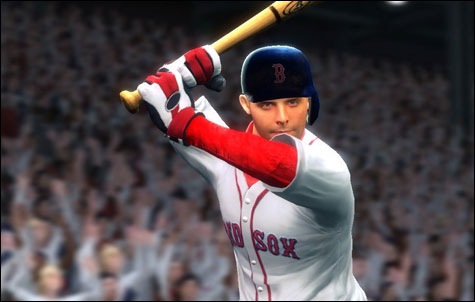
Above: Dustin Pedroia, looking somehow even less human than usual.

My review of The Bigs 2 is up now at thephoenix.com.

I am by no means an expert on sports games. The reason I wanted to play The Bigs 2 is that I expected it to be unlike most sports games. And it is, to some degree, but a big part of the reason I didn't like it turned out to be the extent to which it betrayed the game of baseball.

In my life, I've been fortunate to attend a couple of significant baseball games. My favorite memory is game 3 of the 2003 ALDS, the Boston Red Sox against the Oakland Athletics. The Sox had dropped the first two games in Oakland, and were facing elimination at home. After the game went into extra innings, the Red Sox brought in pinch-hitter Trot Nixon, a fan favorite and a lefty who'd been on the bench to start the game. Trot launched the game-winning bomb into the center-field seats. You know what, I could almost feel the shockwave from that blast.

The Bigs 2 does a good job of rendering that type of thing. When a "big blast" home run bursts into flame, streaks across the sky like a comet, smashes into a building, and shatters all the windows, I'd say that's faithful to the spirit of the sport. It's exaggerated and cartoonish, sure, but it captures something true about the way a game-changing home run feels. It takes something real and pushes it to the extreme.

Most of the rest of the game does not do this, usually for less obvious reasons. The fielding animations are just terrible -- there are hardly any of them, and the transition from a fielder's picking up the ball and actually throwing it is cumbersome. Fielding at all is bizarrely difficult, because your fielders stop running well before you have a chance to tell where the ball is in relation to them. These fielders are actually slower than their real-life counterparts.

As for the mini-games that mark every dramatic catch, they're not only insanely difficult (for you, not for the computer), but they bear no resemblance to what the player onscreen is actually doing. It's as though another game entirely parachuted in for just those sequences.

Batting is a little weird too. I understand that the pace needs to be quicker than in a faithful sim. Yet I can't really understand why The Bigs 2 punishes you for taking a pitch. If you see a pitch coming that's not in your batter's wheelhouse, you'd think the smart move would be take the strike. But doing so fills up the other team's turbo meter, so you have to just flail away at every throw. That's stupid. In all the time I spent with this game -- which, I'll grant you, was not a lifetime, because I disliked it so much -- I never once saw a batter walk.

I mentioned this in the review, but perhaps not strongly enough: I hate, hate, hate the way this game portrays the players. To a man, they are depicted as mean, joyless, roided-up idiots. When the art isn't inadvertently comic (Jonathan Papelbon's head looks like Charlie Brown's), it's just frightening (Joe Mauer does not, in real life, walk around looking like he's spoiling for a fight). I'm only half-joking in the review when I say they should have made J.D. Drew into a literal robot. A great way to make a cartoon-like baseball game that still showed love and respect for the sport would have been to try to represent the players' personalities in an outlandish way.

But that's not what The Bigs 2 is about. It's about turning baseball into just another violent, stupid, adolescent power trip.

(Did I just do the thing where the blog post is more interesting than the published review?)

Tuesday, June 30, 2009

Breakdown

I'll not bore you with the details of my PlayStation 3's long, grueling journey toward health, except to note that I still haven't sent it in yet. This is going to take awhile.

I was in the middle of griping to myself about how they just don't make consoles like they used to, when I realized that hardware failures are just a fact of life. The Xbox 360 has gotten all the bad press, but my systems have historically had about a 50% failure rate, no matter who made them. A look back:

Console: Atari 2600
Year Acquired: 1984 (?)
Serviced or Replaced: No.
Diagnosis: A solid performer, although we never touched the damn thing once we got the NES, so who knows how long it might have lasted.

Console: Nintendo Entertainment System
Year Acquired: 1988
Serviced or Replaced: Replaced.
Reason: I can't recall the specific reason why our original NES bit the dust after only a couple years of service. It must have been that warranty-busting Game Genie. Damn you, Galoob!

Console: Sega Genesis
Year Acquired: 1992
Serviced or Replaced: No.
Diagnosis: The first star performer of any console I ever had. As of the last time I plugged it in, probably 2004 or so, it still worked. Can't say the same for the controllers, though. It's hard to play NBA Jam when you can't shoot.

Console: 32X
Year Acquired: 1994
Serviced or Replaced: Junked.
Diagnosis: I uninstalled the 32X to play Virtua Racing for the Genesis, which was incompatible, and after that the 32X never worked again. You may remember that hooking it up involved metal plates and about ten yards of cables, so I think this was actually for the best.

Console: Sega Saturn
Year Acquired: 1995
Serviced or Replaced: Serviced.
Diagnosis: A simple lens error was easy to fix, although dealing with customer service was a nightmare. (Me: "I think it's a disc read error." Them: "Try wiping the memory." Me: "It says 'cannot read disc.'" Them: "Try placing it on the floor, lighting some incense, and dancing around it in a circle.")

Console: N64
Year Acquired: 1996
Serviced or Replaced: No.
Diagnosis: Another solid performer, the N64 was in fine working order as of the last time I hooked it up, probably five years ago or so.

Console: PlayStation
Year Acquired: 1997
Serviced or Replaced: No.
Diagnosis: The first and last time Sony would not disappoint me.

Console: Super NES
Year Acquired: 1998
Serviced or Replaced: No.
Diagnosis: This was the smaller, redesigned SNES, which may have helped, but this thing even survived several weeks in the common room of a dorm, getting stuff spilled on it.

Console: PlayStation 2
Year Acquired: 2000
Serviced or Replaced: Replaced.
Diagnosis: Some kind of massive mechanical failure. The disc tray stopped working, and the whole system took to emitting a loud grinding noise. I attempted to fix it myself, following instructions on the Internet, and ripped an important-looking cable. Ended up buying the newer, smaller PS2.

Console: GameCube
Year Acquired: 2004
Serviced or Replaced: No.
Diagnosis: Like the 2600, this one was obsolete before it had a chance to crap out. Still, a win's a win.

Console: Xbox 360
Year Acquired: 2006
Serviced or Replaced: No.
Diagnosis: Knock on fucking wood.

Console: Wii
Year Acquired: 2006
Serviced or Replaced: Serviced.
Diagnosis: The reason it went in for service was because it couldn't read Smash Bros, for which Nintendo tried to blame me, but was really because the system is cheap and dinky. At least it was free to fix. The bigger problem with the Wii is the graphical artificating, which occurred as a result of my leaving it in standby mode for six straight months, because there was nothing to play.

Console: PlayStation 3
Year Acquired: 2007
Serviced or Replaced: Serviced.
Diagnosis: Pending. I'm not entirely sure what happened. It might just have overheated. Hopefully they'll say what the problem was when they return it.

There you go. 13 systems overall, and 6 died a premature death. I guess they make them exactly like they used to.

Note: This post has been updated since it was originally published, to include the GameCube.

Tuesday, December 16, 2008

Was Yakuza 2 the most overlooked game of 2008?

Above: A smashing good time

No, probably not the most overlooked game of 2008, but you have to admit that's an attention-grabbing title. Besides, I'm trying to write a blog post here, so let's go for it. Yakuza 2 garnered only "honorable mention" status on GameSetWatch's list of 2008's most overlooked titles, taking a backseat to games with names like "Soul Bubbles" and "Roogoo." With the exception of Pure, almost everything that GSW mentioned was an indie game -- a niche product.

I haven't played or even heard of most of those games (lending credence to GSW's argument -ed.), but I want to make a devil's advocate argument: It's hard to say it's surprising for independent games to be overlooked, because that's their nature. We live in a world where enough marketing muscle can make a million-seller out of even the crappiest games, so what are the odds that an independent game with no budget will ever get any attention? I don't like it either, but that's how things are. It may be unfair in a cosmic sense that these games never gained any traction. You may as well say it's unfair that gravity only causes things to fall down.

Yakuza 2 is a little bit different because it is a big-budget game, a game that incorporates most of the features that "hardcore" gamers respond to, and a game that does those things very well. It's got a sweeping, multi-layered storyline, an immersive setting that's packed with sidequests, and brawling combat so brutal that it makes you wince. This should absolutely be a hit.

It's not a hit, of course. I'm not sure most people even realized it had been released in this country (and I only knew thanks to Steve Gaynor's tireless Twittering about it). The original Yakuza was superb -- even made my top 10 for 2006 -- and sank like a stone in the marketplace. Maybe better marketing would have helped, or maybe the inherent problems in localizing such a culturally specific game put Yakuza behind the eight-ball from the start, but by the time Sega decided to release the sequel Stateside, they hadn't even bothered recording an English-language track. They may as well have affixed stickers to the front of each copy saying, "Even we know you're not gonna buy this."

Strangely, though, the lack of Americanized speech makes the sequel seem even better and more authentic than its predecessor. The guttural cadences of the Yakuza members are hypnotic to listen to. The storyline is still easy to follow, albeit filled with more twists and turns than a daytime soap opera, all of it anchored by its stoic, pure-hearted protagonist, Kazuma Kiryu. I can't help but think that if Sega had really tried, they could have made this series a hit. Maybe that's what they have in mind for Yakuza 3, but if history is any guide, it's not likely.

Tuesday, July 29, 2008

Anyone can play guitar

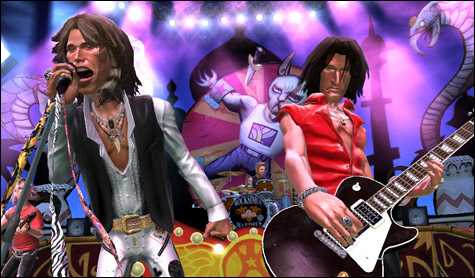
Above: Steven Tyler's had so much plastic surgery that he doesn't even look human anymore.

My review of Guitar Hero: Aerosmith is up now at thephoenix.com. The short version: It's not the worst Guitar Hero game ever made (that honor goes to On Tour, and Rocks the 80s was also worse), but it's symptomatic of the series' downward trend.

In some ways, the Aerosmith edition is almost better than Guitar Hero III: Legends of Rock, because the difficulty level makes more sense, and there's only one guitar battle -- which is still one guitar battle too many. But a music game lives and dies by its tracklist, and this is one of the weakest yet.

Strangely, though, I seem to have gotten much better at Guitar Hero during my most recent sabbatical from playing. I shredded my way through Aerosmith's hard difficulty without any trouble. Then, because the tracklist was so sparse, I popped in Legends of Rock and proceeded to slaughter a bunch of songs that had been giving me trouble before. If you recall, the difficulty in that game suddenly skyrocketed in tier 7. Well, suddenly I found myself five-starring "Stricken" and "Before I Forget" after limping my way through them months before. I don't know what happened. Best not to question it.

Still didn't have the balls to attempt tier 8, though. I'm not a masochist.

Tuesday, January 29, 2008

Who's that guy in the suit?

My review of Harvey Birdman: Attorney at Law is up now. It was a difficult game to review, because it really is like five interactive episodes of the show. That's a good thing for all the reasons the show is entertaining, but it's not so great from a gameplay perspective. Comparisons to Phoenix Wright are perhaps unfair, but inevitable. The biggest difference between the two is that Phoenix's cases are taken all the way through to surprising and satisfying conclusions, whereas Birdman's go for the abrupt gag. The Birdman game is true to the spirit of the show, but as we've seen from most of the attempts to translate games into movies, it's not always easy to translate from one medium to another. It's just not enough of a game.

And if I can toot my own horn a sec, I'm pretty proud of the closing line to this review.

Tuesday, January 22, 2008

The folly of man

When I tell people that I review video games for the Phoenix, usually they're shocked to find out that the Phoenix runs video game reviews. Their second reaction is something like, "How cool!" Usually, I agree with them. Most of the time it is very cool.

Then there are the times I have to play games like Godzilla Unleashed. It turns out that you literally could not pay me enough to play this game more than two hours.

Wednesday, December 19, 2007

The Year in Review: Honorable Mentions

All this week, we'll be recapping the year that was. Today: 2007 honorable mentions.

The best games of the year were superb, every one of them. Today I want to give props to some high quality games that didn't make the list.

Two games this year belonged on the list, but were disqualified on a technicality: they were ports of games that had previously been released. They were Resident Evil 4 Wii Edition and Guitar Hero II (360). In fact, Resident Evil 4 Wii Edition would have grabbed the number one spot if not for that rule. It's the best game I've ever played. But I think it's important to give the spotlight to new games, especially since RE4 and GHII have both made past top-ten lists. (I didn't play Ninja Gaiden Sigma for PS3, but there's a strong chance that would have been mentioned here, too.)

But there were a lot of other worthy games this year that, while not up to that high standard, are still worth anybody's time. In chronological order:

Phoenix Wright: Ace Attorney -- Justice for All. The Phoenix Wright series just a joy to play. Not only are the games funny and populated by a menagerie of crazy characters, there's also a noble undercurrent running through it all: everybody deserves a fair trial based on the evidence. Phoenix wouldn't be half as appealing if he were a prosecutor. I'm also looking forward to Capcom's upcoming Harvey Birdman, Attorney at Law game based on the Phoenix engine.

MotorStorm. Sony's alleged system seller may not have been that, but it was a good, solid racing game that hinted at better days to come for PS3 owners. And once they released free DLC that included essentials like a time trial mode, MotorStorm's value only increased. It's now a pack-in with the 80 GB PlayStation 3 model. You could do a lot worse.

Ghost Recon Advanced Warfighter 2. Could also have been called Tom Tancredo's Ghost Recon, what with its hilariously paranoid take on US-Mexican relations. Still, GRAW2 was a tight tactical shooter that offered tense survival scenarios and was easy enough for someone as dumb as me to play through without much difficulty.

Super Paper Mario. Super Mario Galaxy got all the press, but Super Paper Mario was just as trippy and innovative in its way. The "flipping" dynamic between 2D and 3D space consistently surprised and delighted. Paper Mario's only real problem was a slow pace thanks to some uncomfortably integrated RPG elements.

Odin Sphere. Atlus's PlayStation 2 side-scroller was like Final Fantasy meets Streets of Rage. Its gorgeous, hand-drawn visuals had an artistic flair lacking in most games with technically superior graphics. A little too Japanese and weird at times, but its unique play dynamics really worked. Who knew you could make planting seeds fun?

Sam and Max Season 1. Like Phoenix Wright, the Sam and Max games are all about using your wits to solve hilarious criminal scenarios. Although this new series doesn't reach the twisted heights of LucasArt's classic Sam and Max Hit the Road, it's a worthy successor. The streamlined, low-budget approach suits the material well.

Skate. Probably the biggest surprise of the year. Skate tried to depict a more realistic skateboarding dynamic than you usually see. Its skaters don't have superhuman abilities -- they can't jump ten feet in the air or survive massive drops. Instead, the game was all about identifying trick opportunities in a realistic city, and it was a lot more fun that that description makes it sound. Skate landed one right on the chin of the Tony Hawk series.

Resident Evil: The Umbrella Chronicles. The Umbrella Chronicles is a whirlwind tour through the Resident Evil canon, in the guise of a light-gun shooter. With a few deeper mechanics than you'd expect, like the surprisingly useful knife, it's got a little more meat on its bones than something like House of the Dead. And being able to experience memorable RE moments and boss battles from a fast-moving, first-person perspective is worth the price of admission. For as much grief as I've given GameTrailers.com on this blog, their description of The Umbrella Chronicles as a love letter to Resident Evil fans is exactly right.

Tomorrow: The worst games of 2007.

Thursday, November 15, 2007

The soapbox

I sure hated Manhunt 2. This is the rare review where I feel like it actually says what I meant it to say, and have nothing else to add here.

I'd also recommend Ryan's feature article about Rock Band.

Tuesday, September 18, 2007

Paste reviews online now

I just moseyed on over to Paste's game section and found that some of my reviews have finally been posted. These are a little different than the usual Phoenix reviews. With only 200 words to play with, it becomes more important to give the review a narrow focus. You've got to whittle an entire video game down to one sharp point. On a professional level, I think writing for Paste has helped me develop a more incisive critical faculty, thanks in no small part to the help from (now former) games editor Chris Dahlen.

Anyway, check out the reviews of Odin Sphere and The Darkness.

Tuesday, July 03, 2007

Happy Fourth of July

Let's celebrate by casting off the bonds of another British tyrant.

Coming next week: A surprisingly awesome game!

Tuesday, May 29, 2007

Great Odin's beard!

Odin Sphere is a pretty interesting action-RPG hybrid for the PS2. It's actually getting less fun the more I play it, but even so it's a unique title that may be worth checking out if you're into weird Japanese stuff.