Thursday, April 03, 2008

Overdrawn at the memory bank: The power of nostalgia in games

I've been splitting my time recently between Super Smash Bros. Brawl and Crisis Core: Final Fantasy VII. The two games couldn't have less in common, except for one thing: they both tap into a deep well of nostalgia as an implicit part of the gameplay. These aren't your typical sequels or spin-offs. Unless you had some prior emotional attachment to the source material, it's likely that these games wouldn't make any sense to you at all.

Smash Bros. draws on well over two decades of some of the most popular and enduring gaming franchises around, from Donkey Kong through Pikmin. For those of us of a certain age in the early 1990s, the question of who would win a fight between Mario and Sonic the Hedgehog was a matter of grave import. Now, we can finally learn the answer. Hell, if you've ever played a video game in your life, you've probably spent time with more than one of the Smash Bros. roster. The whole experience of playing it is like being on a runaway train through nostalgia country.

But here's the thing I don't get about Smash Bros.'s popularity: The game is terrible.

Above: Your childhood memories exploited like the Brazilian rainforest.

I have never had fun with a Smash Bros. game in my life. Mostly, that's because the weird, floaty controls sometimes make me wonder if I'm commanding the right character. (I will grant the possibility that with four combatants onscreen, I often am trying to command the wrong character.) Now they've added a crappy adventure mode called The Subspace Emissary, and it is such a lousy example of platforming that I would have stopped playing it after about half an hour if beating it weren't the only way to unlock several major characters. The controls just aren't made for precision jumping and environmental navigation, and with few exceptions the levels are repetitive and boring.

The Subspace Emissary
, to its credit, doesn't really try to hide that it's just playing you like a fiddle. There's a story that makes no sense -- something about all the evil Nintendo characters trying to turn the good Nintendo characters into trophies -- but it's all just an excuse to burn through the cultural capital Nintendo has built up over the years. I'm reminded of when a heel pro wrestler gets on the microphone and insults the city he's in, just to score some easy boos. Smash Bros. is one cheap pop after another:

Look! It's Link, from The Legend of Zelda!

*Cheers*

Look, it's King Dedede!

*Boos*

Considering that Nintendo has been coasting on its major franchises in this generation, all Smash Bros. does for me is remind me that there was a time when these characters and their accompanying motifs meant I was in for a wonderful time. For all Nintendo's innovation on the hardware side with the Wii, Twilight Princess and Metroid Prime 3 were only more of the same, with a slightly different control scheme (in fairness, Super Mario Galaxy did innovate to a greater degree). And that's the case here.

Nintendo is banking, literally, on the fact that millions of people already know and love these characters. Obviously, if you like the game to begin with, this will strike you as no problem. For me, I can't help but feel like Nintendo's exploiting their most valuable properties -- or they're exploiting me.

Crisis Core similarly looks to the past for inspiration. It's a prequel to one of the grandest achievements in the gaming canon, Final Fantasy VII . But it does something Smash Bros. fails to do, and that's add to the original game instead of just strip-mining it for its vast, revenue-producing resources.

Above: Sustainable, long-term nostalgia farming.

Admittedly, I didn't approach Crisis Core with quite the level of built-in love for its source material as I had for some of the characters and settings in Smash Bros. (Metal Gear Solid and Metroid in particular). I played FFVII only once and loved it, but couldn't give you a detailed synopsis of the story, or the exact materia combination I used to vanquish the Ruby and Emerald Weapons. Still, the last time I played one of these FFVII spin-offs, I think I was doubly disappointed that it wasn't just a bad game -- it was a bad FFVII game.

Well, Crisis Core is a good game. A very good game. It succeeds on its own merits, as a stripped-down, portable RPG. The gameplay reminds me more of Final Fantasy X than VII -- there's no overworld screen, and your character, Zack, travels from one locale to the next essentially on rails. Zack fights battles on his own in a nearly real-time manner. Although you can queue up Zack's next action -- attack, cast a spell, use an item -- you can also guard or evade an enemy's attack at any time. Doing so uses up Action Points, which are analagous to Hit Points and Magic Points, so it's not always the best idea. It helps to streamline the gameplay, while still maintaining that basic Final Fantasy feel.

The Final Fantasy VII connection isn't the crux of Crisis Core's appeal, but it does serve to flesh out the universe and deepen the fanbase's understanding of the events of FFVII. In the original game, Zack was a character seen in flashback. He was integral to the narrative, but only in backstory. Crisis Core puts him center stage. The game essentially is that cutscene blown up to full size.

Consider how well-known characters are used. Sephiroth doesn't just pop up in a cheap cameo, like Frank Sinatra in Around the World in 80 Days. We knew, from Final Fantasy VII, what Sephiroth had done. We didn't understand why. Crisis Core fills in that picture. And in the hero, Zack, we have an inversion of the usual alienated Final Fantasy protagonist. Zack starts off as the idealistic company man, and grows disillusioned as the reality of Shinra and the SOLDIER program becomes clear to him. If you draw a line from Zack's naivete through Cloud's nihilism and his eventual redemption, you'll come up with something like a circle.

In both cases, the callbacks and references to games we already knew and loved work best when they're used as a spice, and not as the main course. Although millions of gamers genuinely enjoy the Smash Bros. gameplay, and a small minority even make money on it in competition, the latest installment strikes me as a bloated, aging rock band playing all its old hits. Nothing about it adds to our appreciation of the source material.

By contrast, Crisis Core crackles with vitality. Instead of reminding me what it felt like to play Final Fantasy VII for the first time, it's giving me something more valuable for the future: memories of what it felt like the first time I played Crisis Core.

Wednesday, April 02, 2008

Workers of the world unite!


File this under: "Things you don't have to worry about when you only get 150 page views a day." Employees of Gawker Media -- which includes gaming mega-blog Kotaku -- don't have any idea what they're being paid.

In short, each writer gets a base salary and then a bonus for exceeding specific page-view goals, but those goals are adjusted quarterly and Gawker's major-domo Nick Denton hasn't yet handed down the details. Gawker writers are expected to produce now without knowing how they'll be compensated. As the author of the Valleywag post, Jordan Golson, puts it:
If a potential advertiser asked Gawker to start running its ads and promised to negotiate terms later, they'd be laughed out of the room — but that is exactly what the company is asking of its writers. If I were a salesperson, I'd expect to know my quarterly sales goals well in advance.

Ironically, this particular Valleywag post will probably result in a fat payday for Mr. Golson. But I'd be interested to see if other Gawker folks pick up the gauntlet that he's thrown down, particularly the folks at Kotaku. I imagine they're not hurting for page views over there, as Technorati's 27th-ranked blog, but it would be nice to see some good old-fashioned labor strife in this new economy. Gawker is a behemoth, and it's the writers that make it happen.

Tuesday, April 01, 2008

Pardon the pun


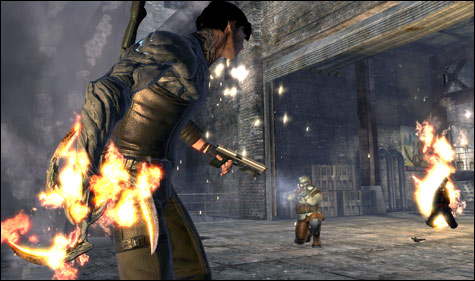
Pardon the couple of puns, actually, in the hed and subhed of this Dark Sector review.

I mentioned yesterday about the silly way the sinking ship springs leaks in this game. That sort of thing pops up all over Dark Sector. Early in the game, you come across an empty room in which a projector is still showing some kind of propaganda film. It's all very atmospheric. When I walked my character in front of the projector, as you'd expect the film displayed on his back -- but his shadow didn't appear on the screen! So instead of being impressed by the mood of desolation, I was wondering why they'd think to have the image project on the character but forget to have him block the movie screen.

You'll also occasionally see things like old pieces of paper fluttering in the breeze. The aerodynamics are convincing, but the trash will pop into view out of nowhere. The little touches don't add to the ambience as they were probably intended to do. All they do is call attention to themselves.

This is a game that could divide some people, and there are definitely those online who think it's great. I wouldn't be so quick to ascribe that reaction solely to lofty expectations, as Chris does, although it's no doubt the case for some people. Instead, I think that what's good about Dark Sector is so good that it may be possible for some people to forgive its flaws. I felt the same way for the first few hours.

Monday, March 31, 2008

The ship is sinking! Get out!

In the past few months, I've played three games in which my characters had to flee a sinking military vessel within a certain time limit. For whatever reason, sinking ships are the new hotness -- the 3D equivalent of the collapsing bridge in old-school platformers. You know, where you ran across as pieces of the bridge tumbled away beneath you.

Above: The bridge is collapsing! Go go go!

Which is to say that it's not usually all that surprising or fun, escaping from sinking ships. Some games do it better than others. From worst to best, here are the sinking-ship sequences I've played recently.

3. Army of Two

Above: "I'm gonna sink this bitch."

The biggest problem with Army of Two's ship-sinking sequence is that half of the cool stuff happens offscreen. The aircraft carrier is loaded with nuclear warheads that could fall into the wrong hands unless our intrepid duo -- you guessed it -- sinks the ship, and detonates the explosives underwater. There's a little cutscene where you push the warheads onto an elevator, and then suddenly you appear on the flight deck with a minute to run to a lifeboat. Not only do you need only about twenty seconds to make it, but the only obstacles are a bunch of shipping containers that appear from the ether and tumble toward you. It's bush league. You hear me? Bush league.

2. Dark Sector

Above: Not a sinking ship. Thanks for nothing, Google Image Search.

Dark Sector's sinking ship sequence plays out a bit better than does Army of Two's -- but on the downside, it happens in the game Dark Sector. Here, you have ten minutes to escape a sinking ship, and it may be a sign of how muddy the storytelling is that mere days later I cannot recall what I was doing on the ship or why. To escape, you have to solve a few puzzles using the glaive's "aftertouch" ability, steering it around corners and through gaps in fences and whatnot, all while fending off a bunch of brainless mutants.

The biggest problem, like much of the game, is that the puzzles aren't integrated well into the game. Why would a ship have doors that can only be unlocked by hurling an electrified boomerang at them? It just doesn't make sense. Plus, they tried to increase the drama by having the ship spring leaks all over the place, but the leaks are all identical: they're all at the same height on the walls, they all spray the same amount of water, and they're usually evenly spaced along your path. It's not good when these things call attention to themselves.

1. Call of Duty 4

Above: Sinking?! I did NOT see this coming!

As I've said before, Call of Duty 4 is awesome, and the funny thing is that it doesn't do anything that hasn't already been done in other games. It just does everything so much better -- including sinking a ship.

Once again, I don't really remember what we were doing on the ship, although I think it had something to do with retrieving some vital documents. What matters is that the escape is executed brilliantly. The ship lists to one side, with the controls providing just the right amount of resistance, and various committed foes take potshots at you. In the Call of Duty way, the whole sequence is a sensory overload. I felt something like panic my first time through, particularly when I lost sight of my squad and found myself charging blindly down corridors -- the wrong corridors, as it turns out. It was to be the first of my approximately seven thousand deaths over the course of the single-player campaign.

In conclusion, if you really want to escape from a sinking ship, do it in Call of Duty 4. Or, more likely, do it in every game for the next five years, until somebody comes up with a better idea and suddenly you're making one hang-glider escape after another from mountaintop fortresses.

Friday, March 28, 2008

Gamestop.com User-Submitted Previews: Grand Theft Auto IV

A new trailer for Grand Theft Auto IV has excitement at a fever pitch. The game is due to be released on April 29, but that hasn't stopped our friends at Gamestop.com from sharing their opinions on the final product. As always, spelling mistakes and grammatical errors are not a result of transcription.

"Beastmaster" has taken a scientific approach to analyzing the game:
After perfusely scouring the internet for information and specs I have come to the conclusion that this installment of the GTA Series is shapping up to be the best yet. Rockstar is stepping away from the more aspect they used in San Andreas and are going more toward realism. Many of my friends are constantly saying that I am overly hyped about GTA 4, but I just reserved my copy today and wont they regret those words on release day.

They won't regret those words because they'll be too busy asking nicely if they can play. And you'll let them. We've all been there.

"Gummi" counsels his fellow gamers to be a bit more circumspect:

Alright.... look ! GTA 4 is going to be a game to look forward to in april, but only ONE of the great games coming out in "08" People say GTA 4 is GOING 2 Be THE BEST GAME EVER !
How can it when GOW 2 comes out later this year ? GTA 4's graphics don't even look like what they should for a next -Gen game, the Guns they put in the Game seems like the same ones they put in every GTA, an the Quote on Quote "Best GAME Ever dosen't even have a online Mode where you can share the excitement with your friends ? Halo 3, one of the best games ever ! COD4,one of the best games ever ! GOW, one of the best games ever ! GTA 4 still needs to prove a lot more before it Ranks in as BEST GAME EVER!!!!!

How can one sequel I've never played be the best game ever when another sequel I've never played might come out at a later time? GTAIV needs to prove a lot more before anybody but the most ardent fanboy believes it's better than Resident Evil 9, which comes out in 2019.

"Jordan" laments Rockstar's betrayal of the little guy:
I think this is going to be a good game to play but whats sucks is that the people who own PS2 don't get the chance to play it and they get screwed.

And how come Sega Saturn owners are getting screwed? Where's the Atari Jaguar version? Multi-platform, my eye.

"Black JaCu" seems a little confused about something:
I always love reading what people have to say. But I think who ever comments about these games are really gay. I just felt like i had to say something. SO who ever is going to coment on this game or any game saying this is the best ever or finaly or yes its comming your all realy gay.

If everybody who comments on the game is gay, and Black JaCu is commenting on the game, doesn't it follow that Black JaCu is himself gay? Or will he invoke the Larry Craig defense ("I have a wide commenting stance")? Not that there's anything wrong with that, of course.

"xbox 360 guy" deserves plaudits for effortlessly blending incoherence with bald-faced lies:
this game is going to be so cool because the graphics and i played the game. it feels like your in the game it so cool you can do so much now you should get this game i like it because sound and missions the xbox 360 is the best to get grandtheft auto iv for that system i already played the playstation 3 for iv and it sucked. get iv for the 360 the = end

To recap: It's cool because graphics, and he likes it because sound and missions. And even if you take it at face value that he did play the game before this comment was posted last November, his username kind of gives the game away.

Of the numerous comments proclaiming GTAIV the best game ever made, none quite reach the grandiloquent heights of the one by "colbog":

this is the reason why you have a system, this game is why you came to life, this game is the best, trow all your games to garbage, and forget about the world this is time to brake up with your girlfrien guys, the graghics and game experince is 5000 stars, ?????? yea really.

After posting this, colbog ascended to heaven on a winged steed.

The = end.

Wednesday, March 26, 2008

Dark Sector has got me stumped

Immediate Update: So the first time I tried after making this post, I figured it out. It turns out you have to go back out into a particular hallway, where an otherwise nondescript portion of wall has magically opened up to reveal a hidden passageway. I don't know whether to blame myself or the game for this, but at least you've gotten a rare insight into just how terrible I am at video games.

The game is probably too new for anybody to be able to help me yet, but I figured I'd ask. I am stuck in Dark Sector. Hopelessly stuck. As in, I've replayed the same part at least fifteen times and still don't even have the slightest idea what I should be doing. If anybody could possibly help, I'd appreciate it.

Here's the scenario: I've just gotten the glaive's shield power. There's a cutscene where I'm introduced to a character named Nadia. Immediately following the cutscene, I have 60 seconds to either escape the room, defuse a bomb, or maybe even do something else I'm not thinking of. There's a door that looks like the probable escape route, but there's no prompt to open it. I've searched for switches or buttons that might open it and come up empty. I can't see anything that might interact with the glaive. The route I took into this area is blocked.

I don't have any idea what to do. I can't even tell you how much time I've spent replaying this part. It's probably something obvious, but I just have no idea at this point.

Addendum to "Nintendo and the last mile"

In my last post, I talked about Sony's nearly bulletproof manufacturing, and their lack of any systemic hardware problems. That's still true -- the failure rate for the PS3 seems to be substantially lower than that of its competitors. But Moriarty at Ain't It Cool News is experiencing one massive exception. Not only has he been having severe problems with his unit, but Sony is seriously face-planting the last mile:
The first girl who helped me today told me that the update can do that to machines. Now, when I first got my PS3, one of the selling points was that the machine is essentially "future proof," but if these firmware updates might fry your machine completely, then that’s not really future-proofing anything, is it? The girl seemed to be totally nonchalant in telling me this, too, like it shouldn’t bother me.

So suddenly, I’m feeling a whole lot less evangelical, folks. I’m going to call my friends who I convinced to buy the PS3 this week, and I’m going to make sure they know that this might be an issue. I thought I could sneer at the Xbox 360 RROD, but it turns out this machine is just as susceptible to sudden and complete system death. At least in my experience.

When I mentioned to the second guy I dealt with on the phone today that I felt like should write about why I couldn’t write my reviews, and how unreliable my experience with the PS3 has become in the last month and a half, he told me to "go ahead and slander us if it makes you feel better."

It's hard to imagine Sony's customer service reps handling the problem any more haphazardly. Note to CSRs: You never know how big a megaphone the customer may have. How bad does this look for them now? Even if the 1% failure rate Sony claims is true, that's no reason to slag off those customers who do experience failure -- particularly in Sony's case, where their installed base is still lagging behind Microsoft's and Nintendo's. That's terrible form.

Nintendo and the last mile

Ramit Sethi at I Will Teach You to Be Rich once wrote about something he called the "failure of the last mile," which simply means that it's the last contact with someone that's the most important. In business terms, it means this: Every company makes mistakes. Bad companies make it hard for their customers to get those problems taken care of. Good companies make it easy. What matters isn't so much what was wrong, but how -- and whether -- it was made right. Ramit cites the peak-end rule: "…we judge our past experiences almost entirely on how they were at their peak (pleasant or unpleasant) and how they ended. Virtually all other information appears to be discarded."

I bring this up because all three current-gen console manufacturers have shown how they run the last mile. Microsoft and Sony have both stumbled a bit along the way. Nintendo hasn't. Recall all of the problems that have accompanied the Wii. First, the wrist straps were breaking. Then the Wii Remotes themselves were. Then it turned out that leaving the Wii in Connect24 mode for too long caused the hardware to overheat. Then a significant number of units couldn't read the Smash Bros. discs. In each case, Nintendo got out in front of the problem.

Rather than let the drumbeat of customer complaints reach a crescendo, as soon as it became clear that the wrist straps weren't strong enough, Nintendo announced that they'd be replacing everybody's straps free of charge. Just go to the web site, fill out a form, and you'll get yours in just weeks. Same thing with the new padded jacket that now comes standard with all Remotes, and the GPU overheating issue. I happen to dislike the feel of the jacket and don't use it, and never took advantage of the graphics card repair, but it's the principle of the thing: Public outcry hadn't reached uproar status in either case, but the company stepped up, said it was their fault, and upgraded everybody for free.

And that's what they did with the Smash Bros. snafu. What am I going to remember about this incident six months from now: That my Wii was unable to read a particular game, or that Nintendo repaired my unit for free and returned it to me within a week?

Contrast this to the way Microsoft and Sony have handled similar (and similarly inevitable) problems. When reports of Xbox 360 hardware failures started popping up everywhere, Microsoft took a page from the Bush administration playbook and denied that anything was wrong at all. That only made the problem worse, so they took the next logical step: Attacked the people making the complaints. Microsoft claimed the reports of an epidemic were exaggerated, a vocal minority was making them look bad, and so on. When they later extended their manufacturer's warranty to three years, this was seen in the community less as good customer service and more as a grudging admission of guilt. Although these days you can get your 360 repaired pretty easily, and usually free, peak-end theory still applies: What people remember is the arrogance, and the denial of any widespread problems in the first place.

The PlayStation 3 hasn't experienced even a fraction of its competitors' problems on the manufacturing side. But on the marketing side -- hoochie mama! Sony's PR pronouncements from Bizarro World have been well chronicled here and elsewhere, so I'm not sure it's worth rehashing all of them. But just consider their spin on the missing rumble support from the SIXAXIS: "Rumble is dumb. Only fags want a controller with rumble." (I am paraphrasing slightly.)

In the meantime, educated consumers were aware of the pending lawsuit against Sony by Immersion Corporation, claiming patent violation. Once the lawsuit was resolved, Sony magically decided once again that rumble was the smartest and most heterosexual controller feature anybody could ever offer. The Dual Shock 3 goes on sale on April 15. Will they follow Nintendo's lead and offer a free Dual Shock to those of us who bought their system before it was available? Just after they admit that Xbox Live blows the doors off the PlayStation Network, I'd imagine.

Although the problems ranged in severity from Sony's boneheaded community outreach to Microsoft's catastrophic hardware failure, in every case what customers end up remembering is how each company dealt with what had gone wrong. Nintendo seems to be alone among the hardware manufacturers in understanding the value of a little humility. It's yet one more reason why the Wii is running away from the pack in this console generation.

Tuesday, March 25, 2008

Wii Watch: Day 9

"Out for Delivery." Huzzah!

Let's hope all goes well from here, and I can stop burdening you with the mundane details of a console repair.

Monday, March 24, 2008

Wii Watch: Day 8

The Wii repair has hit its first real setback. After my earlier optimism, the UPS tracking page has changed since the "arrival scan" in Louisville, Kentucky. That was on Saturday. If this page is to be believed, it's still there. And that would be terribly upsetting. I'm impressed that Nintendo was able to turn it around so quickly, but now I turn my ire to the United Parcel Service.

And my ire is up.

Army of Two review

Not only did I fail to spend my entire Army of Two review talking about the storyline, I actually spent the bulk of it talking about the gameplay mechanics. And still missed a lot. So, you know. Do as I say, not as I do.

Either way, this is a pretty fun game. I feel like the single-player mode has actually gotten a bad rap. The only major concern I had with it is that the AI-controlled teammate was usually unable to successfully drag my character to safety and administer first aid when he was hurt. Granted, that's a significant problem when it comes up. But generally he's pretty good about going where you want him to go and doing what you want him to do, even if it's almost always easier to put him in Aggro and just sneak around melee-ing everybody to death.

Another criticism I didn't make in the review: It's kind of hard to enjoy the two-player action when everybody on your friends list is still playing Call of Duty 4 like it's their job.

Saturday, March 22, 2008

Wii Watch: Day 6

These guys don't mess around. They shipped out the Wii yesterday, and according to the tracker it arrived in Kentucky at 2:10 PM today. It's entirely possible I could have this on Monday. Pretty impressive, really.

Friday, March 21, 2008

Wii Watch: Day 5

My repair status now says "shipping," which is encouraging. What's discouraging is that in the "amount" field next to good old ASSY WHITE, it now says $75.00, instead of the "no cost" promised on the original repair form.

I assume that's just to let me know how generous Nintendo is by not making me pay that amount.

Thursday, March 20, 2008

Wii Watch: Day 4

In an awesome development, Nintendo allows you to track the status of your repair on their website. So far there's nothing for me to see except that they've received my Wii and the game. Those are itemized on the page as:
DISC, SMASH BROS BRAWL RVL-USA

And:

CONSOLE ASSY WHITE RVL

"Assy White" sounds like a character from The Wire.

Rock Band: $11,000,000 and counting


Let's do some math, shall we? Everybody likes math.

Game|Life reports that Rock Band has now totaled six million digital downloads.

You can buy individual songs for $1.99, or three-song packs at slight per-song discount, $5.49 (using the PlayStation Store numbers here, although I believe Microsoft Points price out about the same).

Assuming that every downloaded song was purchased as part of a pack (not a safe assumption at all), that's two million purchases at $5.49 per purchase.

2,000,000 x 5.49 = $10,980,000

Now factor in any number of single-song downloads for $1.99 and Rock Band has easily topped eleven million dollars in online revenue alone. That doesn't count revenue for the $170 bundle, or any of the recently-released peripherals.

This thing is a runaway train. And the new in-game store is only going to grease the tracks further.

Wednesday, March 19, 2008

Wii Watch: Day 3

FedEx.com tells me that my Wii has arrived at Nintendo's offices. I was about to say it arrived "safely," but the truth is I have no idea what those animals did to my defenseless Wii in transit. I think I did a good job of packing it. Who knows? I just stuffed a bunch of newspaper all around it and then shook the box to hear if anything moved. Nothing did. Still, it's entirely possible that Nintendo's repair dudes will open the box to find a pile of pulverized plastic. Worse still, they may open it to find nothing at all.

These are the things I worry about. I should never have children. I'll be calling the school every day to make sure they're still alive.

Strike hard! Stick to the rhythm!


Okay, so one clever closing line can't make up for an otherwise uninspired Patapon review. But it sure can't hurt!

Patapon is part of a proud tradition of games whose intentions I very much like, and whose gameplay I do not. It's always a strange feeling to applaud developers for what they tried to do, but I do think it's important for them to take risks and stretch their creative muscles. Sometimes it may not pay off right away, but the experience of trying something like this may pay off later. (This is how I felt about Puzzle Quest, and as a result I have high hopes for its sequel, Galactrix.)

For a more positive and in-depth look at Patapon, I recommend Daniel Purvis's review.

Tuesday, March 18, 2008

Two sides to every review


Via GameSetWatch, I read an interesting thread on NeoGAF about Gamespot's Army of Two review. (Is that enough links in one sentence for you?) The complaint is that the reviewer, Joe Dodson, centered his critique on the game's storyline and themes, and therefore failed to do his job. Worse, the original poster seems to feel that such considerations have no place in game reviews. As somebody who tries to base most of his reviews on issues of story and theme, I frankly found this troubling.

So I was heartened to read both the review in question, and many of the dissenting replies in the thread. I have a couple of possibly unfair prejudices in mind about Gamespot and NeoGAF. The former has often seemed dry and snooty to me, and the latter has seemed like the Internet's petri dish. Gamespot's review says, basically, that Army of Two is a fun game with some troubling overtones. (In fact, the bulk of the review deals with gameplay issues, and not the storyline.) I haven't played the game too much yet, but from my experience so far, Gamespot's take seems about right.

This is the first game I'm aware of that explicitly name-checks 9/11, to the point where an early cinematic shows a character waking up to see an image of the Twin Towers burning on his television. How do you see that and still say this is just a game? How do you play the rest of the game -- which is about Blackwater-esque mercenaries fighting in such fantastic locales as Afghanistan and Iraq -- without constantly drawing parallels to the real world? I'd suggest that if you can play this game without once considering the issues it raises, maybe you really are desensitized.

To be clear: I'm not saying any of this is out-of-bounds for a game. In fact, I think it took some serious stones for Army of Two's developers to go this route, and for EA to publish it. This is the world we live in, and I'm glad to see a game embrace that. The only problem I'm having so far is that, even in the short time I've played it, the undertones keep shifting under my feet. It seems thematically confused. On one hand, it's goofball satire, with braindead and vaguely homoerotic interplay between the two leads, and hyperbolic portrayals of suicide bombers who run toward you shrieking and waving their hands above their heads. On the other, it trends toward distressing realism when talking about the uneasy balance between the military and unaccountable private contractors. It's possible this all gets tied together in a cohesive way before it's all said and done, so I don't want to go too far with it just yet. I only want to emphasize that the angle Gamespot took in reviewing Army of Two is a legitimate one.

And I'm glad that so many of the commenters on NeoGAF seem to agree. A significant number of them don't, and think that reviews should stick to the basic issues of graphics, play control, and so on. That, too, is defensible. But it's less interesting to me than more critical game reviews, and most people seem to agree that critical game reviews are what we currently lack. This comment summed up the dischord in the thread:
The videogame media are a bunch of parochial idiots for just mechanically praising games on graphics, sound, sex, and violence in reviews, instead of being more mature and evaluating games as an entertainment medium with storytelling, characterization, and a cultural context.

The videogame media are also idiots for evaluating games as an entertainment medium with storytelling, characterization, and a cultural context instead of just telling me how the graphics are and whether the game is worth playing.

Or something like that.

Well put, but let's not forget that there's room for both kinds of reviews. It may be fair to criticize Gamespot for publishing this particular Army of Two review when they've made their bones by catering to hardcore gamers with a more straight-ahead editorial style. I happen to think someone could write an interesting and enlightening review of the game without spending more than a token passage or two talking about the gameplay. A game that explicitly raises topical issues absolutely deserves to be dealt with on that level, if not by every reviewer.

What is Army of Two trying to say? Does it succeed in saying it? These are the kinds of questions we ask without hesitation of books, movies, and music. I've said it before, and I'll say it again now: If we want the broader public to treat games with the respect we think they deserve, then it's our responsibility to set the example. That means answering these kinds of questions first, before people like Jack Thompson try to answer them for us.

Monday, March 17, 2008

The red Wiing of death

My office has become a console graveyard. It's like the scene in Gone with the Wind where the camera pulls back to reveal an endless array of dead and wounded Confederate soldiers. My SIXAXIS, as described in the control pad stress test, lies mangled and useless next to the PlayStation 3. The Dual Shock 3 comes out on April 15, so I need to try to make it a month without playing another PS3 game, or I'll have to buy another SIXAXIS. Yes, I have no one to blame but myself, but I'd still rather not sink $50 into a soon-to-be-obsolete peripheral if I can help it.

The much sadder sight is the empty Wii stand next to the TV. Say what you will about that little system, it's certainly easy on the eyes. And now it's gone, probably for another seven business days. I packed it off to FedEx this morning in an old J. Crew box. The idea was not to draw attention to the package's contents, as Nintendo recommends, but that's sort of hard to do when the address label blares "NINTENDO OF AMERICA" on two different lines. I did not feel confident handing it over to the purple-suited fellow behind the counter at my local FedEx Kinko's.

If you think my apprehension is unwarranted, let me tell you about the time I received a parcel from Rockstar Games that had been ripped open and retaped somewhere in transit. My copy of Grand Theft Auto: San Andreas was nowhere to be found (although, fortunately, the thief had left me a sticker and a hat). The courier? Federal Express. I don't know what's worse: that FedEx employs thieves, or that said thieves probably post at NeoGAF.

Amid all this catastrophic hardware failure, there's one noisy, overheated, disaster-prone machine that just keeps humming along like nobody's business: Old Reliable, the Xbox 360. That console has just passed the two-year mark of uninterrupted service. It's like my office is sitting in some localized Bizarro dimension.

Having said that, I imagine my 360 has only weeks to live.

Friday, March 14, 2008

Good old Nintendo Wii

Well, after not using it for months caused my the graphics card to partially melt itself, now my Wii seems to be resistant to loading Super Smash Bros. Brawl. Twice it gave me an error message that recommended turning the system off, and now it's displaying the loading screen while making a horrible grinding noise.

Oh, there we go: "An error has occurred. Press the Eject Button, remove the Game Disc, and turn the power off. Please read the Wii Operations Manual for more information."

So that's great. It seems like every time I put a new game into this system, it doesn't want to run it. There's almost always an error message of some kind. Usually it only happens once, though. I feel like I read something about Smash Bros. giving people trouble.

To Google!

Edit: Yep, here it is. Great that Nintendo will pay for shipping for me to get this fixed, but that doesn't really help me file a review next week. Awesome.

Thursday, March 13, 2008

Smooth move, Best Buy

All right, unrelenting pressure from my peers in the gaming community, not to mention my editors, led me to pick up Super Smash Bros. Brawl at Best Buy. Generally I'm a big fan of that store, not least because I can walk in two days after the release of a popular game and buy it without being guilt-tripped about not reserving it by some choad wearing a Bluetooth earpiece. Best Buy just takes your money and gives you the game! It's a revolutionary business model.

Even so, I was pretty upset to see this:


Did you catch that? Take a closer look.


Yep. And that was plastered on every one of the dozens of copies they had on display. I mean, if you're going to try to gouge gullible consumers, you could at least make sure you're spelling your stupid sales pitch correctly.

I still like them better than Gamestop.

Wednesday, March 12, 2008

One-second Sins of a Solar Empire review

After last week's hemming and hawing, I think my Sins of a Solar Empire review came out all right. It might even be helpful to a general audience -- who knows?

Even so: In some ways, that review is about six hundred words too long. I can distill it to its essence without writing any words at all. Allow me to present the one-second version of my review:

Tuesday, March 11, 2008

Burnout: No, not the game

Maybe it's the brighter days and warmer weather. Maybe it's the string of mediocre games I've been playing for weeks. Maybe it's the steamrolling hype for Smash Bros and GTAIV. Whatever the cause, one thing's for sure: I'm feeling burned out on games.

I don't feel like playing them. Don't feel like writing about them. Don't much feel like reading about them (although Kotaku's story on the haunted Ms. Pac-Man machine was an exception). I've failed to respond to solicitations for pitches from two different publications, which is always a brilliant career move. But what can I say? I'm not feeling the juju, and I don't know why.

Does anybody else ever have this problem? Leigh Alexander once tried to abstain from playing anything for a full week, and found it impossible. Jeff Gerstmann's gamer score is over 55,000. The internet is awash with people who come up with dozens of blog posts per day. That's dedication. It's all I can do to power up my PSP to sock away another level or two of Patapon.

This, too, will pass, but if you were wondering why posting has slowed down lately, now you know why.

And you were wondering, weren't you?

Friday, March 07, 2008

Super Smash Bros streets early

Word is that several retailers have broken the street date for Super Smash Bros Brawl. This according to threads on NeoGAF and Hipinion, so I'm convinced. One piece of advice: You're better off checking your local independent stores instead of bigtime chains, what with all their "rules."

Still can't say I care too much. I don't think Nintendo's PR firm is sending us a copy, either.

But you guys feel free to go nuts on that thing.

Thursday, March 06, 2008

Sins of a solo game reviewer

I need some advice. I'm reviewing Sins of a Solar Empire for the Phoenix. You may have heard of this game -- it combines elements of real-time strategy and turn-based strategy in an intergalactic setting, on what the box promises is an "unrivaled scale." It's been reviewed well elsewhere, with a Metacritic score of 89.

And I don't have the slightest idea how to review it.

I've argued before that an encylopedic knowledge of games is only part of the equation for good games criticism. But obviously a writer needs to have a solid foundation in the genre he's playing if it's to be an informed and balanced review. When I play an action-adventure game, I'm drawing on decades of experience with that style of play. I can zoom right up the learning curve, without getting hung up on the basics.

That's not the case with strategy games like Sins of a Solar Empire, whether we're talking about real-time or turn-based. I've never played a Civilization game or a Command and Conquer game. I've spent about five minutes each with Warcraft and Starcraft. I know so little about strategy games that I can't even think of any other ones off the top of my head. And I'm spending my time not on comparing Sins of a Solar Empire to other strategy games, but on learning how to play it.

I see from the Metacritic page that Sins was streamlined compared to its brethren, but you could have fooled me. The instruction manual is novella-length. For people steeped in the genre, it might feel like the most user-friendly interface ever designed. For me, it's like learning a foreign language. My biggest fear is writing a review that comes off as dumb and uninformed -- to write the RTS equivalent of a review of an action-adventure game that sounds baffled that you press the A button to make your character jump. And yet... I am uninformed.

So what do I do? It would be unfair to the game to review the genre by proxy in place of a detailed discussion of its unique characteristics. But it would also be unfair to the readers to pretend I'm an authority on strategy games, or even that I would have paid any attention to this game if I weren't getting paid to do so. I'm thinking it'll take some combination of a forthright admission that I'm not an expert with a focus on those things that I really do like about it, even if they may not be intrinsic to what most strategy fans are looking for.

But I'm not sure. How would you approach it?

Tuesday, March 04, 2008

Won't find me in the Club

My review of The Club is up now. I'm tempted to say it's not a bad idea for a game, except I couldn't really tell you how they could have made it better, so maybe the idea was the problem after all.

One thing that confused me about this game was the sometimes contradictory feedback you get. For example, much of the environment is destructible, which is neat visually. But with the exception of numerous exploding blue barrels (of course) scattered everywhere, none of it can be used to kill your opponents. And since you're scored partly on accuracy at the end of the level, taking advantage of this feature is detrimental. So why is it there?

(I suppose it's possible that you aren't docked for shooting interactive items, but that's a better excuse for why I usually scored around 20% accuracy.)

Still, The Club isn't a poorly made game at all. I just think its appeal lies wholly for Skill Players, and I do not count myself among them. Could still be worth a rental if you consider yourself that type of gamer.

Monday, March 03, 2008

Career opportunities

With the departure of Jeff Gerstmann, Frank Provo, Alex Navarro, Ryan Davis, and now Jason Ocampo (did I miss anyone?), it appears that Gamespot is hiring. They're advertising three open Associate Editor positions: two general, and one PC-specific. It still doesn't seem to fill all the gaps left by the departed, but it's much more than I've ever seen posted. That place used to be locked down like Fort Knox.

Despite all that's happened there over the last few months, I'd be surprised if they have any trouble filling these positions. Without knowing any specific numbers, I'd be willing to bet that the number of people who want to make a living writing about games still exceeds the number of available jobs by at least a thousand million percent. Really, despite the hit its reputation has taken of late, Gamespot is still a leading publication -- one of the first two or three sites that come to mind. They might even pay a real salary, who knows. (Actually, does anybody know? I'm curious. Post anonymously, if you want.)

Friday, February 29, 2008

Friday afternoon tidbits

No drinking beer and falling asleep on the couch for me this weekend! I'm going snowboarding. Let me just apologize in advance if I break my wrist and can't type come Monday.

A few items of note before the weekend begins:

-The comments have been great around here recently, so thanks to everybody who takes the time to respond. Blogging should be a dialogue and not a monologue. I always appreciate any considered comments, whether they're assenting or dissenting. Group hug.

-Every time I think I'm done talking about Fairway Solitaire around here, they pull me back in. Bill Harris linked to an interview with the game's designer, John Cutter. It's probably more interesting if you've played the game, such as when you come across passages like this:
"One of my theories about game design is that there is a direct correlation between the quality of an action's feedback and the perceived enjoyment of that experience. So with that goal in mind I was pretty diligent about giving players great feedback each time they "play" a card to the foundation," he said. "I really wanted this action to feel like a golf shot, with a nice solid "WHACK" sound and the card spinning and arcing down to the bottom of the screen."

It's totally true. I can't stress it enough: Fairway Solitaire is an absolute gem. At least try the demo.

-The anonymous scribe behind Magical Wasteland rarely posts, but each new update is always required reading. "In Defense of the Meaningless Video Game" touches upon some of the issues we talked about in yesterday's post on racing games. A key quote: "World of Warcraft means something (to millions of people) because it provides the framework for meaningful occurrences, not because it, itself, contains and delivers meaning." That's true. But the meaningful occurrences people create for themselves are naturally shaped by the decisions of the folks at Blizzard, whether or not either the developers or the players mean for that to be the case.

Without arguing any of the author's core precepts -- that some games are fun for fun's sake, and that most don't need to be overtly relevant to the world we live in -- I still can't shake the notion that every game has some kind of meaning. The reason it has meaning is because conscious decisions had to be made about even its smallest aspects. Yes, you can take this to ludicrous and self-parodying extremes. But think about it: For each design decision made, an infinite number of options was rejected. If you ask yourself why a particular choice was made, then that's where you'll find the meaning -- no matter what the game.

-Today, Game|Life, Kotaku, and Rock, Paper, Shotgun all posted gushing previews of the dystopian Parkour game Mirror's Edge. I agree that it sounds neat. But honestly, people: Have we learned nothing?

Thursday, February 28, 2008

Going in circles

There's a thought-provoking feature in Edge about the decline of the racing game as a genre (via Rock, Paper, Shotgun), as discussed by a roundtable of developers behind games like Dirt, Sega Rally, MotorStorm, and Project Gotham. The essence of the problem with racing games was flagged by RPS in their headline, and it's spoken by Bizarre's Gerard Talbot:

"Why am I doing this?"

This was the question I was unable to answer while playing Dirt. It's the question I can't answer while I'm playing The Club (which, though not a racing game, shares many characteristics in common with Bizarre Creations' Project Gotham series). It's the question that has prevented me from investing the time and effort necessary to succeed in Gran Turismo and Forza. For some people, simply being challenged to do well is reason enough to play, whether that means achieving high scores or low times. But these skill players are only one segment of the gaming community, and those of us who look for some more personal reason to play won't find one in these games.

What racing games don't generally do is tap into the player's emotions. I don't mean that they should have stories or characters, necessarily, just that there needs to be some animating reason for the player's actions beyond a basic desire to win. Look at Dirt: the rally style means that you race alone, and afterward compare your time either with that of hypothetical computer opponents, or of real-life opponents you never actually see. There's no drama there. The best games for tourist-style players are those that connect with something elemental, like fear, empathy, or a desire for justice. Obviously this wouldn't work for hardcore sims -- the niche products -- but I think it's going to be necessary for mainstream racing games to connect with mass audiences in the future.

One way to do it would be to ditch the straightforward lap mechanism, and instead create courses in which the player is racing either toward something or away from something. "Why am I doing this?" Because if I don't get to the finish line in time, something terrible will happen. Because if I don't outrun this horrible thing behind me, I'm going to die. What about a game based on The Wages of Fear? The physics engine possibilities alone are exciting, and the ticking-time-bomb scenario adds that missing impetus for those of us who need one.

Whether that's a good idea or not, the point is that as long as racing games are just about running laps, then they'll all be going in circles. There will always be a market for Gran Turismo and games based on NASCAR. But if developers really want to push ahead conceptually, then what's needed is a willingness to move beyond the prevailing mindset that racing is about winning a trophy. There's a chance to do so much more.

Wednesday, February 27, 2008

Tuesday, February 26, 2008

The difference between reviews and criticism

Pat Duggan sends a link to a piece at Play This Thing!, titled "Game Criticism, Why We Need It, and Why Reviews Aren't It." The premise is one that has been bounced around for years, and which seems to be popping up with increasing frequency: that the vast majority of game reviews really aren't criticism at all. As this piece puts it:
A review is a buyer's guide. It exists to tell you about some new product that you can buy, and whether you should or should not buy it...

Criticism is an informed discussion, by an intelligent and knowledgeable observer of a medium, of the merits and importance (or lack thereof) of a particular work. Criticism isn't intended to help the reader decide whether or not to plunk down money on something; some readers' purchase decisions may be influenced, but guiding their decisions is not the purpose of the critical work. Criticism is, in a sense merely "writing about" -- about art, about dance, about theater, about writing, about a game--about any particular work of art.

The piece argues that the games press is well stocked with "reviewers," and totally lacking in "critics." You can go anywhere for a Consumer Reports-style look at a game, but it's tough to find any really insightful or illuminating critics -- especially someone whose reviews are strong enough to stand on their own as readable essays. I don't disagree with this. The places people tend to identify with game reviews -- IGN, Gamespot, Game Informer, etc. -- take a rudimentary approach to their craft. I do disagree with this point:

The truth is that, for the most part, we don't have anything like game criticism, and we need it -- to inform gamers, to hold developers to task, and to inform our broader cultural understanding of games and their importance and impact on our culture.

That "for the most part" is key, because you have have to dig to find what this person is looking for. But that doesn't mean it's not out there. Lots of the writers on my blog roll take a more critical approach to games, like Leigh Alexander, Michael Abbott, and Chris Dahlen, and so do I. Whole blogs exist to fill precisely this alleged void, like Critical-Gaming. Paste publishes a page full of critical game reviews every month, and that's a popular national magazine. What about The Escapist?

Do we have the equal of Pauline Kael yet? No, not that I know of, and if there is, she's certainly not getting published in anything like the New Yorker. But that doesn't mean she's not out there. It may simply mean we haven't found her blog yet. The implication of something like this, too, is that Kaels abound in the world of film. It's not so. Most movie reviewers are guilty of the same sins as game reviewers, even if they tend to be more witty and literate across the board. The piece calls out Roger Ebert as more of a reviewer than a critic, but hell, if a game reviewer ever won a Pulitzer as Ebert has, I'd consider that a victory for all of us.

I'm glad Play This Thing! brought up Ebert, in fact, and not just because of the controversy he's ignited in the gaming community of late. He's one of my few heroes in the world of criticism/reviewing/whatever, and not just because he's a wonderful writer who can find something interesting to say about the most boring of films. It's because the man cares, and cares deeply, about movies. He doesn't let ugly or cynical films slide because they're "just movies." He believes in the promise of films to bring us to a higher emotional and spiritual plane. When that doesn't happen, you can tell he's disappointed. That brings me to what I think is the most important and true bit in this whole piece:

The point is that a critic has to take his subject seriously, as an example of art, or at least of craft; and take seriously as well the intentionality of the creator, and the importance to those who experience the results of the results, and the impact on how they think and feel.

This, in a nutshell, is what's wrong with game reviews today. Which is not to say that it's true of all reviews or reviewers -- only that when and where reviews fail, this is most often the reason. We are happy not to take games seriously. We treat them as playthings.

Which, to be fair, some are. Not every game may be worthy of the critical approach, quite honestly. Good ones are. Some bad ones are. The wasteland of acceptable, unremarkable fare isn't worth the time or attention, I don't think. I'm happy to be proved wrong on this point. But right now I'm playing through a game called The Club, a pretty rote exercise in skill-based gaming, and I can't even fathom applying to it the slightest intellectual rigor. It's not a bad game -- certainly entertaining enough in spots -- but it is a game with literally nothing on its mind. Therefore, I will take an entirely different approach to reviewing it than I did, say, No More Heroes. The point is that each review should be tailored to the game, rather than trying to cram each game into the same review template.

As ever, the best way to fill the void of critical gaming discourse is to begin to discourse critically about games. It is valuable to point out where the games press is failing readers, but just as with criticizing a game, it takes more than simply identifying flaws. It's about aspiring to an ideal. It's about demanding more from our games and from ourselves. The corporate sites won't do it, because it doesn't make sense financially. They're already getting the biggest slice of the pie -- why change? That means it's up to bloggers and independent sites to dig deeper. There are plenty of us out here. If we lead, the readers will follow.

And then -- only then -- so will the publishers.

Monday, February 25, 2008

Master Chief, release me from this tainted orb!

For everybody who read the control pad stress tests and found themselves nodding in agreement, rather than snorting in derision, Clive Thompson brings some baffling news (which he got from Gamecritics): Science suggests that gamers enjoy dying in games.

We're talking about real science here, not the fake kind intended to mask your childish fits of rage that result in broken controllers. Electrodes were involved. And the electrodes seemed to indicate that gamers have a more positive reaction to dying than to killing others. To gank Clive Thompson's pull quote:
"... instead of joy resulting from victory and success, wounding and killing the opponent elicited anxiety, anger, or both." In addition, "death of the player's own character...appear[s] to increase some aspects of positive emotion." This latter finding the authors believe may result from the temporary "relief from engagement" brought about by character death.

My controllers would suggest otherwise, although perhaps that's some primitive survival mechanism in my brain forcing my body into "relief from engagement." Kind of like how my hearing shuts itself off whenever my fiancee asks me to take out the trash.

Still, this sheds a whole new light on such hilarious online behaviors as "teabagging" one's kill and shouting racial slurs at one's quarry. Just like birds puffing up their plumage and apes beating on their chests, these are nothing more than survival mechanisms. It's not a sign of dominance -- it's a sign of abject terror. We'd always suspected that we were playing against quivering, fearful children, and now we have proof. Thanks, science!

Friday, February 22, 2008

The best ending sequence in game history

For my money, it's this:


There's so much to love: the way the Hyper Beam causes Mother Brain's head to snap back, the option of saving your allies, and, of course, the last Metroid's noble sacrifice. If there's a better example of in-game storytelling out there, I don't know what it is.

Control Pad Stress Test: PlayStation 3 SIXAXIS

Whenever a new game console is released to market, one of its key features is the control pad. Consumers look at ergonomics, button layout, and even aesthetic design, in addition to functionality issues such as the Wii remote's motion-sensitive inputs. Now, after an unprecedented year-long study, Insult Swordfighting is proud to present the results of our intensive stress test of the control pads for the three major game consoles. Today: the PlayStation 3 SIXAXIS.

The Game: Devil May Cry 4

The Scenario: A final, almost tacked-on battle against a nearly defeated Savior, in which Nero must attack the Savior's right hand with a Buster (simple) and then leap and grab the Savior's left hand with the Devil Bringer at a precise moment (IMPOSSIBLE WTF).

The Stress Test: Experimenter remained seated and released the SIXAXIS in a shallow downward motion, simulating disgust and frustration. As always, it was impossible to replicate the exact force and trajectory from one test to the next. In this case, mitigating factors were the oblique angle of the throw, and the area rug that may or may not have been at the first point of impact.

Impact on Aesthetics: Devastating. The plastic pieces between the R1 and R2 buttons, and the L1 and L2 buttons, have both detached -- as has the R1 button itself. R2 and L1 are both loose. The front and back pieces of the controller's body are coming apart. In addition, the four face buttons now feel loose and lack tactile feedback.

Impact on Performance: Substantial. With the R2 button hanging by a thread, a sweeping upward motion is required to press it. The R1 button is missing entirely, and thus unusable. The L1 button has been knocked off its axis a bit, although it still works. And the PS button is stuck in the depressed position. Analog stick functions seem to work fine, as does patented SIXAXIS tilt control, insofar as patented SIXAXIS tilt control works at all.

The Verdict: Kaput. The SIXAXIS was unable to stand up to our rigorous stress test, just as its Dual Shock predecessor was when pitted against the turtle-like boss in Shadow of the Colossus. (You know, the one with all the geysers on the ground and it flips onto its back and you climb up and if you fall off while it's turning over you have to do it all again and oh my god.) A new SIXAXIS will be required to play future PS3 games.

But Insult Swordfighting Labs feels that scientific knowledge is worth the cost, as the benefit to humanity from these tests far outweighs short-term material considerations. Toward a better and more prosperous future!

Thursday, February 21, 2008

Control Pad Stress Test: Xbox 360 Control Pad

Whenever a new game console is released to market, one of its key features is the control pad. Consumers look at ergonomics, button layout, and even aesthetic design, in addition to functionality issues such as the Wii remote's motion-sensitive inputs. Now, after an unprecedented year-long study, Insult Swordfighting is proud to present the results of our intensive stress test of the control pads for the three major game consoles. Today: the Xbox 360 control pad.


The Game: Lost Planet

The Scenario: Wayne, on foot, battles a foe equipped with a Vital Suit and armed with missiles. The concussion of each missile blast knocks Wayne to the ground for several seconds, while the smoke from the explosion obscures his vision. By the time he stands back up, quite often he is hit with another missile, knocked down again, and god it's just so stupid.

The Stress Test: Experimenter leapt up from his chair and released the Xbox 360 controller in a sharp downward motion, simulating disgust and frustration. The pad only traveled a short distance, due to the unforeseen presence of a desk between experimenter's release point and the floor, but as compared to the Wii remote stress test, the velocity was much higher. Researchers believe total force was approximately equal.

Impact on Aesthetics: Moderate to high. The right palm grip of the control pad initially split open, and appears to have been widening slightly ever since, with the gap now centimeters wide. As a result of this asymmetry, the control pad no longer sits flush on a level surface. Worse still, it is much less comfortable to hold.

Impact on Performance: None. In more than a year since performing the test, researchers have observed no discernable loss of function in the Xbox 360 control pad -- all the more remarkable considering its grievous exterior damage. One might have suspected, at the very least, that dust and other environmental hazards might have found their way into the delicate circuitry at the controller's heart. That has not been the case.

The Verdict: Mixed. The Xbox 360 control pad scored the highest of the three controllers, by far, on issues of performance. However, it scored substantially lower on the aesthetics scale than did the Wii remote, so it's hard to call this a total victory for Microsoft's controller. Ultimately, performance matters most, but there's no denying the hypothetical embarrassment that could be caused if someone were to come into your apartment and observe a smashed-up controller that hadn't been put there for purposes of science. Even if it still works really well.

Tomorrow: The PlayStation 3 SIXAXIS.

Wednesday, February 20, 2008

A tumbleweed blows through Google Reader

Here, have a review of Devil May Cry 4. This was a game I felt I was enjoying the whole time I played it, and yet when I finished and thought about it, I could only focus on its flaws. Certainly a decent enough game, but not as good as its predecessor.

What's going on this week? Is everybody at GDC? They're certainly not blogging. My Google Reader is barren, except for the "news" coming out of the conference, like the shocking existence of a Gears of War 2. Sure, I'll look forward to playing that game in another nine months, but I don't see the point of working myself into a lather over it.

Same goes for most of the stuff coming out of the Game Developers Conference, although there's always interesting tidbits like Ken Levine's retrospective on the narrative of BioShock. But the news -- the hard news -- just couldn't interest me any less. Ninja Gaiden 2 release date? Great, remind me a week or two before it comes out. A new Red Faction? Sweet, that makes three Red Faction games I won't have played.

What interests me most about games is the experience of playing them. Events like GDC just build hype, which is something I try to avoid. Not that there's anything wrong with buzz, necessarily, but it helps to avoid it if I want to maintain objectivity. Nor do I think that anybody ought not to cover one of the biggest gaming news events around, just because of my proclivities.

I just get so lonely, is all.

Control Pad Stress Test: The Wii Remote

Whenever a new game console is released to market, one of its key features is the control pad. Consumers look at ergonomics, button layout, and even aesthetic design, in addition to functionality issues such as the Wii remote's motion-sensitive inputs. Now, after an unprecedented year-long study, Insult Swordfighting is proud to present the results of our intensive stress test of the control pads for the three major game consoles. Today: the Wii remote.


The Game: The Legend of Zelda: Twilight Princess

The Scenario: Link must escort a carriage across Hyrule, fending off attacks from creatures both land- and air-based. This sequence requires Link to control his horse, Epona, while shooting at his enemies with the Wii remote-controlled bow-and-arrow, and putting out fires on the carriage with his boomerang. Failure results in the scenario restarting.

The Stress Test: Experimenter leapt up from his chair and released the Wii remote in a sharp downward motion, simulating disgust and frustration. Although the first-generation wrist strap did break, it likely retarded the remote's acceleration. This was a variable that Insult Swordfighting Labs unfortunately did not foresee. It should also be mentioned that subsequent stress tests have failed to defeat the newer, hardier wrist strap.

Impact on Aesthetics: Hardly any. An almost imperceptible separation appeared on one side of the casing, where the front and back portions of the exterior meet. The finish was not chipped or scuffed in any way.

Impact on Performance: Mild. Since performing the test, a loose particle is audible inside the Wii remote when it is shaken vigorously or upended. For a brief span of time, the B button had a tendency to stick in the depressed position, but the problem seems to have resolved itself. No discernable impact on pointer and motion-sensing functions.

The Verdict: Unclear. As stated above, the effect of the wrist strap on the stress test is unquantifiable with current data recording techniques. Additionally, newer Wii remotes come with a thick, rubbery casing that did not factor into this test, but would likely increase its durability. Nevertheless, for something that feels in your hand like it cost six cents to make, Insult Swordfighting researchers were suitably impressed that the stress test resulted in no apparent loss of function.

Tomorrow: The Xbox 360 control pad.

Monday, February 18, 2008

Cheat codes versus public education

Video game codes I remember without even trying:
  • 30 lives in Contra: Up Up Down Down Left Right Left Right B A
  • Face Mike Tyson in Mike Tyson's Punch Out: 007-373-5963
  • Warp to Dr. Wiley's castle in Mega Man 2: A1 B2 B4 C1 C5 D1 D3 E3 E5
  • Play Metroid without Samus's suit: JUSTIN BAILEY
  • Jump to the second quest in The Legend of Zelda: ZELDA
  • Activate blood in Mortal Kombat (Sega Genesis): A B A C A B B
  • Invincibility in Doom: IDDQD
  • Acquire all weapons and keys in Doom: IDKFA
Things I remember from high school chemistry class:

Friday, February 15, 2008

Friday afternoon tidbits

Just a few leftovers before I embark upon a weekend full of exciting activities, like drinking beer and falling asleep on the couch:

-I'll take full credit for this: The Boston Phoenix cleaned up at the New England Press Association awards. The paper won the association's top prize, the George A. Speers Newspaper of the Year Award. In addition to almost two dozen individual awards, the Phoenix also nabbed first place nods for General Excellence in the Alternative Weekly category, and for Arts and Entertainment Section, alternative class, for the September 29, 2006 issue. I think it was my Yakuza review that put us over the top.

-In the Brainy Gamer podcast, we touched upon the commercial prospects of No More Heroes domestically. Kotaku has the numbers, and the verdict is: it's doing okay. I don't know what the benchmarks are to call something a success or a failure, sales-wise, but 200,000 units shipped and over 100,000 sold in the first month sounds pretty good to me. Much better than under 40,000 shipped in Japan, even accounting for the population difference. Crazy.

-N'Gai Croal is in the midst of an epic multi-part series called "Is the Cultural Trajectory of Videogames Doomed to Parallel That of Comic Books?" As usual, it seems silly to even attempt to piggyback upon the man's wisdom, so I'd only suggest that you waste no time in reading it.

Okay, maybe I'll toss in one observation. N'Gai quotes Steve Gaynor as saying that the barrier to mass acceptance is much higher for games than for other media: "To read a book, all you need to do is go to a library, pick one up, and start reading (which isn't usually an obstacle considering the high literacy rate in the modern world.)" Which is true, but that's a relatively new development. You only need to go back a few hundred years to find a time when the only literate people were the ruling classes, either in government or clergy. Even our hyperliterate society is largely a post-war phenomenon. Maybe we need to look ahead by decades, or even centuries, to find a time when gaming will be as ubiquitous as reading or watching movies, but it seems to be catching on much faster than its predecessors did.

-Along a similar track, Alastair Harper of the Guardian makes the bold claim that games already are art. He argues that the vast majority of all forms of art and entertainment is trashy -- just look at the bestseller list, the box office charts, the Billboard charts. Yet we don't disqualify the works of genius in those media because of their association with lower-brow fare. Nor do we use their weak sales numbers as an argument against their worth. It's generally accepted that commercial fiction subsidizes literary fiction, blockbusters subsidize art films, and so on. We're not there with games. Instead, games with something on their minds have to sneak in that part of themselves, under cover of blaring pronouncements about next-gen graphics.

-Following up on recent Blu-ray news, Wal-Mart has announced that they, too, will be discontinuing HD-DVD in order to focus exclusively on Blu-ray. The writing's on the wall -- even Toshiba may be ready to pull the plug.

-Enjoy your weekend!

Checking in with Crispy Gamer

Two weeks ago, I remarked upon the launch of Crispy Gamer, a new site that intends to counterbalance the fawning and uncritical coverage you allegedly find at the bigger game sites. There's no question that the industry could use more even-keeled, incisive journalism -- which is not to ignore the valuable contributions of legit journos like N'Gai Croal, Brian Crecente, Geoff Keighley, and many more. But for all the individuals doing solid work, there's still not one place readers can go to find high-quality journalism coupled with insightful game reviews. You have to mix and match your favorite writers from around the web, if that's what you're looking for. Or you have to wade through a bunch of filler.

The first thing Crispy Gamer did right was to assemble some excellent writers, and besides the initial "Game Trust" they've now also posted a review by erstwhile Gamespot scribe Alex Navarro. It's an all-star cast. They've also lent their aegis to Kyle Orland's illuminating "Games for Lunch" project. They've got the right people and the right idea. What I wonder is whether they have the right attitude.

This week, Crispy Gamer debuted a column titled "I Call Bullshit," pitching itself as "a 1,000-watt spotlight on anything and everything in the videogame industry that, you know, just doesn't smell right," and pledging to reveal the "hard, cold truth about the videogame industry." The first few paragraphs are snarky and self-congratulatory, as though the necessary corrective to the supplication of mainstream sites is macho chest-beating. Does the game industry need to be told some hard truths? Yes. Is the way to do that to be insulting and dismissive? Doubtful. If anything, it may only serve to create a bunker mentality among the PR class. Which, granted, may be a step up from the "profound contempt" they seem to be operating with now.

But then the piece goes on to call bullshit on issues that are well past their sell-by date, like the Mass Effect sex controversy and Xbox 360 hardware reliability. The former issue is dead and buried at this point, and this article adds no fresh perspective to it. Microsoft's ongoing inability to address their manufacturing troubles is a legitimate concern, but also one that has been well covered from one end of the web to the other. The world was not desperate for a hero to finally stand up and point out that Xbox 360s break. And, again, this wouldn't be a problem if the column illuminated the problem, instead of merely reiterating it.

Some of the complaints are ironic. An item about the New York Times' struggles to correctly identify industry figures and the names of video games is interesting, because you'd certainly expect the newspaper of record to show more professionalism. But coming as this does in a column that includes sentences written in all caps and questionable grammatical formulations like "Bullshit = called," the criticism loses some of its punch. The article also calls out "fresh-out-of-the-Photoshop-oven screenshots." But if you wait for the second rotating feature to load on the Crispy Gamer homepage, you'll see that it's promoting "exclusive screenshots" for LittleBigPlanet, Starcraft II, and the especially bullshotty Dark Sector. For a site that prides itself on not feeding from the PR trough, this is an interesting juxtaposition.

I know Crispy Gamer loaded up on content prior to their launch, so that could explain some of the staleness of this column. If future installments occur closer to real-time, stopping some of these runaway PR nightmares in their tracks, it'll be a worthwhile feature. But if it's going to remain nothing more then carping and namecalling, then guess what?

I call bullshit.

Thursday, February 14, 2008

Insult Swordfighting visits the Brainy Gamer

I was flattered to be invited to appear on the Brainy Gamer podcast. Michael Abbott writes one of the most considered, highbrow gaming blogs around, and it was fun to be able to talk to him in person. We chatted about No More Heroes, Burnout Paradise, the state of the gaming community, and a whole lot more.

Cross-blog conversations tend to erupt pretty frequently, particularly when a game like No More Heroes shows up, but the nature of blogging is still pretty solitary. You tend to soliloquize, or invent straw men to bounce your arguments and opinions off of. It was nice, in this case, to actually trade some ideas with a like-minded person. Give it a listen!

Wednesday, February 13, 2008

Burnout Paradise review, plus one more wrong thing

My official review of Burnout Paradise is up now at thephoenix.com. It doesn't really cover anything different than the two blog posts I've already written about the game, but you should read it anyway. Don't do it for me. Do it for my benevolent corporate overlords.

There's one jarring omission from the list of things wrong with Burnout Paradise that I need to rectify. How could I have forgotten to spotlight DJ Atomica and his wretched playlist? EA's continued insistence on saddling one of their best properties with a brainless announcer and those execrable Trax™ just reeks of boardroom synergy.

I refuse to believe that the cost of hiring one competent composer to score the game could possibly exceed that of licensing all these no-name bands. At least in past Burnout games you could count on them throwing you a bone like the Futureheads. In Paradise, the only good songs are the old ones (Faith No More's "Epic," Soundgarden's "Rusty Cage"), and they play "Paradise City" so much that even that's starting to get tiresome. And even if you disagree with my musical taste, chances are there's plenty here that doesn't suit you, either.

Strangely, the soundtrack includes lots of electronic music from the first three Burnout games, and you know what? It sounds great! It's much better racing music than some band called "Army of Me," because it was made with the game in mind. It complements the action onscreen, instead of calling attention to itself. I don't see what's so difficult about this.

Yes, you can go through and disable any Trax™ you don't like, which is better than nothing, but that's fairly low on the list of things I want to be spending my time doing in a Burnout game. At least the Xbox 360 gives you the option to use custom soundtracks.