Tuesday, August 05, 2008

The best of the best

Above: You're the best around/Nothing's gonna ever keep you down

Got some good comments on yesterday's post about Geometry Wars 2 high scores, which led to some further thoughts on the subject.

One thing that amazes me about almost every high score list is the distribution of scores. I don't know if they tend to fall exactly along a bell curve, but it seems like it. The bulk of the point totals always seem to be within shouting distance of one another. The very best players, though, are operating on another level entirely.

Look at the leaderboards for Guitar Hero III: Legends of Rock on the Xbox 360.* Your top 5 scores on campaign mode, expert difficulty:

1. vipen -- 706,651,708
2. ecartman33 -- 637,281,856
3. Shattered121 -- 612,228,928
4. Lexomatico -- 595,959,234
5. Eldar5150 -- 557,842,830

The difference between the best Guitar Hero III player and the fifth-best Guitar Hero III player is nearly 150 million points! Another way to put it: the top player, vipen, is more than 20% better than the fifth, Eldar5150.

The scores keep dropping from there, but they flatten out quickly. Look at how much further down the list you have to go to mark each subsequent 150 million-point increment.

1. vipen -- 706,651,708
5. Eldar5150 -- 557,842,830
23. XISXISXIS -- 407,726,029
204. uberpwnzn00bs -- 257,721,386
3,314. Just Lucky -- 107,720,493

Now here's the really crazy thing. Judging by that short list above, you'd think that Just Lucky was no great shakes as a Guitar Hero player. He's barely 1/7 as good as the best player. If this were a head-to-head competition, it'd be a bigger blowout than Super Bowl XXIV.

This is a game that has sold millions of copies. The high score list for campaign mode, expert difficulty, on the Xbox 360 version of Guitar Hero III likely contains hundreds of thousands of names. Just Lucky is most likely in the top 1 or 2% of all players, without even factoring in the people who only play on lower difficulty settings, and don't qualify for the expert list. In all probability, Just Lucky rates even more highly than that. He's one of the best in the world. But he's not within striking distance of the number-one guy.

I bring this up because it's inspiring and discouraging at the same time. Let's be honest: Your odds of being the best at a videogame are about equal to your chances of winning a gold medal at the Olympics. Sure, someone has to do it, but six billion others won't. Only a handful can compete. Why should you even try?

Because it's astonishing, the heights to which we can aspire. People have been motivated throughout our history by the notion that certain feats, however unlikely, were still somehow possible. I see someone scoring over 700 million points in Guitar Hero and I think to myself -- wow, I didn't even know the mountain went up that high.

*Caveat lector: Those scores were all accurate via the Guitar Hero website at the time of this posting, but when I went into the game itself to see if I could get a sense of how long the score lists are, they seemed completely different. Some of the same names were on there, but it was difficult to corroborate the lists. But since I'd already written 99% of the post, well, here you go.

Monday, August 04, 2008

I couldn't score in high school, either

Above: Paging Matthew Gallant.

After my first session with Geometry Wars 2*, I was astonished to find that I'd taken over the top spots on all six leaderboards. Maybe, I thought, I had some preternatural ability at this game. At long last, I'd found the one thing I was put on this earth to do -- the one thing I could do so well, I could rightly call myself the baddest man alive.

I probably don't need to mention that, at the time, only two people on my friends list were actually playing GW2. And, no, I didn't really think I was some sort of top-down shooting savant. The lack of competition suited me just fine. When I mentioned, both on Twitter and on a message board, that I was perched comfortably atop my leaderboards, naturally I ignited some competitive fires and received several friend requests. In short order, I'd been put in my rightful place.

Now, one of the fun things about Geometry Wars 2 is that your score seems to increase exponentially as you pick up multipliers. Destroying any given enemy is worth more points the deeper you progress into a game. As more and more foes show up, the faster your score ratchets up. It takes about as long to go from 0 to 100,000 points as it does to get from there to 1,000,000.

Even so -- I cannot freaking believe these scores. People are insane.

My top score in Evolved mode, which is the classic style, is a shade over 9,000,000. As of my last session, the number-one player on my leaderboards had clocked a cool 33,000,000. That was on Friday. I expect to see 9 digits when I log on later tonight, now that people have had a whole weekend to grind me into pulp beneath their shoes.

I had still been pretty competitive in Pacifism mode, with over 14,000,000 points. According to commenters on a related MTV Multiplayer post, at least one videogame Chuck Yeager has already broken 1,000,000,000 points. If your eyes glaze over at the sight of so many zeroes, as mine do, that's a billion.

Here's the surprising thing: this is killing me. I really enjoyed occupying the top spot of a randomly selected subset of geometric warriors. It was easy enough to ignore the little numbers indicating my place in the entire Geometry Wars hierarchy, as long as the large-print friends list looked so tasty. Now? My fallibility has been confirmed.

I have long insisted that high scores and head-to-head gameplay don't interest me. I'm a tourist. I play games to participate in a narrative, to travel through new worlds and partake in innovative interactive experiences. High scores are a relic of a bygone era.

I'll just admit it now: I say those things because I'm not very good at video games. Or, at least, the gulf in ability between me and the best players is so vast as to be untraversable. Usually, I like to think I'm at peace with this. It shouldn't affect my enjoyment of a game. The strange thing is that in this case, it's making it more fun. Geometry Wars 2 would probably be a blast on its own, to some degree, but the emphasis on competing high scores is what makes it impossible to put down, even for a hopeless case like me. I don't expect I'll get the top spots back any time soon -- okay, or ever -- but I'll be damned if I don't claw my way up at least a little bit.

Or I could delete everyone off my friends list, buy a big foam finger, and parade around shouting "I'm number 1!" But what use is it if no one can see?

*Can we clear this up? Is it Geometry Wars 2 Retro Evolved, or is it Geometry Wars Retro Evolved 2? Or can we just call it Geometry Wars 2 and leave it at that?

Wednesday, July 30, 2008

Get by with a little help from my friends

Lucas Arts adventure games hold a special place in my heart, as you can tell from the name of this blog. So I've been following the Vintage Game Club's discussion of Grim Fandango with some interest, even though I'm not participating and, in fact, never played the game.

Much of the discussion so far has centered on the difficulty of the game's puzzles. One of the hallmarks of the Lucas Arts games was the twisted logic of the inventory based puzzles, which often became clear only in retrospect. Consider the scene in The Secret of Monkey Island in which Guybrush is tethered to an idol and thrown off a pier. Dozens of sharp objects surround him, all just a little bit further than he can reach. He is unable to cut the the anchor keeping him on the sea floor.

The solution? Pocket the statue, and walk away. It is the last thing you would think of, and yet within the game world it makes perfect sense. Moreover, because it is the only object in the scene that Guybrush can interact with, no other solution is even conceivable.

Most of the puzzles make more sense than that. But they all require a degree of lateral thinking that action games don't match. My favorite Lucas Arts puzzles are completely straightforward, but it's hard to analyze your way through them. More often, the solution springs from that elusive "Eureka moment," when your brain suddenly connects two pieces of information in a totally new way.

But I've got to be honest: I didn't make my way through these games by myself. In fact, I didn't even own them. I played through The Secret of Monkey Island, Monkey Island 2, Day of the Tentacle, Sam and Max Hit the Road, and Full Throttle all at my friend Justin's house. He walked me through them almost every step of the way, giving me hints where appropriate and solutions where necessary. I did as much as I could on my own, but given the choice between agonizing over some esoteric puzzle, or moving ahead with the storyline, I chose the easier option every time. I don't know if that helped me enjoy these games more, or less. But how could I possibly have liked them more?

Puzzle games weren't the only genre in which I needed a boost. Another friend of mine in elementary school, Ryan, was a gaming savant. There was no single-player game he couldn't rip through, and no multiplayer game in which any of us could compete with him. He entered the Nintendo World Championships and did all right for himself, advancing beyond the state level, if I recall correctly. He was sponsored by Child World, the toy store, and the Framingham location had his picture on their wall. Most of what I learned about playing video games, I learned from him. He was GameFAQs before there was GameFAQs.

Ryan couldn't help me play action games the way Justin helped me play puzzle games, but I improved just by watching him. I never would have figured out on my own to use the Wood Shield against Air Man, the the Air Blades against Crash Man, or the metal blades against Metal Man -- to say nothing of navigating the tricks and traps of Dr. Wiley's castle. To this day, Mega Man 2 is the only game in the series I can beat, because it's the only one I was able to watch Ryan play. My list of vanquished NES games is brief, but I think Ryan deserves credit for just about all of them.

I know lots of people who consider using walkthroughs to be cheating, and whose enjoyment of video game derives from overcoming challenges. But frankly, I think the help I got from my friends is part of the reason I came to love games in the first place. These days I'm much more apt to bail on a game that's giving me too much trouble, because, after all, there are so many other games out there. People remember Contra as being brutally difficult, but even today I can still power through it without even using The Code, and only because I got the guidance I needed from a friend. I cannot say the same about any game released in the last, oh, 15 years or so.

It's hard to remember that some of these older games were ever that difficult, if we can recall them only through the prism of victory. Which brings us back to Grim Fandango. The quirky nature of the puzzles is confounding several of the folks participating in the Vintage Game Club. And it seems to be keeping some of them from fully surrendering themselves to the world that Schafer and company created. What's the better outcome: letting the game defeat you, or getting by with a little help from your friends?

This post is an entry in the July '08 Round Table. To read more entries, use the dropdown below.

Note: After writing -- and titling -- this entry, I saw that another Round Table bloggist had covered much the same ground. It was a coincidence, I swear!

Tuesday, July 29, 2008

Anyone can play guitar

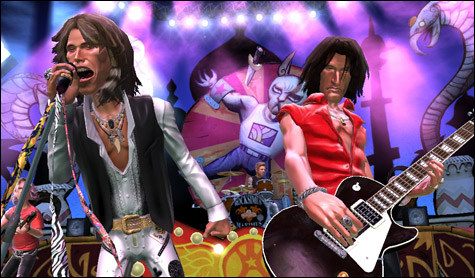
Above: Steven Tyler's had so much plastic surgery that he doesn't even look human anymore.

My review of Guitar Hero: Aerosmith is up now at thephoenix.com. The short version: It's not the worst Guitar Hero game ever made (that honor goes to On Tour, and Rocks the 80s was also worse), but it's symptomatic of the series' downward trend.

In some ways, the Aerosmith edition is almost better than Guitar Hero III: Legends of Rock, because the difficulty level makes more sense, and there's only one guitar battle -- which is still one guitar battle too many. But a music game lives and dies by its tracklist, and this is one of the weakest yet.

Strangely, though, I seem to have gotten much better at Guitar Hero during my most recent sabbatical from playing. I shredded my way through Aerosmith's hard difficulty without any trouble. Then, because the tracklist was so sparse, I popped in Legends of Rock and proceeded to slaughter a bunch of songs that had been giving me trouble before. If you recall, the difficulty in that game suddenly skyrocketed in tier 7. Well, suddenly I found myself five-starring "Stricken" and "Before I Forget" after limping my way through them months before. I don't know what happened. Best not to question it.

Still didn't have the balls to attempt tier 8, though. I'm not a masochist.

Monday, July 28, 2008

Atari 2600 box art vs. Atari 2600 games

No doubt about it, video games look great these days. Realistic character models, lushly rendered environments, and eye-popping visual effects seem to leap off the screen. If only box art had kept pace. In the days of the Atari 2600, the covers for most games were rendered with rich artistic detail, promising boundless visual delights within. If only the games looked anything like the box art promised. Here are some of my favorites.

Berzerk

The box promises:
A pitched battle against super advanced robotic insects through the depths of a Tron-like computerized environment. Your character is a lithe, speedo-clad Bruce Jenner lookalike.

The game delivers:
Several confused golems wait for their turn at the pink water fountain. They all got there at the same time, and no one knows who gets to go first.

Cosmic Ark

The box promises:
A Star Destroyer can pat its head and rub its tummy at the same time, blasting oncoming asteroids while gently scooping up the imperiled citizens of the galaxy.

The game delivers:
The flying oyster is nauseous, possibly from looking too long at the greenish starfield.

Adventure

The box promises:
Dragons! Castles! Hedge mazes! The grandest adventure of all time awaits, if thou are stout of spirit and pure of heart!

The game delivers:
Damn it, Warren left the pool floaty out again.

Custer's Revenge

The box promises:
A horny, nude cowboy ravishes a captive Native American woman.

The game delivers:
A horny, nude cowboy -- ah, crap.

Tuesday, July 22, 2008

A link to the present

A little link love for a post-E3 week:

-If you're not reading Jeremy Parish's 25-part celebration of the Famicom's 25th anniversary, you should be. Nobody does retro reporting so well.

-Stephen Totilo has the definitive take on Nintendo's E3 performance, which was poorly received in hardcore quarters (hardquarters?). To me, this is just another example of the uselessness of these shows in general, but now that the backlash has started against E3 critics, maybe I'll just shut my big mouth.

-Then again, if you still agree that E3 is a waste of space, maybe you'd like Magical Wasteland's take. It didn't have to be this way, says Matthew.

-Matthew Gallant takes a look at bloom disasters. Bloom can be quite pretty, but a little goes a long way. I remember finding myself squinting at Tomb Raider Anniversary, wondering if the settings on my TV were wrong.

-Tommy Tallarico drops by Cruise Elroy to discuss "real music" vs. "video game music." Besides presenting an interesting look at game audio (as Dan Bruno always provides), this is also proof positive that any time you mention anybody on the Internet, they will respond within 24 hours. Even if, as has been this case on this blog a few times, your traffic qualifies you to be little more than an ant under their shoes.

-Giant Bomb launched. Whether the world needs another straight-up news and reviews site, I don't know, but it's hard not to root for Gerstmann and friends after all they've been through.

-I try not to read reviews of games I'll be covering, but when I read Gamers with Jobs' review of Guitar Hero: Aerosmith, I didn't yet know that I'd be reviewing it myself. Unfortunately for me, Sean Sands' take is just about perfect.

Thursday, July 17, 2008

Shorter Electronic Entertainment Expo

Who has time to read painstaking, thorough reports filed from the E3 showfloor by some of the hardest working writers around? Here's your brief but indispensable show digest, by a guy who wasn't even there.*

Shorter Resident Evil 5:
You bet we've got exploding barrels.
Shorter Jeremy Parish:
I am now carrying Mega Man's child.
Shorter Texas Governor Rick Perry:
I was elected too late to help Ion Storm, but we can still save Midway Austin!
Shorter Square Enix:
Although we care deeply about our reputation on NeoGAF, we also value our continued existence as a company.
Shorter Nintendo:
"I'm Keith Hernandez."
Shorter Microsoft:
You can stream movies from Netflix absolutely free -- provided you're paying $50 a year for an Xbox Live Gold account, and at least $8.99 a month to Netflix.
Shorter Sony:
It little profits that an idle king,
By this still hearth, among these barren crags,
Match'd with an aged wife, I mete and dole
Unequal laws unto a savage race,
That hoard, and sleep, and feed, and know not me.
*You may think I stole this conceit from Penny Arcade, but in fact I stole it from Sadly, No!, who themselves stole it from some damn place or another.

Tuesday, July 15, 2008

Space is the place


Count me among those pleasantly surprised by Space Invaders Extreme. Still, there's not all that much I can think to say about it. This was a tough review to write, but an easy game to recommend.

I'm suffering from E3 overload right now, fending off dueling live-Twitters and redundant news posts in Google Reader. Even the interesting stuff from this show still isn't that interesting. It's a little surprising that Final Fantasy XIII is no longer PS3-exclusive, but what does that really mean for anybody? Exclusives are much more newsworthy than non-exclusives.

Anyway, I've railed against the culture of hype before, and I don't really have the energy to do it again. Suffice it to say that much of what comes out of E3 -- even in its newer, sleeker iteration -- is not news. It is publicity. The message is controlled fully by the marketers. By now, you'd think people would know better.

In a perfect world, maybe the only way we'd find out about any games would be by taking them off the shelves at random and discovering what awaited within. Probably not worth the effort pining for that world.

Thursday, July 10, 2008

The worst interview ever

Above: "Not really" big gamers.

Whenever someone refers to me as a games journalist, I cringe. Journalism involves things like enterprise reporting, talking to people, and leaving your house. That's not my scene. My scene is asking someone else to bug publishers for promos, retreating to the privacy of my apartment, and then blustering on for thousands of words while wearing an open bathrobe and drinking Narragansett.*

Nevertheless, when I first got into this racket, I assumed it was expected of me to engage in some journalistic activities. So I attended a Major League Gaming event, visited the offices of Atari and Harmonix (this was before Guitar Hero, mind you), and, on the eve of the 2004 Nintendo Fusion Tour, conducted the worst interview in the history of the printed word.**

You can read that link to find out more about the Fusion Tour, but in a nutshell it was a cross-promotional music festival that featured crappy pop-punk bands on the stage and Nintendo kiosks in the lobby. The kiosks featured, among other games, a playable demo of the not-yet-released Metroid Prime 2: Echoes, which was my favorite part. Onstage were a bunch of up and coming bands, including a pre-"Helena" My Chemical Romance.

Headlining the Fusion Tour was Story of the Year. At each stop along the way, two lucky fans would win a chance to compete against the band in a game of WWE: Day of Reckoning. Somehow, I found myself with an appointment to do a phone interview with the band's singer, Dan Marsala.

You have to understand how nervous I was. I hate the phone. I won't even call for pizza unless physically threatened. Sure, everyone has to start somewhere, but I had no experience interviewing people, and I am not by nature a talkative guy. Someone else needs to lead the discussion. Hiring me to conduct an interview is like asking Amy Winehouse to be your AA buddy. I'm not proud of this. It's just the way things are.

The moment came, and I called. Their manager answered. "This gonna take long?" he said. "Cause we got some other stuff to do."

"No! Just a couple of minutes," I said. I was grateful. The less time I had, the better.

He handed the phone to Dan. All right. Showtime. I'd been thinking hard about what to talk about. Story of the Year. Nintendo Fusion Tour. Metroid Prime 2. WWE: Day of Reckoning.

"So!" I said as cheerily as I could. "Headlining the Nintendo Fusion Tour. Are you guys big gamers?"

"Not really," he said.

Neither of us spoke for a moment. I wasn't sure if the hissing noise was the open phone line, or the blood rushing in my ears.

Finally, I thought of a follow-up: "Oh."

If you read the article, you can tell that I was able to stammer out a few more sentences and get some workable quotes, although I don't even mention Marsala's name until about two-thirds of the way through. When I do, it feels superfluous. But hell, I'd gone to the trouble of doing the interview -- I'd be damned if I didn't use some of it.

As these things go, obviously my interview wasn't as bad as, say, NFL quarterback Jim Everett beating the stuffing out of Jim Rome. If anything, I probably set myself up for failure by not preparing to talk about this guy's music. But it was enough for me to know I never wanted to do that again.

*At least one part of this sentence is not true. I will leave it to you to guess which.

**Sorry these are all Web Archive links; the originals have gone fishin' since the Phoenix's site redesign.

Wednesday, July 09, 2008

This does not assuage my fears

Chris Dahlen got some hands-on time with Rock Band 2 for the AV Club. Among his terrifying findings (all direct quotes):
  • Rock Band 2 is an expansion, not a reinvention.
  • In the band world tour... you'll have more variables to play with. You can hire staff – promoters, your mom – to support your band or find new gigs. A risk and reward system will complicate the business end: hire a sleezy accountant and you may clear more money from a successful gig, or you may get robbed if you underperform.
  • Harmonix has skipped user-generated content for the forseeable future

None of that is encouraging -- particularly the middle part, which reminds me of all of those bloated features that found their way into the Madden games, like picking your custom player's parents, putting him through college, making him do squats, and helping him to score in double-digits on the Wonderlic.

I should say that after airing all my concerns about Rock Band 2 on Monday, I've come around somewhat. The simplest thing I didn't consider is the usefulness of the disc-only version this time around. Rock Band owners won't have to splurge to get almost all of the benefits of the new version, as they did last year. If you consider that the disc will house over 80 songs, according to Chris's article, then you're saving a bundle on song costs alone -- if, that is, you would have chosen to download all of those tracks a la carte. That's a big "if."

While I still think it's something of a kiss-off to people who bought Rock Band last year that newer, better peripherals will be available in September, ultimately it's not a dealbreaker. Even so, I still think that with the DLC spigot spewing cash into Harmonix's coffers, they would have been better off releasing these iterative improvements as updates to the original, while they toiled away on the real sequel.

One more thing about that lack of user-generated content. I'm sure that whatever Harmonix has up their sleeve regarding this "indie initiative" is going to be a positive feature. But Chris's article seems to suggest -- and Ryan Stewart's Phlog post concurs -- that the coming wave of mostly crappy Guitar Hero IV user-generated tracks is a bad thing.

Sure, most of it will be crap. That's to be expected. The sheer volume of it will ensure that, in absolute terms, much of it will also be good -- some of it surprisingly so. The best will rise to the top, just as happens on sites like YouTube, thanks to community involvement. This is a good thing. And it goes further toward democratizing music than does an exclusionary model by which, if you're some kid dicking around in his room instead of playing in a "real" band, no one thinks you could possibly create something worthwhile.

Tuesday, July 08, 2008

Speaking of Guitar Hero

Yesterday, I mentioned that I had played Guitar Hero: On Tour. The full review is up now at thephoenix.com.

In short: The game is disqualified because the peripheral is so uncomfortable. QED.

Guitar Hero: On Tour is sort of impressive to behold on a philosophical level, but in practice it just plain sucks. I could not recommend playing this to anyone. But there are a couple things I didn't get to in the review that are worthy of discussion.

For one thing, the battle mode that was introduced with such a splat in Guitar Hero III: Legends of Rock actually fits better on this Nintendo DS version. Since the whole user experience feels less like you're playing a guitar, these sort of extracurricular gameplay features don't feel as grafted on. Plus, you can actually store up attacks, up to three in all, after you've earned them. There's a bit more strategy as a result (though still not much).

Because this is a DS game, of course, you must blow into the microphone. During battle mode, your opponent may set your guitar on fire, and you have to blow it out. Okay. And to activate star power, your options are to shout "Rock out!" (yeah, right), or blow into the microphone.

This... this was a lot harder than I would have thought. It's easy to miss the tiny mic slot when you've got your eyes on the note charts. As a result, as with the console versions of Guitar Hero, I still cannot activate star power without bungling my note streak at least half the time.

(You can also activate star power by hitting the D-pad or the A, B, X, or Y buttons, but this turns out to be nearly impossible. Might have worked if you could hit the shoulder button, but alas, that's the one button you can't use to activate star power.)

I gave it a 4.0, so I was a bit surprised to see that Guitar Hero: On Tour's Metacritic score is a 74. But in video game terms, that's actually not great. By Guitar Hero standards, it's a disaster.

Monday, July 07, 2008

Rock Band 2: Why now?


Give me a choice between Rock Band and Guitar Hero, and I'll take the former every time. This despite the countless hours of entertainment the first two GH games gave me. That was the past. Now? Activision has ruined Guitar Hero. I don't know how to put it more plainly than that.

(Bill Harris does know how to put it more plainly, laying out in exquisite detail the destruction of the Guitar Hero brand.)

I'll grant that when Harmonix was at the GH reins, they still pinched off a stinker, but that one had "contractual obligation album" written all over it. Besides, by that point, they were hard at work on a much better game: Rock Band.

In the meantime, Activision had dished off Guitar Hero development to Neversoft, a company that knew a little something about running quality brands into the ground. (But let's be fair to Neversoft: The first several THPS games, which they created, were freakin' fantastic.)

This resulted in Guitar Hero III: Legends of Rock, a game which was pleasant enough in its own right, but lacked the secret sauce that made its predecessors so great. Ultimately, it seemed that its developers weren't trying so much to replicate the feeling of playing these songs, but were trying to shoehorn them into a traditional skill-based gaming style, in which harder equaled better.

Most troubling was what GHIII seemed to portend. Instead of focusing on the music, the developers added features like the gimmicky boss battles, which no one enjoyed. Inevitably, the sideshow became the main attraction, and we were treated to Guitar Hero: Aerosmith Edition, which I have not played, and the full-on belly-flop of Guitar Hero: On Tour, which I have.

In the meantime, Rock Band came out and just pushed music. Each week, new tracks were available for download -- not costumes, not backgrounds, just songs. Some songs appeared in both games. In each case, the song was harder to play in Guitar Hero, and more fun to play in Rock Band.

Why?

Insult Swordfighting reader Iroqouis Pliskin actually asked the folks at Harmonix. It's not just how Harmonix draws up the note charts, although that's a big part of it. Song choice is also crucial. Their emphasis is less on pushing new, hot tracks. and instead "reflects a curatorial esteem for musicianship," in Pliskin's words. (Not that this excuses that bland new Motley Crue song.)

Strangely, with Rock Band 2 and Guitar Hero 4 poised to do battle this fall, it's Guitar Hero that seems more innovative, and not because they're stealing Rock Band's idea (except they're putting the cymbals above the drum pads, so it's, like, totally original). No, they're including a create-a-song feature, the first really good idea the series has had since the original, and the logical next step. I don't know how well it will work, but I know I want to try it.

By contrast, Rock Band 2 will have one feature it really should have had the first time around, and everything else new has only been hinted at. Maybe you'll be able to import tracks from your iPod. Everything else seems evolutionary. Improved peripherals are fine, online World Tour is helpful, and other than that we haven't heard much. (In fact, after paging through Google Reader, I'm not even sure if I've hallucinated the online World Tour functionality.)

My question: Does any of this stuff warrant a sequel? Particularly a full-priced sequel, to be released less than a year after the original? I'm not sure I follow the logic. Rock Band's DLC is a financial juggernaut. People are quite happy to keep forking over a few bucks for new songs. Much of what Harmonix seems to be promising for the sequel could probably be implemented on the software side via downloadable updates. Improved peripherals are welcome, but they hardly seem to justify the sequel treatment as would new instruments (I'm dying for some keyboards over here).

I'm afraid Harmonix might be applying an Activision-like squeeze to their property -- releasing a new game not because the world is ready for one, but because it's another calendar year and that's just what you do, dammit. Rock Band wasn't cheap, at about $170 for the game and all its controllers. Will the sequel also cost that much? What does that say to people who bought the game last year, expecting it to serve as a platform for years to come? Yes, I'm aware that both games will likely support future DLC. But by definition, Rock Band 2 will have to have exclusive new features, no?

Harmonix has earned the benefit of the doubt several times over. It's possible, even likely, that there are some terrific surprises in store. Still, one thing I never felt when the original Rock Band was announced was even a semblance of doubt. Rock Band 2 seems like too little, too soon.

Thursday, July 03, 2008

Metal Gear Solid 4 in a nutshell

Joystick Division's Gary Hodges on MGS4:
Playing through MGS4 in all its extravagant glory, I can't help but think of it as something like a Tyrannosaurus rex: the biggest, most extreme, most fully realized example of something that's ultimately an evolutionary dead end.

Can't put it much better than that.

Wednesday, July 02, 2008

Old soldiers never die, they just talk a whole lot


Only about a month late, my Metal Gear Solid 4 review is up now at thephoenix.com.

MGS4 is currently sitting pretty with a Metacritic score of 95. It's a little too much of a coincidence for me that a "one of a kind masterpiece" would be released only about five weeks after the last game the enthusiast press was falling over itself to anoint the best game ever. To read the blurbs about MGS4 on that Metacritic page is like witnessing one of those revivalist worship services where people speak in tongues and collapse to the floor in the throes of religious ecstasy. It's scary and weird, and when I played the game I just didn't see it. Not at all.

The first half of the game was a blast to play -- we're agreed on that much. But as the ratio between gameplay and cutscenes tipped further and further before toppling into the abyss, all I could think was how backwards it all seemed. Gamespot says, "For anyone who appreciates games that rise above the simple act of pushing a few buttons and pulling a few triggers, Metal Gear Solid 4 is a stimulating ride that you won't soon forget." I could not agree less.

"Stimulating" is the last word I would use to describe hour-long stretches without player interaction. In fact, this game could have used many more simple acts of pushing buttons and pulling triggers, because for the most part you don't do anything at all. I like a good cutscene as much as the next guy, but I was hoping the notion of "interactive movies" as something to strive for had gone out with the Sega CD.

The whole thing has caused me to rethink my stance on the entire series. I loved the first Metal Gear Solid without reservation. I hated the second one, mostly because I didn't want to play as Raiden, but also because the story went so far off the rails that I had no idea what I was doing or why. I always assumed that Sons of Liberty was the aberration. But then I could never get into MGS3, again because it was so front-loaded with cutscenes that I was unable to get into the rhythm of it each time I tried to play. Now that MGS4 has similarly failed to work for me, I have to conclude that the original was the exception.

The data doesn't lie: I'm not a fan of the series. It feels like I just found out I was adopted.

Tuesday, July 01, 2008

Do readers want intelligent games criticism? Do writers?

Mike Walbridge interviewed me for his latest "Game Anthropologist" column over at GameSetWatch. I thank him for including my rambling, incoherent thoughts alongside insights from some heavy hitters, including N'Gai Croal from Newsweek, Kieron Gillen from Rock, Paper, Shotgun, and Shawn Elliott from 1up.com. The subject: The state of intelligent games criticism.

Without knowing how much was left on the cutting room floor, I get the impression that nobody is too sanguine about the state of the art. Of the writers interviewed, most contribute to fairly popular, mainstream paper-and-ink publications. Yet, to a man, it seems like we all see our blogs as the only place we can write about games the way we really want to.

N'Gai says all the interesting writing is being done online. Leigh says her blog is the outlet for her voice (which, presumably, means that Kotaku and Variety are not). Shawn says his blog is a place for him to try writing about games as it should be done (again, implying that Ziff-Davis publications aren't). I feel the same way. Although the quote wasn't used in the piece, I said as much to Mike -- that Insult Swordfighting is the place I can say what I actually want to say.

That's strange. Writing for publications as diverse as Kotaku, Newsweek, the Phoenix, and Games for Windows, and we all feel like -- what? Like we're not serving our readers as best we could? What's the implication here? Are we speaking the softest into the biggest megaphones? Do we think the larger audiences are somehow unready for the brilliance we're slinging on the side? If I didn't know better, I'd think this signaled contempt for the readership.

But that's not the case. If anything, this article makes it clear that most of us have faith that things are heading in the right direction, slowly but inexorably. For one thing, you do have to keep your audience in mind when you're writing for a magazine or a newspaper. You have to remember who you're working for. I see the typical Phoenix reader not as a career gamer, so it doesn't make sense to try to talk to them on that level. Instead, I try to talk put the game in a context they'd understand, focusing on things like story and theme when possible.

Am I sure that I've got this hypothetical reader pegged? No. It's a question of intuition more than anything else. But it's always at the forefront of my mind when I write for the Phoenix. Years from now, I think that reader will have much more of an intimate relationship with games, and the style of review will be different at the time. Still, on a blog, that question never comes up. You write what you want, and the readers either come or they don't. Usually, they don't.

You can't ignore the hard numbers. People want newsbites and they want review scores. Web users just don't want to read long, involved essays. As readers migrate from print to the Web, savvy publishers are going to continue to break their content down into easily digestable chunks of fast facts. I'm not suggesting that this indicates a dumbing down of the general population -- it may even be the opposite, as more and more people get online -- but writers and readers may be at odds as far as what they want criticism to look like. And in every case when such a conflict arises, the readers will win. (As they should!)

Of course, there is still an audience for this stuff. People do read The Brainy Gamer and Save the Robot -- just not in the numbers they read IGN or Gamespot. When 1up editors like Shawn Elliott and Jeremy Parish explore the studio space in their personal blogs, they're reaching readers, too. The level of discourse in games coverage is higher than it's ever been, even if you have to hunt for it a little bit. But even that is starting to change. Mike's article is evidence of that.

It won't happen overnight. If good writers are committed to improving the quality of all writing, then there's really no other choice but to keep at it and hope our efforts bubble up through our blogs and into the "real" publications. We have to do this. We're writers.

Wednesday, June 25, 2008

Yvonne Abraham thinks you're dumb

Why does Boston Globe columnist Yvonne Abraham need to bring video games into this screed about lunatic sports fans -- not once, but twice?

In fact, one of the many reasons I wasn't out rioting when the Celtics won the championship was because I was at home, playing Metal Gear Solid 4: Guns of the Patriots. It's one of numerous non-idiotic things I do with my time. I also like to read books, cook, and spend time outdoors hiking and snowboarding. But none of those things would mark me as the kind of drooling ape only Yvonne Abraham has the courage to take on in the pages of a major metropolitan newspaper.

Abraham's implication, which I'm sure she spent upwards of a second and half cogitating, is clear: rioting is a brainless activity, and playing games is a brainless activity. Can't have one without the other. There you go! That's your lede! Now to break this column into several vapid, Bill Plaschke-like one-sentence paragraphs, and sit back and wait for the accolades to roll in. Yvonne, you've done it again!

(I am glad to see that it's not just sports bloggers who are always accused of plying their trade from their mother's basements, though.)

Tuesday, June 24, 2008

But the thing is, the cutscenes are really long

Apparently, you're not supposed to complain about the length of the cutscenes in Metal Gear Solid 4. If you're the game's Associate Producer Ryan Payton, you're not even supposed to acknowledge that they are long.

I already talked about some of the problems with these scenes on a dramatic level. In that post, I brushed aside the question of length, but it's something I want to get back to because I'm getting the impression that it's something people would rather we not discuss -- and I don't just mean Konami's PR department.

Cutscenes are integral to the game's identity. I get that. To remove them would be to make it something else, something not Metal Gear. That still doesn't make them off-limits for criticism. Kojima and company included long, non-interactive narrative sections as a major focus of their game, so logically those sequences should also be well represented in any critical discussion. The question is: Would MGS4 be better if the cutscenes were shorter?

I say yes.

Here's why: At their core, what these cutscenes do is take control from the player. They do so in a couple of ways. First, and most obviously, they simply show events unfolding without any player input. In MGS4, there are several moments during cinemas in which the player can hit a button to view brief, hallucinatory flashbacks, but while that's a cool feature it's really not the same as feeling like you're directing the scene. So these scenes take away one of the most fundamental characteristics of the medium. Whether they add enough in return to make up for that is open to debate.

On another level -- and this has always been one of my biggest pet peeves about games -- they don't let the player control something as basic as starting and stopping according to his whims. When you load up Metal Gear Solid 4, you need to do so with the expectation that you don't know when you'll be stopping. You need to accept that Hideo Kojima will make that decision for you. I do not consider this a virtue, although I'd be happy to hear arguments to the contrary.

Here's an example of when the cutscene length starts to seem silly. I had about an hour to squeeze in some playing time last night, and since I had last saved at the end of some long cinematics, I was eager to get in a little bit of sneaking before dinner. I turned the PlayStation 3 on at 5 o'clock. At 5:50, I saved and turned it off, having not touched the controller once. There wasn't one instance of gameplay that whole time. While some of the scenes I had watched had been entertaining, at about the 20-minute mark I began to feel irritated that I wasn't doing anything, and by the time I was done "playing" I was just this side of pissed off. My only other option would have been to skip the movies entirely, but then I wouldn't have known why I was doing anything. Some choice.

Some games do clever things with the notion of eliminating player control, BioShock and The Darkness being two recent examples. Although Metal Gear Solid 4 is often inventive during gameplay, it fails to break conceptual ground with its cinematics. They're awfully traditional. They're just amped up, loud, and long. The player's actions are the bridge that connects cutscenes, instead of the other way around. This seems misguided to me.

I am trying to remember if the cutscenes bothered me so much in past MGS games. They certainly didn't in the first one, although I remember one afternoon when a particular scene resulted in my being 20 minutes late to work. When I think about that game, though, what I remember are the mindblowing in-game moments: The first fight against an invisible Gray Fox, rappelling down the communications tower under helicopter fire, battling Sniper Wolf across a snowy field.

3/5 of the way in, I don't feel that MGS4 is creating the same kinds of memories for me. That's why, although I'm certainly enjoying the game, I keep writing these long, negative posts about it. There is still a ways to go, though. I'm keeping my fingers crossed.

Friday, June 20, 2008

Why does everybody in Metal Gear Solid talk like that?

Above: "Funny you should mention the war economy; I was just drafting a ten-minute speech about it."

Tycho from Penny Arcade has an unorthodox opinion about the cutscenes in Metal Gear Solid 4:
I actually like the story of Metal Gear, but it's not told well. I don't care if a cutscene is long provided that it's well paced, but these cutscenes aren't simply long, they're eternal - and they feel even longer than they are because they're pure overreach. The script is insipid, didactic, and its insights are trite. The humor doesn't work, period, and it works even less against the backdrop of perpetual war.

Usually, when people talk about the cutscenes in the Metal Gear Solid series, it's only to argue for or against their length, and the quality of their integration with the gameplay. Most people seem to agree that the cutscenes, taken at face value, are done well.

And in Metal Gear Solid 4, from a production standpoint, they're better than they've ever been. Graphically, there seems to be little separating cinematic cutscenes and in-game, player-controlled actions. With no loading time between them, Kojima's team has achieved a seamlessness that has eluded past MGS games. (I should mention here that I've only just finished Act 1, so these are just my impressions so far.)

It's not just the technical side. Artistically, maybe only SquareSoft can compete with Kojima on the cinematic level. I agree with Michael Abbott: "...[Kojima] is a fine and gifted filmmaker. One can easily track his maturation from the original MGS. Unlike other so-called cinematic games like Mass Effect, the filmmaking in MGS4 is visually creative, high-caliber stuff." Kojima uses depth of field and simulated handheld cameras, among other tools, to showcase an aesthetic sensibility that outstrips that of many Hollywood directors.

As a writer, Kojima is less successful. The MGS series has drawn praise for its story, not least because after four games, it's clear that we're dealing with a science-fiction saga as epic in scope as anything comparable in literature or film. These games have real ideas about human conflict, about free will and fate, and now about the intersection of warfare and commerce. That they are not terribly penetrating insights almost seems not to matter -- we're just glad to see a game that takes a point of view at all (compare MGS4's take to the rigidly moralistic viewpoint of Call of Duty 4).

But that's not where I think the writing falters. I'm talking about the nuts and bolts. I'm talking about the words Kojima uses, and the manner in which they are communicated. This man needs an editor.

No one ever lived in Kojima's universe who wasn't waiting for an opportunity to wax rhapsodic about the deepest philosophical questions to anybody willing to listen -- or even to those, like Tycho, who aren't. Characters make their points, and then they keep talking. No one is reluctant to bare his soul. Everyone speaks in paragraph form. People in Metal Gear Solid don't have conversations; they trade soliloquies. The cutscenes are so long because nobody ever shuts up.

This post probably gives the impression that I'm not a fan of the game, and so far nothing could be further from the truth. I'm all the way in, to the point where I've been spending my non-playing time counting the minutes until I could get back to it. But Tycho's comment rang me like a bell, because I do think he's right, and I think in some ways Metal Gear Solid 4, like Grand Theft Auto IV before it, has provided another excuse for the community to anoint a savior. MGS4 ain't it.

In fact, I'd be willing to bet this game would be one of the worst things you could show to a Roger Ebert type in a bid to gain respectability. It focuses so much on the virtual performances that someone with no prior investment in the characters would be unable to look past the clunkiness of the storytelling. For us as players, it's easy to see why we're absorbed: We have a stake in Solid Snake's fate, which makes the game's long sequences of passivity acceptable.

Would the same be true of someone who wasn't playing? I doubt it.

Tuesday, June 17, 2008

Invitation to a beheading

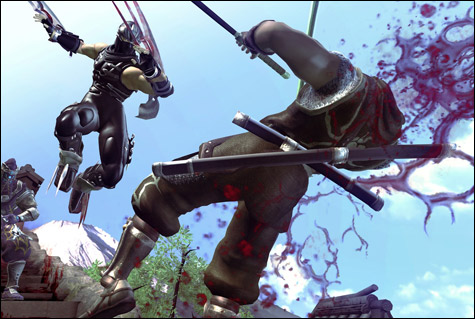
Well, my Ninja Gaiden II review is up now at thephoenix.com. I hold the original in high regard, but that might be because I was able to simply stop playing once it got too difficult. That wasn't the case here. But I also didn't notice quite so many glaring problems with the game camera in the original, possibly because I never got past the second boss. In the sequel, the capricious camera had me tearing my hair out at points.

What's either the best or worst part about Ninja Gaiden II, depending on your point of view, is how much of a throwback it seems like. If not for the fancypants visuals, you might think you'd stepped through a wormhole and were playing a 16-bit sidescroller. It's just hordes of enemies strewn along a linear path, culminating at the end of each level with a brutal boss battle. There's no more sophistication than that, and I think for a lot of people that's the game's biggest selling point. I might have appreciated it more, too, if I hadn't been so busy trying to avoid another control pad stress test.

Wednesday, June 11, 2008

25 years of Capcom

Kotaku says today marks the 25th anniversary of Capcom's founding, which seems like an appropriate occasion to revisit this post: "In praise of Capcom." The post is reprinted below, in its entirety.

That Umbrella Chronicles post reminded me of something. Whenever I get to thinking about my favorite game development houses and publishers -- and, believe me, this is what I spend most of my time thinking about -- one name invariably rises to the top: Capcom.

I could spend all day lauding the work of other companies, but not often without caveats. Valve has never made anything but a great game, but they barely ever release anything. Nintendo has been making great games for decades, but many of their 3D flagship games have struck me as a tad overrated, or at least less interesting than what their competitors are doing. Square Enix falters whenever they step outside their comfort zone, going back at least to Einhander. I have the utmost respect for what Atlus does, although their games are usually a bit too out there for me. Konami is one of the more reliable large publishers, but particularly with their 3D Castlevania offerings they can be guilty of one of gaming's cardinal sins: making boring games.

Capcom, on the other hand, may not always make great games, but even their failures are more interesting than other companies' successes. Dead Rising, for example, was so obtuse as to be maddening, but the bold vision behind it was unmistakable, and those who took the time to delve into it were amply rewarded. Lost Planet, a rather rote third-person shooter, presented a chilly Arctic setting that stood out among the gray and brown mechanical nightmares of other science-fiction-inspired games. Even God Hand, a gigantic mess by any measure, was an audacious joke that cleverly tweaked video game clichés.

And when Capcom connects, they get all of it. Capcom released my game of the year for 2005 (Resident Evil 4) and 2006 (Okami). This year's Resident Evil 4 Wii Edition was a more thrilling, complete game than any new intellectual property. It's quite likely that the upcoming Wii remake of Okami will do the same thing next year. With RE4, Resident Evil: The Umbrella Chronicles, and Zack and Wiki, Capcom is showing a mastery of the Wii that's far beyond the half-baked mini-game collections of their competitors.

They're no upstarts, either: Capcom has been rocking consoles and arcades for decades. Check out Wikipedia's list of Capcom games and try to count all the classics. Tally up the high-quality franchises. Mega Man. Street Fighter. Resident Evil. Devil May Cry. Phoenix Wright. Look at the memorable arcade games: Bionic Commando, Ghosts 'n Goblins, all those great beat-'em-ups and shooters.

And, of course, they also made Super Puzzle Fighter II Turbo. I rest my case.

Review: The Bourne Conspiracy

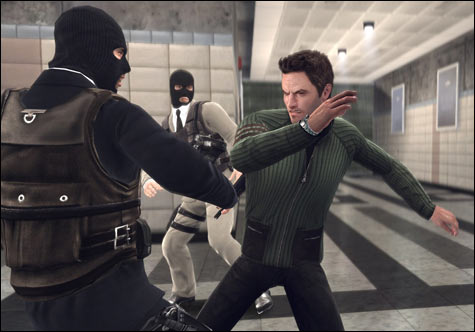
My review of The Bourne Conspiracy is up now at thephoenix.com.

I've noticed in the past that I seem to have a tendency to go easier on games that actually suck, while I savage games that are just mediocre -- which is the case here. It's not a badly made game. But it's repetitive, and pretty much blows its wad right away. The fighting never gets more interesting than the first time you do it. For some reason, enemies can use weapons against Bourne, but unless it's a contextual "takedown," Bourne can't reciprocate. That's annoying. But it is cool to watch, and there's a good chance that some people would enjoy this game more than I did.

Tuesday, June 10, 2008

Backpacking: The Official Game

Over a long weekend, I had the chance to sink nearly 48 hours into a superb new game called Backpacking: The Official Game. Part strategy and part survival simulator, Backpacking also prominently features a Wii Fit-style exercise component (with the peripherals to match). I've enjoyed the developer's previous efforts in the past (among other things, the creators of Backpacking: The Official Game brought us Non-Virtual Snowboarding and Actual Paintball), so I was excited to dig in and review this one.

Above: Real-time rendered scenery includes bump mapping and transparency effects.

Graphics

Let's get it out of the way first: this game is gorgeous. My computer couldn't meet the minimum specs to run Crysis, but somehow, without any computer at all, I was treated to visuals that blew even Crytek's best away. The broad strokes of the game's forest setting are impressive enough. The draw distance can seem infinite at times, and there are some cleverly implemented twists and turns that seem maze-like. But the details are where Backpacking really shines. Individual leaves sway in the breeze, rippling streams cascade over rocks, and bugs scurry over gnarled tree roots. One might expect the all-green palette to get monotonous, but somehow it never does. (Still, it's a treat when the level design opens up to reveal an electric blue sky!)

Sound

I usually associate a thumping, orchestral score with games of this genre. Somewhat surprisingly, Backpacking eschews a musical soundtrack altogether in order to focus on an authentic ambient experience. Sometimes, the environmental noises are so subtle that you have to stop and listen to pick them up. With several channels of audio playing simultaneously, it's stunning that most sounds are crisp and distinct. Birds chirp in full surround. Twigs snap underfoot. A late-night thunderstorm sequence is the closest Backpacking gets to grandstanding, but it's executed so well that you forgive the developers for showing off a bit. You can really feel the rumbling of the bass!

Play Control

To be honest, it's a bit tricky to get the hang of Backpacking. The somewhat onerous peripherals necessitate a slower pace in navigating the maps than in most games. The emphasis isn't so much on ease of use as on realistic player feedback. For example, when the terrain in the game world slopes upward, you'll need to push your buttons harder, in order to adjust. Taking a page from classic sidescrollers, Backpacking also has plenty of obstacles that require the player to jump from one platform to another. But unlike Super Mario Bros., Backpacking has advanced logarithms to calculate momentum, and requires constant fine-tuning. Still, folks who've spent some time with the balance games on Wii Fit ought to find it easy to adapt. Although the learning curve seems a bit steep at first, it's well worth the effort. In no time, you'll be hopping from rock to rock and charging up hills.

Above: The author's realistically modeled avatar (right), alongside three others imported from his friends list.

Gameplay

Backpacking is a little strange because there aren't very many developer-defined goals. You can stick to the trails they've mapped out for you -- although you don't have to -- but as a player you can pretty much choose where to start and where to end. (Imagine a land-based Endless Ocean). Backpacking has a robust multiplayer component. You can invite anyone on your friends list to join in. There's no cap on the number of players, but it may get complicated to handle with more than about ten or so. As a group, you can decide where on the map to head next, what difficulty level to play on, and even share resources easily. I didn't try the single player mode. I imagine it has its charms, but probably is less rewarding.

Backpacking isn't without its challenges, however. You have two power meters that run down as you progress through the game, and if either one of them hits zero, your character will die. (Bizarrely, there's no "continue" option. What is this, 1982?) The first, a hunger meter, runs down a bit slowly. You can boost it sporadically throughout the day by pre-selecting rations, as in The Oregon Trail, and deploying them intelligently. The thirst meter runs down faster, and can be filled back up when you find water sources hidden throughout the game map (there's even a water-pumping mini-game in which you strain out impurities through a tiny sieve). Although the developers went so far as to include an optional pooping side quest, only the most rigid completionists among us attempted it.

Above: The climactic escape from the forest.

Conclusion

Open-world games haven't always been my cup of tea, but Backpacking puts it all together in a brilliant package. Like with the similarly superb Grand Theft Auto IV, the experience is really what the player makes of it. Variable difficulty settings and customizable game parameters make for a robust, user-defined experience. All told, Backpacking: The Official Game is one of the best games I've played in awhile, and I'm eagerly awaiting the follow-up.

However, in the sequel, I'd really like to see a boss battle against a T. Rex.

Tuesday, June 03, 2008

Break like the wind

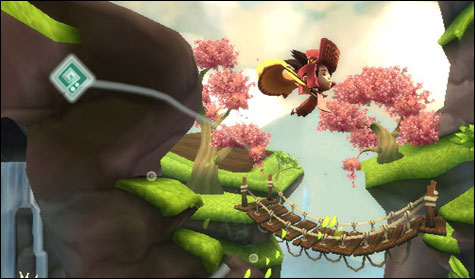
My review of LostWinds is up now at thephoenix.com. Consider me not blown away -- this really is half a game, at best. If I'd known going in that it was intended to be episodic, my reaction might have been different.

I've read that one of the guys at Frontier thinks LostWinds' length compares favorably to bigger titles on a dollars-to-length ratio, and he may be correct on that math. But think about all the cheap casual games you can download with endless replay value, like puzzle games, and suddenly it's a less tempting proposition. No matter what I pay for a game, I want it to be a complete and fulfilling experience. While I'm not sorry that I spent ten bucks on this game, I wouldn't necessarily recommend that others do the same.

Monday, June 02, 2008

I blame the editors!

I got zinged pretty good in a letter to the editor regarding the improper use of the word "touchstone" in my Grand Theft Auto IV review. Consider me enlightened!

Although it's not quite as clever as this recent letter to the New Yorker regarding what is, and is not, iambic quadrameter.

Wednesday, May 28, 2008

True confessions

Random thoughts while trying to figure out why the blogging muse has taken a sabbatical:

-The more I hear the advance buzz about Metal Gear Solid 4, the less I want to play it. Pre-release 10/10s and "game of the year" accolades have become a warning sign. I don't care how good it ends up being, when I'm sitting through a 60-minute cutscene, I'll be thinking: "Is this the game of the decade, like GamePro said?"

-I haven't played Grand Theft Auto IV since filing my review. That would seem to undercut the basis for giving it a 9.0.

-The thought of playing games online with strangers makes me nervous. I try my best to avoid it.

-For all the smart things Nintendo has done in the past few years, I can't figure out why they don't price Wii points on a sliding scale. It's ten bucks for 1,000, twenty bucks for 2,000, thirty bucks for 3,000, and so on. I have 200 points sitting around, and I needed 1,000 to get LostWinds. The game costs 1,000 points. I would like to take advantage of that remaining 200 somehow. If I could have gotten 2,000 points at even a slight discount -- say, $18 -- I probably would have. But there's no incentive to pay more. What are they thinking? They're handicapping their own revenues here, which is not something Nintendo usually likes to do.

-I think if you read between the lines of most of the reviews I write, you won't learn whether the game is good or not. You'll learn whether I was good at it or not.

-I scored Castlevania: Portrait of Ruin too low (8.0).

-I scored Manhunt 2 too high (1.5).

-Sometimes I wonder if I should hold shorter, downloadable games to different standards. Then I remember Portal.

-Which is the most aggravating to follow: video games, politics, or sports? They all come with so many douchebags.

Tuesday, May 20, 2008

One size Fits all

Consider me stumped as to WiiFit's appeal. The game -- er, "lifestyle product" -- doesn't even officially come out until today anywhere except the Nintendo store in New York, but it's safe to say it's going to be a hit. Anecdotal evidence suggests that non-gamers at general-interest publications, to use the scientific term, are going apeshit over it. It happened at the Phoenix, it happened at MTV, and it's probably happened everywhere. Why?

Don't get me wrong: I'd like to play it, too. I'm a sucker for gimmicky video games, and the potential for future games to utilize the Balance Board is intriguing (I would love a Board-compatible update to Nintendo's own 1080 series of snowboarding games). Further still, I'm always interested to see whether Nintendo's Wii experiments can pass the ultimate test of appealing to my non-gaming fiancee (so far, nothing has). Unfortunately, the WiiFit feeding frenzy left me on the outside looking in, so my only option is to buy it.

And, I've got to say, the thought of spending ninety bucks on this thing is somewhat less than tantalizing. Partly, it's because I already exercise regularly, and one of the biggest benefits of doing so is being able to sit on my ass playing video games all night, guilt-free. Still, if WiiFit were fun -- fun in the way that, say, Guitar Hero is fun -- then I'd be happy to do it. But I'm not convinced.

See, exercise isn't fun. It's one of many things I do every day not because I want to, because I have to -- like waking up, or going to work. It's one thing to do something genuinely fun that also has health benefits, like team sports or snowboarding. It's another to do push-ups and get yelled at by a virtual trainer. (Not to mention getting called fat, thanks to Nintendo's dubious inclusion of the Body Mass Index.) There's a reason why people are always signing long-term contracts with their local gym, only to spend two weeks exercising, and fifty weeks feeling guilty.

If WiiFit somehow succeeds in making fitness fun, then it will be the greatest trick Nintendo ever pulled. Call me a cynic, but I think what's really going to happen here is that the Balance Board is going to end up on heaps of discarded NordicTracks and treadmills in basements around the world.

Monday, May 19, 2008

I played The World Ends with You


I didn't really like it.

I know a lot of other people are loving this game. I'm not trying to talk you out of it. It just seemed like way too much for me, and I did not get the hang of the touchscreen controls at all. Maybe with some more time to play it, I might have been able to break through whatever wall I was hitting, but now that the review's over I can predict with confidence that I will never play it again. I think I will survive, somehow.

As always, feel free to berate me in comments.

Friday, May 16, 2008

Friday afternoon tidbits

Nothing worth mentioning about the upcoming weekend. Plenty to mention about the past week.

-Where are my manners? Earlier this week, I posted about a Village Voice Media story without mentioning their newish blog, Joystick Division. It's jam-packed with high-concept pieces, the best of which may be Nate Patrin's attempt to play 24 games in 24 hours. Consecutively. There's even a video.

-The latest New Yorker has a story about an experimental treatment for Iraq war veterans suffering from post-traumatic stress syndrome: a modified version of Full Spectrum Warrior. This is heartening to hear, and it sounds like preliminary results are encouraging. But it makes me wonder: If it could be scientifically proven that games could affect someone's psychological makeup in a positive way, wouldn't it logically tell you that they could also be psychologically damaging? The difference, of course, is that someone suffering from PTSD is already damaged. Perhaps that makes him more susceptible to this sort of conditioning.

-Gene Koo alerted me to the existence of Valuable Games, a joint venture between Harvard and MIT that aims to, as he put it, instill some "pro-social" values into gamers. Besides their blog, they also meet monthly for discussions. Next Wednesday, they'll be discussing Grand Theft Auto IV. Now that I seem to be off the hook for reviewing anything next week, I just may go. If I do, I'll be sure to report back here.

-If it's not murder simulators teaching kids how to kill cops, it's WiiFit telling them how fat they are. The BMI is a useless tool for measuring fitness, but it's also quick and easy, and that's probably why Nintendo chose to use it. Whoops. I doubt this will turn into a bona fide controversy, but considering how people seem to be going apeshit for this "lifestyle product," who knows.

-Matthew Gallant ponders the upcoming BioShock movie. Count me as cautiously optimistic about this one. I actually think that there's plenty of latitude for the filmmakers to change what's there, while still keeping true to the spirit of it. I'd like it if they went with practical effects for the Big Daddies, but they'll probably be CG. Easy prediction: Dr. Tennenbaum's role will be expanded significantly.