Monday, November 03, 2008
The must-play game of the year
A while back, I reviewed Stardock's The Political Machine 2008 for Paste. It's a turn-based strategy game all about the presidential election, with fairly realistic simulations of campaign fundraising, political ads, and the all-important electoral college. It was a lot of fun, even for a remedial strategist such as myself.
As much as I decry ever referring to a video game as "just a game," they're all just games compared to a real-life presidential election. Many of us are spending the season agonizing over which hot new release to get. Even when we settle on one, we immediately feel like we made the wrong call. ("Why, oh why did I leave Fallout just sitting on the shelf?") It's probably not much of an exaggeration to say that gamers are putting serious brainpower into figuring out how to cope with all these games. But the impact of that decision pales beside the consequences of a presidential election. With a teetering economy, people losing their homes, two wars, and countless other obstacles facing us all, I am begging you, if you haven't yet, to spend just a little bit of time today not thinking about games, and instead thinking about who to vote for.
In the movie WarGames, the computer realizes that the only way to win a nuclear war is not to play. Voting is the opposite: the only way to lose is not to play. So please go out there tomorrow and cast your ballot for whatever candidate you think is the best choice, based on their stated policies. Every election is important, and this one is no different. Nothing else you do all year will matter as much.
(There, I made it through a couple paragraphs without getting cute or editorializing. I'll just hit the "publish post" button here and --
OH GOD I CAN'T HELP IT FOR THE LOVE OF ALL THAT IS PURE AND GOOD IN THIS WORLD VOTE FOR BARACK OBAMA YES WE CAN)
Friday, October 31, 2008
Friday afternoon tidbits
Ah, Halloween. I look forward to the day I am a suburban homeowner, so I can hide in the bushes and spray miscreants with my hose. Until then, I'll continue to spend the holiday as I always do: barricaded in my apartment. But first, some leftovers from the week that was.
-First of all, welcome to everyone who showed up here thanks to N'Gai Croal's Edge column, "The Importance of Being Easy" -- and there are a lot of you! N'Gai and I seem to be coming from the same place regarding game difficulty. It's not that games shouldn't be challenging, it's that they shouldn't be so punishing. I, too, was a big fan of the Vita-Chambers in BioShock. And it's a marked contrast from Far Cry 2's approach, which is to rob you of all progress since your last save when you die. So if you die and haven't saved after finding some diamonds, scouting guard huts, or whatever, you'd have to do all that again. Given the scope of the game world, that's difficult, and frustrating.
-As long as I'm stroking my own ego here, Iroquois Pliskin wrote a great post about survival horror, in response to the Brainy Gamer podcast from earlier this week. He makes an excellent point about Resident Evil 4. Why was it still so scary when it did away with the series' usual miserly distribution of resources, and instead emphasized high-octane action sequences? Because, "...the key element is the fact that you cannot run and shoot at the same time. This turns open ground between you and the enemy into the scarce resource; you are constantly torn between ceding and standing your ground." Insight, people.
-This must be a watershed moment: The New Yorker profiled Cliff Bleszinski. It's a good read, although there's not much that's new to the kinds of people who spend their time reading and writing video game blogs. Still, nice to see coverage of this sort in such a highbrow publication. I guess this article had a few high-profile detractors (including Matthew at Magical Wasteland), but I didn't see the problem with it. Hell, compared to Patricia Marx's shopping columns and Sasha Frere-Jones's pop music reviews, this is Pulitzer-worthy. (And despite Tom Bissell's noting Bleszinski's request not to be called "CliffyB" anymore, the editors proceeded to do just that in the subhed. Nice work, guys.)
-Speaking of all that, the magazine's profile of Will Wright a couple years ago was also good, but less unexpected, somehow. I can honestly say that the last thing I expected to see when I got this week's issue was a picture of CliffyB dressed in Marcus Fenix's armor and holding a chainsaw bayonet.
-Just in case you thought you were the only one struggling with what to play and what to skip, we're having the same problem at the Phoenix. There are just too many games for the space we have. (Partly, that's because this is the first holiday season that everything we've requested has actually shown up.) It's leading to some hard questions about what's worth covering. We'll try to get everything in if we can, even if it means running some stuff web-only, but it's disappointing.
What about you? What are you buying? What games have you decided to skip, and why?
Thursday, October 30, 2008
Quiz: The Year in Swooning
1. Grand Theft Auto IV
2. Metal Gear Solid 4: Guns of the Patriots
3. Dead Space
4. Far Cry 2
5. LittleBigPlanet
6. Fable 2
7. Fallout 3
8. Resistance 2
A. "Is it possible to give a game an 11? If so, this would be the game that would merit that score."
B. "I now know how film critics felt after screening "The Godfather." ...doesn't just raise the bar for the storied franchise; it completely changes the landscape of gaming."
C. "It is not hyperbole... an achievement that rivals greats like Half-Life 2 and BioShock. Its nuanced and labyrinthine plot, fully-realized characters and devastating attention to minute graphical details are beyond reproach."
D. "...a staggering, genre-defining achievement - marrying an utterly immersive world, memorable characters, incredible production values, some of the most inspired ... mechanics ever devised and so much heart ... Stands so far ahead of the majority of the games ... that it would be a crime against gaming not to laud this title as anything other than a masterpiece."
E. "...a landmark title that fundamentally changes the genre. Better than the original in every way, it is an amazingly rich adventure packed with anything and everything from exploration to fierce gun battles to harrowing car chases. It's incredibly polished, enormous in scope, and one of the best games of 2008."
F. "While the single-player experience is a great tale with an epic scope, it is equaled, and perhaps surpassed, by the multiplayer modes, which are perhaps some of the best I've ever played, and I'm particularly picky about my multiplayer."
G. "...one of the most important games to be released this decade. A tall order with the hype machine running overtime for the game but the way it reinvents how video games are played is sure to have lasting effects indefinitely."
H. "One of the greatest RPG’s ever made, a must own game for fans of the genre and anyone who wants to experience something truly unique."
Answers:
1. B (Game Informer)
2. A (IGN)
3. C (GameSpy)
4. E (GameShark)
5. G (Kombo)
6. H (WonderwallWeb)
7. D (Xbox World 360)
8. F (IGN)
Wednesday, October 29, 2008
Confabulous
Above: Leigh Alexander, right, defends Princess Debut to a skeptical Mitch Krpata and Michael Abbott, left and center.I had the pleasure of joining Leigh Alexander as a guest on the latest episode of the Brainy Gamer podcast, as part of Michael Abbott's new "Gamers Confab" roundtable discussions. We covered quite a few topics, including what we're playing now (Rock Band 2 ftw), the difficulty of keeping up with all the fall releases, the desirability of keeping up with all the fall releases, and the state of the survival horror genre. That last subject takes up about the second half of the conversation. We talked about Dead Space and Silent Hill specifically, with room to talk about classics of the genre, and what the hell makes a game scary, anyway.
I thought we had some pretty interesting things to say, while covering a lot of ground. Mostly it was nice to have the discussion with live people, as these are topics I never discuss with anybody in real life. Sometimes it's nice to just sit down and shoot the shit about these subjects, without all the editing and hard work of a good blog post. You sort of get the impression, listening to the podcast, that we all felt that way.
Have a listen, won't you?
Tuesday, October 28, 2008
The sounds of silence
My review of Silent Hill: Homecoming is up now at thephoenix.com.
The comparison to Dead Space is unavoidable. As horror games, they couldn't be more different. Dead Space is all surface: it's loud, flashy, and precision engineered. Silent Hill is a bit more sloppy as a game, but it's also the more subtle and disquieting experience. Both are good, but I think the overlap between them is probably as small as it could be while still falling under the general heading of horror. I liked Silent Hill a bit more, although since both games essentially did what they set out to do, I imagine that opinions differ.
I mentioned in the first paragraph of the review some of the glaring gameplay problems. I left one out: You can't invert the Y-axis for your camera controls. You can invert them for aiming a gun, which is something you don't do often in this game. Probably 80% of the combat is with a melee weapon. I'm a Y-axis-inverter since old times, and it took me a good five hours to get used to this. In a weird way, that ended up making the game scarier, since I always seemed to be looking just slightly away from where I wanted to. Given the choice, I'd still have wanted the option to change it.
Monday, October 27, 2008
Collecting scalps
ETpwnhome: d00d i got far cry 2
doobyscoo420: what!! it doesnt even come out 4 like another week
ETpwnhome: haha i no they totally broke street date at my best buy
doobyscoo420: i gotta go check mine
ETpwnhome: good luck man im gonna go SHOOT THE FUCK OUTA AFRICA
doobyscoo420: k have fun
doobyscoo420: guess ill just play dead space or some shit :(
Friday, October 17, 2008 -- 11:10 P.M.
ETpwnhome: OMG U HAVE 2 PLAY THIS GAME
ETpwnhome: OMG OMG OMG
doobyscoo420: they didnt have it at my best buy :(
ETpwnhome: IT SO AWESOME
doobyscoo420: and i tried gamespot and even target
doobyscoo420: :(
ETpwnhome: GAME OF TEH YEAR
ETpwnhome: GAEM OF EVAR
doobyscoo420: well i got to the last boss of dead space and its pretty cool
ETpwnhome: dude.
ETpwnhome: srsly?
doobyscoo420: it has big tentaculs and stuff
ETpwnhome: who cares about dead sapce lol
doobyscoo420: did u ever get past that asteroid shooting part
ETpwnhome: my guy has MALARAIA
ETpwnhome: fuck u
Tuesday, October 21, 2008 -- 7:37 P.M.
doobyscoo420: DUDE I GOT FAR CRY
doobyscoo420: i havent even started it yet but im so siked
ETpwnhome: lol good luck with that pos
doobyscoo420: we should play mulitplayer
doobyscoo420: wiat what
ETpwnhome: its so dumb
ETpwnhome: like it doesnt make sense. theres all these dudes who keep making u do dumb stuff for no reason, and like u drive around 4 an hour and dont do anything
doobyscoo420: what about the malaria
ETpwnhome: its GAY
doobyscoo420: so do u want to play multiplayer or no???
ETpwnhome: haha no dude i got littlebigplanet an im about 2 play the FUCK out of it
doobyscoo420: what i thought that got delayed 2 next week!!
ETpwnhome: lol ya i got mine from gamestop cuz i no the manager n they have tons of copies in the back
doobyscoo420: oh shit i gotta check my gamesotp
doobyscoo420: guess ill just play far cry or some shit :(
Wednesday, October 22, 2008
Space is the place
My review of Dead Space is up now at thephoenix.com. As usual, space restraints kept me from mentioning a couple of things I would have liked to. Briefly:
-The audio really is spectacular, but upon reading some other reviews, it seems that I missed out by not having surround sound, or any kind of home theater setup at all. It's a real shame. If you haven't played it yet, I'd recommend headphones. Or maybe you have a sweet 5.1 surround setup -- in which case, go to hell.
-Another terrific aspect of the interface is the ability to locate the direction of your current objective. All you do is click the right trigger and Isaac will generate a blue, laser-like line along the ground toward his destination. Simple, intuitive, and useful -- and occasionally dizzying in the zero-G rooms.
-Dead Space gives you the ability to upgrade your suit, weapons, and abilities by exchanging power nodes at sporadically placed workbenches. Every time I cashed in a power node, I immediately felt sharp pangs of buyer's remorse. On the first playthrough, there only seem to be enough nodes to power up a couple of things all the way. I maxed out my suit's stats -- which increased my hit points and my air supply -- but otherwise I only minimally upgraded each weapon. Maybe not the wrong choice, since I made it through without much trouble, but now I wonder what it would have been like to have some awesome firearms. (You do get 10 free power nodes and the option to start a plus game upon completion, though, and I have to admit it's a little tempting.)
-Can we talk about the ending yet? What's the statute of limitations on that? Felt like a real kick in the balls to me, but I don't want to say anything in case people are still working their way through it.
(By the way, is "Dismembers only" the most clever headline of the year? I say yes.)
Tuesday, October 21, 2008
Mama, I'm coming home
Reviewing games can be harder than I think people realize, but it's still not that hard most of the time. Although it takes work to play through a game and then write a decent story about it, at least it's usually easy to figure out exactly how you feel about a game. Once in awhile, though, along comes one of those split-personality games, one that has much to recommend it, and much to recommend against it. The biggest difficulty in reviewing a game like that is figuring out what kind of reader you should be targeting.
I say this because I'm currently playing through Silent Hill: Homecoming, a game with a tepid Metacritic score, but also at least one passionate defender whom I respect. I can't help but compare it to the last game I played, Dead Space, which I liked but did not love (review to be posted soonish.) Both are nominally survival horror games, but in many ways they couldn't be more different.
Dead Space is a polished gem of an action game, made at the highest level of competence. But it's also, in the final analysis, "just" a shooter. Its scares are exclusively of the loud, icky variety. Silent Hill has that, too, but it has a more subtle and insidious approach to horror. For all that critics have rightly lauded Dead Space's sound design, it's Silent Hill's audio that has gotten under my skin: the crackle of my radio when monsters approach, the snuffling of hungry beasts somewhere in the fog. The fundamental difference between the game is one of subtext: Dead Space is all surface, and Silent Hill is all about the primal fears that lurk underneath.
And yet -- Silent Hill is also, in some ways, not a very well made game. It hews to the rules of the genre: save points are few and far between, resources are scarce, and the controls are almost useless in key moments. Excusing the combat because it's supposed to be bad sounds like a lame argument even before you've finished making it -- but one of the reasons I didn't find Dead Space as scary as I hoped was because the combat was too good! Silent Hill's problems are even more mundane than that: I lost about 20 minutes of progress when my character got stuck between a bookshelf and a filing cabinet, and I had to reset.
The other day, I was reading through some of my old reviews, and was a little chagrined to realize how inconsistent my criticisms have been across games. Sometimes sloppy details cut the legs out from under a game with a gripping story, or sometimes they seem irrelevant because I've gotten so involved in the narrative. Sometimes all the polish in the world can't make a game interesting. There doesn't seem to be a consistent metric, except that I like what I like.
This may not be as bad as it sounds. One of the only truths about video games I've ever come up with is this: A good game succeeds in spite of its flaws, while a bad game fails in spite of its virtues. You may choose to judge a game by how well it plays to its strengths, or how egregiously it showcases its weaknesses. Sometimes that's an easy call. Sometimes it isn't. The hard part is knowing that, whichever you choose, half of your readers will probably disagree with your priorities.
I think I know which way I'm going to go here.
Friday, October 17, 2008
Friday afternoon tidbits
-The tsunami of praise for Dead Space reminds me of Leigh Alexander's "Four-Month Bell Curve" hypothesis, which will seem ever more relevant as we head into the holiday release season. It's a good game! But I get the impression on message boards, and even in some reviews, that people are talking themselves into something on this one. But it's easy to think that when you feel like you're in the minority.
-Speaking of Dead Space, Stephen Totilo got stuck at the same asteroid-blasting sequence that I did. It's really hard. The controls are great when you're on foot, as you are for 99% of the game. I don't know what happens once you strap into that laser cannon. I felt like I could never put the sights where I wanted them. All told, it probably took me 10-12 tries to beat that part. Even the boss battles never took more than two. It's strange when a game executes its core gameplay so well, and then grafts on something that feels so out of place.
-Tom Armitage at Infovore had a good post on the relationship of player, camera, and character, vis-Ã -vis Alone in the Dark. Sounds like the developers had the right idea, if not quite the chops to pull it off. Then again, Tom's post reminded me of the impassioned defense of the game from Gamecritics.com's Daniel Weissenberger. This could be one of those misunderstood works of genius we're always saying we want. One day, when I have all the time in the world to play whatever I want, I might give AitD a spin.
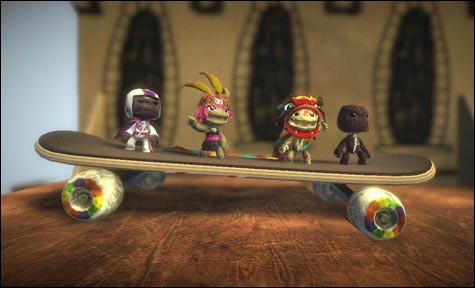
-I'm not going to get on my high horse about the LittleBigPlanet delay. It's a pretty astonishing story, though. The funny thing is that the letter making Sony aware of the religiously offensive content suggests a smarter solution than delaying the game: removing the song with a downloadable update.
-A blog can be a cruel mistress. It's hard enough to keep one updated at all, never mind regularly posting quality content. Andrew Sullivan, one of the first real, full-time bloggers, has published a piece in the Atlantic called "Why I Blog," which is well worth reading, especially if you are a blogger yourself. Blogs will never replace books, essays, and long-form articles. But they don't have to. They are their own form of expression, with their own virtues and their own drawbacks.
-A high school student in Kentucky faces felony charges after writing a story in which zombies overrun his school. No matter how many news stories like this I read, I'm flabbergasted every time. (h/t Pat Duggan)
-It occurred to me that I'm only about two months away from having to put together a top-10 list for the year. As it stands, I can think of maybe 5 games that would belong on there. Before the year is out, I'm going to need to make the time to catch up on some things I missed, including Castle Crashers, Yakuza 2, and Wipeout HD. What else do you suggest? (For a list of everything I've played and reviewed this year, see all posts tagged with "reviews.")
Thursday, October 16, 2008
Have you hugged your boss today?
Today is National Boss Day. In observance, I'm re-posting the link to a project that Ryan Stewart and I worked way too hard on: The Phoenix's 20 Greatest Bosses in Video Game History.
This list contains no real surprises, but I'm proud of the descriptions we wrote of each character. Plus, Wikipedia has linked to this article at least twice, which is an odd point of pride for me.
Make sure to read some of the comments, too. Pure gold.
Wednesday, October 15, 2008
Gamestop.com User-Submitted Previews: Far Cry 2
As regular readers of this series are aware, Gamestop.com users generate enough hyperbole to power 60 million American homes for a year. Everything they talk about is a surefire game-of-the-year contender, based often on screenshots or clips at Gametrailers that feature no actual gameplay. Which is why I was a little surprised at the tepid response to Far Cry 2. Oh sure, the plaudits are numerous, but compared with what users have to say about most high-profile games, this is a drubbing.
"Bond Fan" sets the tone:
This game is going to be good. Its gameplay looks good, the story should be good. They even have multiplayer this should be ok, still debating on whether it will be good. This is definitely a game to look at and ask for christmas so you have time to rent it.
I've never seen a Gamestop.com user hedge his bets so much. If guys like Bond Fan were running the economy, we wouldn't be in this mess. "This mortgage-backed security should be good, still debating on whether it will be good."
"TUTZO" lays down the ultimatum:
After reading the multiplayer reviews, i am a little hesitant as to the playability of multiplayer in the long term. The map editor and the main story is what is keeping this title on my pre-order list. I can't wait to create some new school versions of classic Counter Strike user created maps..... AWP Map REDO...anyone?? Although it will be competing with Fallout 3 and Fable 2....which are also pre-ordered..... it better be good or this game is getting shifted to the bottom of the pile.
He'll still buy the game regardless, but if it's not good it's going to the bottom of the pile, where presumably it will have plenty of time to sit and think about what it's done.
"gamestopper" has the bleakest outlook:
You have to reserve it to get 3 more hours of gameplay and a fold out map which is cool, but it looks kinda bad because the farcry predator was always the same as the last ones, and i hope it doesn't have that, and if i reserve it it's just a waste of money because there's no demos of it or actual good game play, so i wouldn't buy it, but rent, but to me i give a thumbs down. This is my opinion.
He almost sounds like he's being forced to play this game, and renting is the least painful way he can choose to do it.
Maybe gamestopper should be a little more stoic, like "jtk43":
I will probably buy this game soon after release.
I mean, my God, what other choice do you have?
Tuesday, October 14, 2008
Who am I, Dead Space edition
Yesterday, we talked about the relationship between the player, his character, and the game camera, and how that relationship needs to stay consistent throughout a game in order to maintain the illusion of reality. If the player is assuming the role of a character -- not just directing his movements, but inhabiting his body -- then the game shouldn't do anything to take away the player's agency, without a good reason. This is a mistake many first-person games make.
Dead Space, a third-person shooter, has the opposite problem. The hero, Isaac, is a silent hero in the Gordon Freeman mold. Other characters speak to him constantly, but he never replies. His face is covered at all times by an impersonal mask. He may as well be a robot. Yet by showing Isaac from a third-person perspective, the developers have removed the logic from this style of protagonist. As the player, I am watching him from a distance -- a slight distance, but a perceptible one. It doesn't make sense that he doesn't respond to the things other people say. I think to myself, I can't possibly be the only person who thinks this guy is weird.
Further, the storyline attempts to give Isaac motivation in the form of a personal relationship with a crew member on the Ishimura, the ship he's been sent to rescue. It's not clear if she's a lover or an ex-lover, but the prologue shows Isaac pining for her, and as events on the Ishimura become ever more dire, he begins to hallucinate her presence. But because the player is unable to form that third-person relationship with Isaac -- because Isaac is not given his own dialogue and personality that we can share -- this attempt at providing subtext doesn't quite work.
Dead Space also does something original that does work, and that I'd like to see emulated in other games. When it comes to characterization, the game gets lost a little bit between first- and third-person. But Dead Space's interpretation of the physical space of the Ishimura, and of the relationship between the character and his surroundings, is consistently played out in smart ways.
To start with, there's no HUD. Isaac's health is represented by a light meter running up his spine. Each weapon displays its own ammo count. But that's been done before. What's unique to Dead Space is that when Isaac pulls up a map, his inventory screen, or his mission objectives, these elements are actually projected holographically in the game space. We're not looking at them so much as we're looking at Isaac looking at them. They don't live in their own meta-space, apart from game events.
It may not be obvious that this is what's happening at first. Isaac picks up audio and video logs that display in front of him. You might notice that their relative position to him doesn't change with the camera. What's surprising is when you swing the camera around and notice that you're looking at a reverse image of a video message, or your inventory screen. At one point, you see another character watching a video communication that hovers just in front of him, and you realize how committed the game is to rooting everything in its virtual reality.
With a survival-horror game like Dead Space, the setting is every bit as important as the action. The Ishimura still doesn't feel like a character all its own to me, the way Rapture or the Von Braun did. But the developers have set down a useful marker for others to follow.
Monday, October 13, 2008
Who am I?
Video games have a similar spectrum -- and about the same spotty record of success as a bunch of undergraduate wannabe novelists. In a game, there are three entities sharing control of the experience: the player, the camera, and the character. The difference is that these don't exist on a straight line. They all overlap, like a Venn diagram. In a first-person shooter like Half-Life, the player, the camera, and the character are all the same. In a third-person action-adventure game like God of War, the camera and the player are distinct, but the player and the character are mostly one and the same. In a strategy game like Warcraft, the player and the camera are the same, but the characters are on their own.
That's the broad theory I've been turning over in my head for a few days, ever since I started playing Dead Space. I'm less interested in how this applies to all games, and more interested in how it might help us make sense of single-player, storyline-driven games. Essentially, what these games need to decide is where to put the barrier between the player and the character he's controlling. Camera control can be the most important element in this. (Corvus Elrod's recent series of posts about game cameras informed some of my thinking on the subject.)
I mentioned Half-Life above. It's a game that comes up often when people discuss the pros and cons of trying to make the player feel like he is the character. Some people like the approach Valve takes to Gordon Freeman, and some people don't, but what's important to note here is how consistent it is. You see the world only through Gordon's eyes -- he is the game camera. When NPCs speak, they are addressing the character, the camera, and player all at once. Through four different Half-Life installments, this has never changed. The concurrent camera and character control is never arrested from the player, except when Gordon Freeman is physically restrained by something in the game world.
Compare this to the muddled take in the very bad, inexplicably defended, Clive Barker's Jericho. It seems as though Jericho takes the Half-Life approach, merging the player with his character(s) as closely as possible. But there are problems almost immediately. At the beginning of the game, your character wakes up in bed and answers the phone. You see this through his eyes: First you glimpse then ceiling, and then your perspective see-saws as the character sits up. You see his hand reach down, pick up the phone, and raise it to his/your ear. And then, you don't hear what's being said on the phone.
That one moment gives the lie to the whole charade. If you were watching him from a third-person perspective, the lack of audio would make sense. But you're not. If you were in the head of this character -- a conceit which forms the basis for most of the gameplay that follows -- you should hear what he hears, in addition to seeing what he sees. Without that internal logic, it's harder to lose yourself in the game. It's behind the eight-ball even before the flaws of the gameplay show up.
As I said, this issue has been on my mind since I started playing Dead Space. That's because Dead Space does one thing extremely well with its take on the player-camera-character spectrum, and one thing poorly. Tomorrow, I'll talk about both of those in detail.
*I look forward to the day that Professor Reiken, upon finding this page after Googling himself, leaves a comment to let me know I got that all wrong.
Thursday, October 09, 2008
Between a Rock Man and a hard place

My tepid review of Mega Man 9 is up now at thephoenix.com. Frankly, it may be less interesting than my first blog post about the game, but it's more of a traditional review so perhaps you will get some value from that. Or not! At the very least, clicking through helps to ensure that I will continue to have a job.
I am hoping to show this game to some other old-school Mega Man fans and get their take on it. My guess is that they will be more positive than I was. Then again, most people probably don't allow video games to plunge them into existential crises.
Wednesday, October 08, 2008
Midweek link love
(Okay, quick digression: I'm working my way up the challenge mode on hard difficulty. I can't believe it, but after the first three tiers, I'm starting to feel downright proficient. Syncopation isn't taking me by surprise. Relatively fast rolls on the snare are nothing. I see every reason to be overconfident at this point. "Painkiller," here I come!)
So instead of all that, how about a brief link dump?
-This is why it's good to check your referrer logs. I had a couple of hits in there from a site called PixelVixen707, which I highly recommend you check out. Rachel's newly posted review of Fracture is much more entertaining than it sounds like the game was. Great stuff.
-Mike Walbridge has been on a tear lately. His write-up of Mega Man 9 is an insightful look at the game that makes a few points I haven't seen elsewhere. Mike argues that MM9 is much more forward-looking than anybody gives it credit for. I can't disagree, and yet it was the retro elements that were responsible both for what I liked and what I disliked about the game. (My review should be up shortly.)
-Hit Self-Destruct may often qualify as "brilliant," such as in this post about whether Hideo Kojima needs an editor. I was disappointed to learn that Insult Swordfighting shows up on the second page of Google results for the phrase "Kojima needs an editor." Here's hoping this post boosts my ranking!
-Iroquois Pliskin wrote a nice look at Call of Duty 4: Modern Warfare. Sometimes there's an advantage in reviewing a game well after its release, because you're not swept up in the excitement of its newness. You can talk about what really interests you without feeling the pressure to condense the entire game into one easily digestable paragraph. (By the way, I thought my own post about Call of Duty 4 made some similar points.)
*Is "embargoed from" accurate? I don't have any idea what the proper usage is here.
Monday, October 06, 2008
I must be holding the drumsticks wrong
I wracked my brain trying to figure out what I'd done. I hadn't fallen, hadn't tried to catch anything heavy, hadn't smacked my forehead in response to idiocy. And yes, it does hurt a little, particularly on the bone right where the wrist meets the hand. There's only one thing it could possibly be.
It's got to be the drumsticks.
What else was I doing all weekend? Just drumming my brains out in Rock Band 2.
(This includes completing "Give It Away," btw, and nearly five-starring it. I was feeling confident until "We Got the Beat" added 10 times as many kick drums as anything else I'd played to that point.)
That still doesn't explain the bruise to my satisfaction. It's not like I've got the sticks in a death grip, pounding away on the skins as though they'd killed my parents. I hold the sticks pretty loosely between my thumb and forefinger. I hit the pads lightly, for fear of annoying the neighbors. There's just no way I'm rocking hard enough to cause bruising. But what else could it be?
Not that mere injury will keep me from continuing to rock out. Rick Allen lost an arm and kept playing the drums. What kind of a wuss would I be to let a bruise stop me?
Friday, October 03, 2008
Beat not happening
Seems like it's always two steps forward and one step back in Rock Band 2. I'd mentioned recently that I seemed to be stuck between medium and hard difficulty on the drums. At this point, drumming on medium is almost boring -- which is not to suggest that I'm hitting 100% on most songs, just that I feel like I've got a handle on it and I'm ready for something new.
On my first attempt at increasing the difficulty, I attempted challenge mode on hard difficulty. Did all right for the first couple of songs, and then got trounced by "Give It Away," making it perhaps 20% of the way through the song before failing out. I retreated back to medium.
Last night, I quickplayed a few more songs on hard, and found to my suprise that I was owning them. During "Go Your Own Way," I couldn't believe my limbs were actually keeping up. I felt like they were doing all the work on their own, with my brain acting as a spectator. I earned five stars. That was also the case on a few other of the easier songs. Flush with confidence, I returned to my saved challenge game and restarted "Give It Away."
Well, this time I only failed after about 40%. There is a fundamental conceptual shift from the beats I've been playing succesfully, and the beat in "Give It Away." It's as hard as moving to hard mode on the guitar for the first time, when you have to learn to shift your hand up and down the neck. Instead of being iteratively more difficult, it requires you to learn an all-new mechanic. That's where the challenge and the fun both come from.
I don't know the terminology -- maybe Dan Bruno can help with this -- but the problem I'm having is that "Give It Away" starts to insert the bass drum in between hits on the pads. Other songs have done this, too, even on medium difficulty, but they haven't tripped me up in the same way. Usually that's because you at least ride one of the pads the whole way. Here, you ride the blue pad most of the time, except for one hit where the bass pedal takes its place. You sandwich that kick between two other beats: the blue pad by itself, and then the blue and red pad simultaneously. I can't make this work in my head. Playing at 80% speed in practice mode helped a little.
No doubt I'll get past this, sooner than later. That's how these games usually go. By Monday I'll probably be talking about how I ripped through several tiers of songs on hard mode. At least, that's the plan. But this is the difference between difficulty that entices and difficulty that discourages. Rock Band 2 gives you endless avenues for improvement, while dangling the carrot right in front of you. When I say that Mega Man 9 demonstrates, more than anything, how much games have changed, this contrast is what I'm talking about. Games today are your friends.
Thursday, October 02, 2008
Let there be rock
My review of Rock Band 2 is up now at thephoenix.com -- and while it's still a 360 exclusive, at that!
It's a very positive review, and yet I think my enthusiasm for the game still doesn't come through all the way. I've given two other games a higher rating this year (Crisis Core and Braid got a 9.5; this got a 9.0), and yet I'd be hard pressed to say this isn't actually my game of the year so far. I fell into the trap of thinking that because it's not so different from its predecessor, that must be a strike against it. Well, it isn't. This game rocks.
That was driven home for me when I invited my brother over to play. He'd been a big fan of the first two Guitar Hero games, but had never played Rock Band. Sure, I'd been enjoying the hell out of it, especially since I'd never owned the original. But to see the reaction of someone who'd never played the drums before at all reminded me how much freaking fun it is. There's still no other way to have such an experience, unless you're actually in a band. Playing Rock Band 2 ought to be mandatory.
Tuesday, September 30, 2008
Man and Megaman
Above: There are places I remember / All my life, though some have changed / Some forever, not for betterI've been playing Mega Man 9, and enjoying it -- mostly. But there's an unintended consequence of my playing this game: It's causing me to re-evaluate my relationship with Mega Man 2.
Along with Contra, Mega Man 2 is my favorite NES game. Both are considered among the most difficult 8-bit games, but I can beat each one without breaking a sweat. That's not thanks to any particular skill on my part. It's because I played these games until I knew every screen by heart. Playing them isn't a matter of reacting to what's happening onscreen. It's all muscle memory. I know every move my enemies make before they make it. I know what hazards will appear onscreen at each moment. I can leap with confidence to platforms that haven't even appeared yet. I can fire at the exact location my offscreen foes will be seconds from now.
I can tell you everything you need to know about Mega Man 2 more easily than I can remember my family members' birthdays. Beat Metal Man first, then use the Metal Blade to defeat Flash Man, Bubble Man, and Wood Man. The Wood Shield takes down Air Man, whose Air Shooter makes short work of Crash Man (hang onto those Crash Missiles; you'll need them in Dr. Wily's Castle). Use Flash Stop against Quick Man and Bubble Lead against Heat Man.
In Dr. Wily's castle, the Quick Boomerangs will dispatch both the flying dragon and the Gutsdozer with ease. Use Metal Blades to knock off the second stage boss, and Crash Missiles against the fourth stage boss (hot tip: to avoid getting hit by the converging fire from the latter boss, pause and un-pause the game as quickly as you can until the rounds have passed through you). To destroy Dr. Wily's ship, first use a charged Atomic Fire to blast away the hull, and then go at the cockpit with Metal Blades. To defeat the final boss, Bubble Lead is your way to go.
And, of course, if you want to skip straight to Dr. Wily's castle at start-up, the code is A1 B2 B4 C1 C5 D1 D3 E3 E5.
I say all this not because you need to know it -- you probably knew it already -- but to demonstrate how reflexive one's knowledge of an NES game had to be. For me, that was partly a result of simply playing the same games over and over for weeks or months at a time. But it's also what was required to beat these games. You had to know them inside out. They were littered with traps that would be unavoidable unless you already knew they were coming. Unless you could traverse the levels with your eyes closed, you couldn't do it at all. With minimal extra lives, and a frequent "game over" screen, getting through a Mega Man game was a matter of attrition.
This is still the case with Mega Man 9.
As others have noted, and as I will note in my review, Mega Man 9 is a perfect emulation of a Nintendo game. From the graphics, to the sound, to the level design, you could have told me this game was originally released in 1988 and I'd believe you. That's the argument in the game's favor. It's also a stark reminder of how games have changed since then -- for the better, I'd argue.
There is a feeling of accomplishment in getting through a tough game, sure. And the platforming challenges and boss battles I've encountered so far in Mega Man 9 aren't all that difficult from a purely mechanical standpoint. They just require a little planning and practice. (An early example: In Splash Woman's stage, you drop from one screen to the next. If you are not already pressing left or right on the d-pad when the screen scrolls, you will not have enough time to avoid hitting insta-kill spikes.) But this method of level design feels cheap to my 2008 self. Why shouldn't I be able to hang back and regroup? I've seen the "game over" screen more after three levels of Mega Man 9 than I did in the entirety of BioShock.
Still, my enjoyment of Mega Man 9 increased when I decided to hit up GameFaqs for the optimal stage order. For a minute I felt like I was cheating somehow, but then I realized: I never figured anything out in Mega Man 2 on my own. Not a thing. Not only was I told which weapon to use on what boss, I even watched my friend Ryan go through all the levels before I ever completed any of them myself.
There's the basic truth of this: In all my warm and fuzzy memories of Mega Man 2, I cannot remember a time when I didn't know all there was to know about it. That level of mastery colors my perception of the game, as it has for the past 20 years.
Now? I may be able to look up strategies to help me get through Mega Man 9, but after that I'll be done with it. This has to do with how games have changed, and how I've changed as a player. What this game has done is convince me that if I played Mega Man 2 for the first time today, I wouldn't like it very much. I can't imagine anything sadder.
Friday, September 26, 2008
Conflict of interest
Among the points of concern Gary raises:
- GameCyte managing editor Jason Babler is simultaneously employed as a creative director at TriplePoint.
- Richard Kain is an investor in Telltale Games. Telltale Games was once a client of TriplePoint. Neither relationship was disclosed in GameCyte's positive reviews of any Telltale titles.
- GameCyte's review of Off Road, published by TriplePoint client Empire Interactive, was among the most positive to be found anywhere.
I'll be honest: I never heard of GameCyte before I read this story. If Kain's claim of 62,000 unique visitors last month is true, then it's not a massive site by any means. And it's well within the realm of possibility that the GameCyte staff is doing solid, independent work. But in journalism, transparency is everything.
Gary sums it up when he says this system is "designed in a way that allows for abuse." That doesn't mean it has been abused, only that the possibility is there. And once you open the door to that kind of suspicion, your credibility among your readers is shot -- or ought to be. The simple remedy is disclosure. That's standard practice for newspapers, and if Kain wants to defend the quality of his site's journalism then he ought to hold it up to the same standard.
It seems that since Gary started talking to the GameCyte and TriplePoint people, they have revised their About pages to include more information about the relationship. If you want to know what games journalism really looks like, read the whole interview. Incredible stuff.
Update: Dan Kennedy at Media Nation, writing on a different topic, shares a hilarious aphorism about conflict-of-interest that I'd never heard before: "You can fuck an elephant if you want to, but if you do you can't cover the circus."
Thursday, September 25, 2008
Some more Rock Band 2 impressions
Otherwise, the gameplay is just terrific. My drum skills are at the point where medium difficulty is a little too easy, and hard difficulty is just about within my range. It seems like Harmonix has calibrated the difficulty levels exactly -- the toughest songs on medium seem about equal to the easiest songs on hard. It's a simple and logical progression for the low-talent drummer. (By the way, I tried using the drum trainer and it seems like it's helpful, but less helpful than learning those same patterns in the context of songs you know.)
I had my doubts about whether online play would work for this game. Not because of the precise timing required -- latency was probably a bigger issue for the original Halo than it is here -- but because I thought at least half the fun of playing Rock Band is doing so with other people in the room. That's still the optimal setup, but playing with friends online turned out to be a blast. I think it helped that we both had avatars that looked (somewhat) like ourselves.
There are so many songs available that it's hard to criticize what's there. It got easier to skip some of the worse songs as I progressed through World Tour. And there are some real gems, too. It's nice to finally see the Replacements and Dinosaur Jr. get their due in a game like this. I might have picked a different AC/DC song, but other than Led Zeppelin there is no band that needed to be in the game more. And one day I will tell you about the time I played the solo at the end of "Alive," and in the process became a being of pure light.
Without having the original drums handy, I can't tell if the new ones are any quieter. They still seem loud, but it's more of a rubbery thud than the high-pitched clacking I seem to remember from the first kit. So far, the neighbors haven't complained. These drums are supposedly "velocity sensitive," and I'm wondering how good a drummer you need to be for that to matter at all. I'm still at the point where I accidentally miss the green pad when it comes up. The kick pedal still slides back and forth along its bar, too. I need to appropriate the solution my friend Pat came up with and clamp it in place.
Finally, that gorgeous guitar. Without question, it's the best-looking fake plastic guitar controller I've seen, and at this point I've seen more than I ever expected to. Feels great, too. The problem with the original Rock Band guitar was the mushy feel of the strum bar, compared to the precise "click" you got from the Guitar Hero axe. You still don't get that click, but the edges of the strum bar's range feel more solid this time. It's easier to play those fast strumming sections purely by feel. Initially, I also had trouble shifting up and down the neck without spaces in between the fret buttons to guide me, but as I've gotten used to it I think this design actually makes it easier to slide back and forth quickly.
It is still hard to escape the feeling that this isn't exactly a full-fledged sequel, and more of a spit-and-polish, but I had that same initial impression about Guitar Hero II and look how that turned out.
Tuesday, September 23, 2008
Rock Band 2's lockbox
I should say first that I'm not sure whether Tour mode is any different, better, or worse than it was in the first game. I've only played multiplayer quickplay in the original. But Tour mode in the sequel strikes me as curious. Progression in Guitar Hero games was always logical, if a little boring. Complete a group of easy songs, then move on to a group of slightly harder songs, and repeat until finished. Here, the conceit is that you are actually in a touring rock band, and you have to travel around the country earning fans and money. As a result, it's actually quite difficult to know what you've already unlocked, and what there is to unlock next.
The menus are tough to navigate in tour mode. Each city has three venues, and each venue has multi-song setlists in addition to single-song selections. New venues and new setlists are marked as such only temporarily. I am continually finding things I haven't completed only by taking the time to scrounge around. This could have been organized better. I know the flat list of quickplay mode is unexciting, but, damn it, it works.
Beyond that, the structure of Tour mode means that you have to play some songs multiple times before you earn enough stars to unlock new stuff. I'm having to play songs I don't like repeatedly in order to earn enough stars to unlock some more songs I do like. I suppose the "mystery setlists" are just random, but it's almost as though the game knows I don't want to hear "Conventional Lover" again as long as I live, and has a sadistic streak.
The thing is, in practice I don't really mind having to play everything one time in order to unlock other stuff. I don't think it's necessary in a game of this type, but I'm willing to go with it when it's as simple as it is in the Guitar Hero games. But in Rock Band 2, there are levels of needless complexity I just don't care to master. I seem to be earning virtual fans with each successful show, but so what? I just want to play some music.
Far be it from me to impute selfish motives to the people who made an otherwise fantastic game, but here's what I think happened: Harmonix put the time and effort into making this robust, detailed Tour mode with its endless features and leaderboard options. Whether or not they discovered in testing that many players didn't care about this mode, they didn't want to see their efforts go to waste, so they decided to force everyone to grapple with Tour mode anyway -- even though most people who play the game want to dive right into the rocking, accoutrements be damned.
Which is not to say that Tour mode is a total bust for the solo player. There is some sense in making more of a "game" for the single-player mode. Nor am I yet to the point of using a code to unlock everything on the disc. For the multiplayer, though, it's just nonsensical to hide the game's best songs from the users. That's not the kind of game Rock Band is.
Monday, September 22, 2008
Indulge me for one second
So yes, I took a little time off to get married and go on a honeymoon and all that. Truly it was the party of the century, followed by a harrowing journey into the heart of Caribbean darkness -- where the liquor flows freely, and Internet access is spotty at best.
Back to business tomorrow, with a cavalcade of Rock Band 2 posts that will astound the mind and dazzle the senses!
Wednesday, September 10, 2008
Insult Swordfighting presses the pause button
Life circumstances require me to take a short break from blogging. Initially, I had this great idea to line up some guest posts around a single theme to put up while I'm gone. Then, when I failed to do that, I planned to write a bunch of posts in advance of my sabbatical, so nobody would ever realize I was gone. Well, I didn't do that, either. So I'm going into radio silence for a little while.
Posting will resume the week of September 22.
Tuesday, September 09, 2008
Fall videogames preview
Hello there. Do you like videogames? Would you like to know what videogames are coming out for your favorite systems this fall? Why not check out the Phoenix's 2008 fall videogame preview?
As you might have inferred from last week's post -- or from the piece itself! -- I had a hard time getting energized for most of this year's selections. Last year's was such a strong lineup, and the year before that we had the launches of the PS3 and Wii to look forward to. This year, you've got mostly sequels: Gears of War 2, Resistance 2, MotorStorm: Pacific Rift, Rock Band 2, Guitar Hero World Tour, and Fallout 3* all appear on the list.
Some new franchises are on the slate, of which LittleBigPlanet strikes me as the most promising. (My interest in The Force Unleashed wanes by the day.) Mirror's Edge also looks striking, but that's got my vote for game most likely to be delayed until 2009. Dead Space and Left 4 Dead both look solid, though hardly revelatory -- finally, someone had the balls to make horror-themed shooters!
As Matthew Gallant notes, previews are busted even when they are laudatory. Still, what does it say when I can't gin up excitement for anything based on preview copy? I hope to be pleasantly surprised by many of these games. Otherwise, it's going to be a short best-of list come December.
*Granted, Fallout 3 isn't quite like its counterparts here. Enough time has passed that a Fallout sequel is necessary and welcome.
Monday, September 08, 2008
Do not fear the Large Hadron Collider
Gordon Freeman is on the case.
But just in case, I recommend stocking up on crowbars and batteries.
(By the way, do you remember how mindblowing the opening sequence of Half-Life was? If there's a better way to start a game, I haven't seen it yet. The introduction of Black Mesa is perfect. Then the interactive sequence in which the resonance cascade opens up and Gordon is temporarily transported to Xen. And then, everything that had seemed so familiar and safe is changed forever.
Really, the whole game was one brilliant, sustained dramatic sequence. Valve never relied on cutscenes or lazy storytelling. They used in-game, scripted events and intricately crafted level design to ensure that the player's attention was always focused in the right place. That's why you caught glimpses of the G-man through windows and around corners. It's why the scientist dangling off the ladder screamed just long enough for you to locate him visually before losing his grip and plummeting down an elevator shaft. It's why facehuggers leaping out of dark places was just as scary the fiftieth time.
Don't even get me started on the propulsive nature of the level design. After the dimensional breach, all anyone wants is for the military to bail them out. All you want is to reach the surface. Finally, you reach sunlight in time to greet the military -- and they open fire on you. So you plunge right back the way you came, back toward the hideous creatures below. Going forward is terrifying, but going backward is even worse.
Excuse me, I have some business to attend to on Steam.)
(Yes, nearly this entire post was a parenthetical.)
Thursday, September 04, 2008
Have you seen this man?
This week I've been toiling on the fall preview for The Phoenix. It's my annual look at the biggest and best videogame releases of the holiday season. The process isn't too scientific: I check out the release schedule on Gamestop.com, Gamespot.com, and Gametops.com*, make a note of what seems interesting, and then write a fluffy paragraph about each game. My choices are unfortunately based more on what's been marketed well, or what's a big sequel, than on any direct contact I've had with these titles.
What's been interesting about the 2008 edition is the total lack of any exciting new Wii games. That's not to say there won't be any good ones this season. Every year, some of the games I mention turn out to be duds, and it's easy to overlook something that'll be great. Last year's preview didn't even include Call of Duty 4! There's also the inevitable delay immediately after the preview goes to press. But some selections are no-brainers for a preview like this, and this year none of them are for Nintendo.
I've read that Nintendo seems to be bowing out of the preview business, preferring to launch games on short notice without the usual build-up of publicity and expectations. On one hand, that's refreshing. Not much is worse than previews written years in advance for a game that ends up disappointing. And it's not as though they need help convincing people to buy a Wii at this point. Still, to look on the holiday release schedule and see nothing for the best-selling system is unprecedented.
Sure, there's Wario Land: Shake It, which... I don't know. Are you psyched about Wario Land: Shake It? Or would that be an affirmative-action pick?
More to the point: Am I evincing a critical blind spot because I can't see anything but shooters and sequels as games worthy of previewing?
*One of these sites is not real.
Tuesday, September 02, 2008
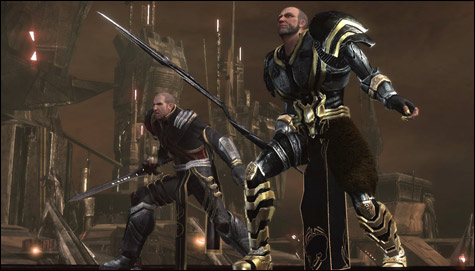
Too Human review
Friday, August 29, 2008
Friday afternoon tidbits
-Game Boy "De-Makes": What if you ported today's biggest games onto the original Game Boy hardware? The results might look a little something like this. (Thanks, Jim.)
-You have to read Chris Dahlen's interview with Jonathan Blow in the A.V. Club. Blow is such a fascinating guy. I guess he rubs a lot of people the wrong way, but I think with Braid he's earned the benefit of the doubt. When I read interviews with him, I get the impression that he really has sat down and thought about everything he's talking about. And I think it bothers him that other people don't do the same.
(Also, I'm terrified as to who Blow was targeting with this quote: "By which I mean, there are lots of random blog posters on places like Gamespot or NeoGAF or whatever who show a clearer understanding of the game than people who are all, “I’m all about games, and narrative and meaning, and I write a blog just to tell you about how I analyze all these things.” Those people have the same hit rate as your general forum poster.")
-Speaking of interviews, you may remember that Mike Walbridge interviewed me awhile ago for a piece he was working on for GameSetWatch. At his personal blog, he's posted a longer entry about that interview and others. My suspicions have been confirmed: I am a boring conversationalist. That's why I write!
-Bill Harris wonders what's up with 1up.com's review scores. I don't know why I thought they were one of the tougher graders out there -- maybe because they do such a good job with features -- but it turns out they're the most lax! I thought IGN had that honor. Also surprising is that Gamespot is the toughest reviewer of the biggest sites, particularly given Gerstmann-gate.
-Tom Chick lists the 10 most ridiculous lines of dialogue from Too Human. Although you could pick any 10 lines at random from the game and it would be equally silly.
What are your gaming pet peeves?
Above: Captain Picard has just lost 20 minutes of his life due to spaced-out checkpoints on the Holodeck.Yesterday I mentioned that one of my three biggest pet peeves is a bad game camera. In comments, Quinn wondered what some others were. In a bit more detail, here are the 3 things that drive me nuts in any game.
A bad camera. This problem has largely gone away in recent years, as most games let you control what you're looking at. And some games, like God of War, implement an external camera pretty well. But nothing's worse than when you're running along and the point of view suddenly shifts, completely throwing off your sense of direction. Well, maybe one thing's worse: staring at a giant wall between your eyes and the action.
Interminable opening cinematics. When I start a game, I want to do something, anything, right away. I don't want to sit there for 20 minutes watching a movie with the controller in my lap. I would be happy enough to walk my character across the room and then watch the cutscene. Better still would be for the game to tell a story through in-game actions. (An example of a great game that still bugged me for this reason: Okami.)
Sparse save points and checkpoints. It's not so much about the difficulty factor, although it does bug me to lose 10 minutes or more of progress because I've failed to reach a checkpoint. This stuff really bugs me because I want to be able to start and stop my gameplay session according to my own whims. I don't want to traipse across a level for 20 minutes looking for a save point. I don't want to have to keep slogging ahead, waiting for the little "checkpoint" message to appear, before I can go to bed.
That's not a comprehensive list by any means, but any time I come across any of these problems it's like hearing the needle scratch off the record, even in an otherwise good game. There's just no reason for any of them.
What about you? What in a game drives you absolutely batty?
Thursday, August 28, 2008
Standards and practices

Ryan downloaded Bionic Commando Rearmed and seemed to enjoy it, although he had a complaint about the button mapping. On the Xbox 360 control pad, you press the B button to grapple and the A button to fire your weapon. Something about that seems off. For the sake of ergonomics and usefulness, you'd think playing with the A and X buttons would make more sense. Look at the picture of the control pad atop this post and tell me that wouldn't fit the human thumb better.**
A similar phenomenon has afflicted an awful lot of 8-bit remakes, for reasons I don't understand. They can't -- or won't -- properly replicate the NES experience. A few years ago, I was playing the Mega Man Anniversary Collection for the GameCube, where the developers had swapped the functions of the two buttons. They mapped firing to the A button, and jumping to the B button. This is exactly backwards.
When I remember about playing those simpler NES platformers is that all of them worked the same way. You hammered your knuckle on the rightmost button to jump, and fired your weapon with the tip of your thumb. This was an ideal arrangement. The leverage of your thumb allowed rapid-fire button presses for the main action without sacrificing the more deliberate pace of most jumping mechanics.
Why do so many remakes reverse the button positions? Partly, I think it's a rudimentary mistake: on the original NES pad, the B button was on the left and the A button was on the right. On the Xbox 360 pad, the A button is on the bottom, and the B button is on the right. Keeping the same button assignments results in a reversal of their positions.
This is a bigger deal than it might seem like, and not just because it made such an awkward experience out of Mega Man 2, which I was playing for an audience. It comes down to user experience and expectation. There is a temptation among tech people sometimes to blame their users when the users have trouble with a product. Although this is sometimes true, most of the time it's because the designers didn't do their homework with regards to usability.
The Web usability expert Jakob Nielsen likes to say that website designers ought to do the same thing as 90% of their competitors, because that's what users have come to expect. They have learned to navigate web pages in a certain way. It's the same with games. An Xbox 360 user playing a platformer will expect the A button to make his character jump. If you're going to deviate from the norm, you'd better have a damn good reason.
This isn't to suggest that progress isn't desirable. When a change in control is worthwhile, then it's going to happen. Ten years ago, any racing game you played assigned the gas pedal to one button and the brake pedal to another (mapped to a modern day 360 pad, you'd probably go with A and stop with X). Today, these functions are assigned to the analog triggers in nearly every game, because that's a better way to do it.* User expectation has kept pace. Nobody picked up Burnout Paradise and pressed the A button to accelerate.
Too Human shows some of the pitfalls of going your own way. Users expect to be able to manipulate the game camera in a 3D platformer by using the right analog stick. But Silicon Knights had a different approach in mind for their dungeon crawler, and instead assigned the right stick to melee attacks. It's an interesting choice. I don't want to knock it simply because I wasn't used to it. In fact, it wasn't even that hard to get used to, and works pretty well in some ways.
The question is: Is what the developers gave up with this new approach equal to what they gained? I'd have to say no, and not just because poor game cameras are one of my top 3 videogame pet peeves. While the melee action does what it's supposed to, using firearms is practically impossible. Cycling between enemies doesn't work too well, especially when the boss you're trying to shoot at is standing behind grunts. That's a pretty big part of the combat.
Standards become standards for a reason. Nothing is beyond revisiting, of course, but it's not helpful for 90% designers to eschew decades of user expectation because they think they've found a marginal improvement. Maybe Too Human wouldn't have been the same game if it copied the control scheme from God of War, say, and had you press the X button to attack and use the right analog stick to dodge. But one of those games relied much more on the user's built-in expectations -- maybe it's only coincidental that it was the much better game.
*Another excellent example is EA's Skate. They took a completely different approach to videogame skateboarding than did the Tony Hawk series, and it was a stroke of genius.
**John Barleycorn points out in comments that you can remap Bionic Commando's buttons, if you want to. This is always the best solution. Even so, the default configuration ought to be the most familiar one.