Thursday, July 30, 2009

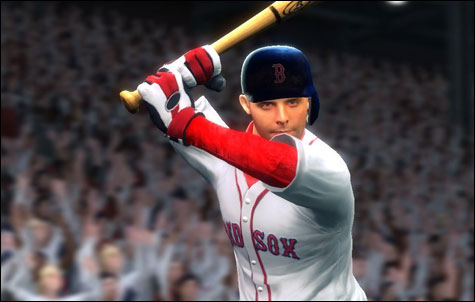
The Bigs 2 comes up small

Above: Dustin Pedroia, looking somehow even less human than usual.

My review of The Bigs 2 is up now at thephoenix.com.

I am by no means an expert on sports games. The reason I wanted to play The Bigs 2 is that I expected it to be unlike most sports games. And it is, to some degree, but a big part of the reason I didn't like it turned out to be the extent to which it betrayed the game of baseball.

In my life, I've been fortunate to attend a couple of significant baseball games. My favorite memory is game 3 of the 2003 ALDS, the Boston Red Sox against the Oakland Athletics. The Sox had dropped the first two games in Oakland, and were facing elimination at home. After the game went into extra innings, the Red Sox brought in pinch-hitter Trot Nixon, a fan favorite and a lefty who'd been on the bench to start the game. Trot launched the game-winning bomb into the center-field seats. You know what, I could almost feel the shockwave from that blast.

The Bigs 2 does a good job of rendering that type of thing. When a "big blast" home run bursts into flame, streaks across the sky like a comet, smashes into a building, and shatters all the windows, I'd say that's faithful to the spirit of the sport. It's exaggerated and cartoonish, sure, but it captures something true about the way a game-changing home run feels. It takes something real and pushes it to the extreme.

Most of the rest of the game does not do this, usually for less obvious reasons. The fielding animations are just terrible -- there are hardly any of them, and the transition from a fielder's picking up the ball and actually throwing it is cumbersome. Fielding at all is bizarrely difficult, because your fielders stop running well before you have a chance to tell where the ball is in relation to them. These fielders are actually slower than their real-life counterparts.

As for the mini-games that mark every dramatic catch, they're not only insanely difficult (for you, not for the computer), but they bear no resemblance to what the player onscreen is actually doing. It's as though another game entirely parachuted in for just those sequences.

Batting is a little weird too. I understand that the pace needs to be quicker than in a faithful sim. Yet I can't really understand why The Bigs 2 punishes you for taking a pitch. If you see a pitch coming that's not in your batter's wheelhouse, you'd think the smart move would be take the strike. But doing so fills up the other team's turbo meter, so you have to just flail away at every throw. That's stupid. In all the time I spent with this game -- which, I'll grant you, was not a lifetime, because I disliked it so much -- I never once saw a batter walk.

I mentioned this in the review, but perhaps not strongly enough: I hate, hate, hate the way this game portrays the players. To a man, they are depicted as mean, joyless, roided-up idiots. When the art isn't inadvertently comic (Jonathan Papelbon's head looks like Charlie Brown's), it's just frightening (Joe Mauer does not, in real life, walk around looking like he's spoiling for a fight). I'm only half-joking in the review when I say they should have made J.D. Drew into a literal robot. A great way to make a cartoon-like baseball game that still showed love and respect for the sport would have been to try to represent the players' personalities in an outlandish way.

But that's not what The Bigs 2 is about. It's about turning baseball into just another violent, stupid, adolescent power trip.

(Did I just do the thing where the blog post is more interesting than the published review?)

Tuesday, July 28, 2009

Breathing room

Game Informer's cautious realism is vindicated once again with news that Sam Fisher has, in fact, snuck past his fall release. The list of games not coming out this fall is an impressive one. Besides Splinter Cell: Conviction, you can look forward to not playing Bioshock 2, Heavy Rain, Singularity, Red Steel II, Bayonetta, MAG, Starcraft 2, Red Dead Redemption, and almost certainly many more. The fall 2010 release window is starting to look like Omaha Beach.

This is the best news I could imagine.

In recent years, the holiday videogame season has turned into a form of ironic punishment. If you like one AAA action title, the reasoning goes, you're going to love several of them every week! So we flail to keep up with the rising tide of must-have games, using each new release as a handhold on the way to the next one, because, dude, I'm pretty sure the one that comes out next week is GOTY material. It's like your mom catching you with a cigarette and forcing you to chain-smoke a whole pack, just to teach you a lesson.

In the meantime, nobody can stop to sink their teeth into games that deserve thoughtful consideration. Some games get overlooked completely amid the hubbub, games that at other times of the year would rightfully earn the spotlight. Sometimes it seems like being a gamer today is more about catching 'em all than about playing them once you've got them, in the same way that Facebook is more about collecting people like baseball cards than about friendship.

I say we should enjoy the chance to go deeper with fewer games this year. And it's not as though we'll be wanting for anything new: Batman: Arkham Asylum, Uncharted 2, Modern Warfare 2, Beatles Rock Band, Brutal Legend, Halo 3: ODST, Borderlands, Ratchet and Clank Future: A Crack in Time, Assassin's Creed 2, Left 4 Dead 2, and freaking dozens of other games are still on the schedule.

Geez, look at that list. It would be nice if a couple more of them got pushed back, actually. We'll never have time to play all that.

Friday, July 24, 2009

Friday afternoon tidbits

Because I didn't learn my lesson last time, I'm going hiking again this weekend. Presumably there will be no waist-deep snow to wade through at this time of year, unlike the last time. If I don't come back, tell them I was cool.

-Duncan Fyfe's farewell tour at Hit Self-Destruct (which is total bullshit, by the way) includes a penetrating look at the state of games journalism. His conclusion: It's much better than it was, but there's always something tragic about growing up. No one really sees working for a game magazine as akin to landing a job in the Wonka factory anymore. That makes for better writing. Isn't it also a little sad?

Duncan talked to a few excellent writers for this piece: Simon Parkin, Kieron Gillen, Nick Breckon, and Chris Remo. I'm in there too, for some reason. When Duncan first asked me about my career high points, I wouldn't have expected that one of them would be seeing myself mentioned in the same breath as those guys.

-The announcement of the Rock Band Network is further evidence that Harmonix isn't just fumbling around in the dark. Rather than forcing people to use in-game samples, they're giving musicians the tools to import their actual music into the game. Kirk Hamilton has a good take on what this means from the musician's perspective. You have to wonder how they'll handle the inevitable flood of submissions. Good problem to have, I suppose.

-The latest edition of the Brainy Gamer podcast features an interview with Clint Hocking, plus a round-table discussion about game design with Hocking, Manveer Heir, and Borut Pfeifer. All three guests have some terrific insights into game design, which comes as no surprise. It's great to hear the perspective of the people who make the games. That's something the broader public -- myself included -- doesn't make enough of an effort to do.

-More reasons never to have kids, from Julian Murdoch at Gamers with Jobs. What I mean by that is: I can't risk somebody melting the ice around my heart!

-Anybody notice that PixelVixen707 hasn't posted since the book came out? Guess the marketing budget's tapped.

Thursday, July 23, 2009

Game informing

Selected closing sentences from several previews in the latest issue of Game Informer, presented without comment:

Splinter Cell: Conviction -- "Let's just hope Sam doesn't sneak past his fall release, because we've been waiting long enough to play what's looking like one of the best games of the year."

The Last Guardian -- "With the PS3 breaking down technical barriers, the possibilities with Team Ico's next masterpiece seem to be endless."

God of War III -- "With the massive titans waging war, more gods entering the fray, and Kratos determined to topple Olympus, God of War III will be packed with jaw-dropping moments worthy of passing into legend."

Assassin's Creed II -- "We'll know more about whether our high hopes are justified as we get hands on time with the game in the coming months."

Uncharted 2: Among Thieves -- "Our time with the game left us confident that Drake's second big journey may be just what Sony needs to draw in PS3 doubters."

ModNation Racers -- "If the gameplay shows even half the potential of its customization tools, ModNation Racers might be the game that finally drags the kart-racing genre into the 21st century."

New Super Mario Bros. Wii -- "There definitely were bigger, more graphically impressive games at E3, but we'll be surprised if many of them are as anticipated as New Super Mario Bros. Wii."

Dirt 2 -- "We're eager to see what other cities Codemasters has transformed into rally circuits."

Heavy Rain -- "We can't wait to meet the remaining protagonists in the upcoming months to see if they, too, can dodge a grisly end."

Alan Wake -- "While we still have nearly a year before this spooky narrative finally hits the Xbox 360, it looks like the title will be worth the long wait."

Castlevania: Lords of Shadow -- "But if the final game can live up to the excitement caused by the trailer... Lords of Shadow may finally give gamers a 3D action title worthy of the Castlevania name, even if some series staples are missing."

Borderlands
-- "With fast-paced action, strong co-op, and this much variety, we can't wait to gather some treasure hunters and start exploring this promising wasteland."

Homefront -- "Though it wasn't shown or talked about in detail... what little we've seen of Homefront looks good."

League of Legends: Clash of Fates -- "We've spent a lot of time with DotA and other games, and League of Legends is clearly the most exciting title in the sub-genre to date."

Wednesday, July 22, 2009

Monkey business

Above: Guybrush drinks in the beauty of Flotsam Island.

My review of Tales of Monkey Island episode 1 is up now at thephoenix.com. There's a brief mention of the voice acting, although not to the degree that I talked about it yesterday. Instead, I spend more time in the review talking about what works in this game, because on the whole it's a pretty entertaining way to spend a few hours.

Still, it feels pretty insubstantial on its own, and depending on your play style it may be worth waiting for the entire series so you can play through all at once. That was the case I found with the Sam and Max revival, anyway. But there I go scooping myself again. It's all in the review!

Tuesday, July 21, 2009

The voice of the oppressive

Above: Guybrush Threepwood, mighty pirate.

The only accurate blanket statement anybody can make is that there are no accurate blanket statements. But this one is close: voice acting never makes a game better, and can only make it worse.

Let's acknowledge the exceptions early. Plenty of games have had good or even great voice acting (The Darkness and Half-Life 2 come to mind). I'm saying that the presence of recorded dialogue is, at best, a net zero for the overall quality of a game, and more often, it's a negative. The history of atrocious voice acting is well documented elsewhere. Yet the campy grandeur of the original Resident Evil is, in its own way, one of the biggest reasons to enjoy that game. It's the games with passable voice acting that can be more insidious -- games where speech adds nothing, while slowing down gameplay or, more often, hammering you with the same few soundbites over and over.

Lots of games suffer from repetition. Recall Marcus Fenix growling "Nice!" after every successful active reload. Resident Evil 4 is still my favorite game of all time, but one of its two noticeable flaws was the merchant's boundless curiosity about what you were buyin' or sellin'.* Recently, Ghostbusters, a game with better-than-average voice acting, decided it would be a good idea for Egon to shout "Aim high!" every four or five seconds during battle. What's the logic behind stuff like this? I think it's, "We've paid for the actors' time; we'd better get our money's worth!"

Nowhere is this a bigger problem than in adventure games. Games like Tales of Monkey Island rely on dialogue for everything. The story is told largely through character interaction, and many puzzles can be solved only by sweet-talking the characters who have what you want. The voice acting is just fine in this game -- totally serviceable. It is not, however, so good that I want to hear the same handful of lines repeated dozens of times in the course of a five-hour game.

Guybrush has only a few stock responses when you attempt to use an item somewhere it has no use. He says something clever about almost each one. And he says the same clever line every time. It's possible -- no, likely -- that many of you are smarter than me, and in the course of playing an adventure game aren't reduced to trying to use every item in your inventory with every hotspot on the screen. That's just how I roll, and in the old days, when the written rejection was superimposed over the action, it was easier to ignore.

Worse, in this case, is that the game seems to provide the player with more dialogue choices than they actually recorded for Guybrush. You'll see four different jokes to choose from, but when you select one Guybrush doesn't say it. He says some canned, plot-advancing line, one that may or may not also be funny. Then, the player has no option to go back and explore the other lines. I think this is also a case of the producers trying to maximize their dollar: you pay the actors as little as possible, and use their work as much as you can. A sensible business decision; not great for the gameplay.

Tales of Monkey Island is pretty fun (my review is coming later this week). Still, I couldn't help but think that it would have been better if the developers had gone the text-only route. They could have packed more jokes and deeper dialogue trees into the game, while saving on costs and even bandwidth for digital distribution. Instead, they hired actors and ended up making, perhaps, a lesser game.

(Then again, it's totally possible that you can choose to disable the speech and enable subtitles. I didn't even think to check that until right this second.)

*The other flaw: QTE knife fight against Krauser.

Friday, July 17, 2009

Friday afternoon tidbits

Seeing a couple of movies this weekend: The Hurt Locker and Harry Potter. Which will be better? I can't even begin to guess.

-Kyle Orland imagines what life would be like if game characters used Twitter. Pretty funny, and an excellent opportunity to link to my own game-related Tweets.

-Also on Crispy Gamer, Scott Jones envisions a world in which great authors reviewed video games. The Hemingway excerpt almost made me choke.

-While I was on vacation, Clint Hocking responded to the Far Cry 2 perma-death phenomenon that's sweeping at least two blogs. He's a hell of a sharp guy, and argues forcefully once again that it's the elements of gameplay themselves that create meaning, and not a designer-imposed narrative.

-Ryan Stewart's review of Guitar Hero: Smash Hits is worth reading on its own, but he does himself one better with a visual summary. His Guitar Hero Venn diagram neatly categories each song according to whether it is fun, good, hard, or any combination of the three. And, yes, "Back in the Saddle" is terrible.

-This one's been making its way around the intertubes, but in case you messed it: Jeff Atwood explores the devolution of the ads for Civony and Evony, from the initial generic Lord of the Rings rip to -- well, see for yourself.

-The sports blog Deadspin took a page from their Gawker media compadres Kotaku and posted "If They Were Athletes: The Robots from Mega Man 2." Curt Schilling as Air Man is too perfect.

Let the weekend start... now!

Thursday, July 16, 2009

Retro game bash: The ugly

Pushing 30 years old, and I still select clothing for humor value.

Because what's a retro game bash without a game-related novelty t-shirt? Yes, I did wear this. And I'd do it again. In a second.*

On one level, the retro game bash was a chance to get together and re-live some good experiences. Those all-night game sessions in high school were some of the best times of my life. It was great fun to revisit them for a day.

It was also a reminder to savor what we already have. If you're anything like me, you've got a lifetime of gaming collecting dust in a closet somewhere. Games that defined your childhood, that formed the basis of lifelong friendships, that provided some of your happiest memories -- they're sitting in the dark, waiting for you. Give them a try. You might like what you find.

It's so easy to focus on the next big thing, to get swept away in the hype, especially if you're plugged into the games blogosphere. Ask yourself: Does it really matter if BioShock 2 gets delayed? Is it more important to drop today's new release the second tomorrow's hits shelves? At this point, we've got over 30 years of other games to enjoy. It's a shame if we don't stop, once in awhile, to do exactly that. You won't regret it.

Unless you play GoldenEye.

*Preferably with a sexier pose next time.

Wednesday, July 15, 2009

Retro game bash: The bad

Above: Unfortunately, a real product.

Yesterday I talked about the high points of the retro game bash. Not everything was hunky dory. Take the food. (Please!) I don't know when it happened, but at some point over the last 10 years I stopped enjoying junk food. It wasn't even a conscious decision. Little by little, things like soda and chips vanished from my diet. Gorging on this crap at the bash came as a shock to the system.

Drinking Mountain Dew was not a pleasant experience, nor was drinking several more, all from the World of Warcraft-themed "Game Fuel" line. Both the cherry-flavored Horde and berry-flavored Alliance varieties are sickly sweet, but you have to give the edge to Alliance because it is a blue color that exists nowhere in nature. It looks like it should be in a beaker in a mad scientist's lab. Plus, I just don't understand why soda has to be high-concept these days. (You even see beer starting to go this way now and again, when "it gets you drunk" ought to be the lynchpin of the whole thing.) But the drinks weren't nearly as bad as the food.

The Doritos "Late Night" line is, frankly, bewildering. What is the difference between tacos at midnight and tacos at another time of day? Has anyone ever gone to Taco Bell at 6 P.M. and thought, well, this is okay, but what it could really use is another six hours sitting out at room temperature? Because that's essentially what "Tacos at Midnight" Doritos taste like. Don't even get me started on the other flavor, "Last Call Jalapeño Poppers." There's no way that's even a thing. I mean, at least people have occasionally eaten tacos at midnight. Nobody has ever rushed the bar at last call for remaindered apps.

Onto the games. I'm not hugely into bigtime retro gaming (i.e., pre-NES), and it didn't take long to remember why. The Intellivision controller is insane. The control pad is a shiny disc, which might lead you to think it rotates. You would be wrong. You press its sides for four- or eight-way controls. I understand that when the Intellivision was released, there was no precedent to draw on for the controller, but they could have done better with a little common sense. Atari's joystick made perfect sense at first glance.

I am not a big fan of the Atari 2600 catalog, though, and it's not hard to remember why. It seemed like every game for that system was a direct clone of something else, usually Space Invaders. Even acknowledged classics like Adventure and Yars' Revenge seem unplayable to my modern sensibilities. They're like cave paintings: obviously important, and fascinating historical artifacts, but I can't engage them on their own level.

Some of the bad games we played weren't surprises. We love Area 51 precisely because of how bad it is. That was the lightgun shooter that used digital photography of costumed actors to depict an alien invasion of the infamous government facility. The pace is slow, the graphics choppy, and the gameplay rote. Enemies all explode in an identical, cartoonish gib animation. The cover art depicts some sort of ghoul in a sleeveless orange jumpsuit brandishing two assault rifles. At one point, an actor playing an ally runs in front of the camera, waves his arm slowly, and shouts "Stay low!" in the least intense tone you can imagine. It is truly terrible. And so awesome.

A couple games, sad to say, have aged terribly. I remember Treasure's Guardian Heroes as an unappreciated classic. It's a sidescrolling fighter with heavy RPG elements and what I remember to be incredible hand-drawn graphics. Today it's a pixelated mess, prone to slowdown, and not very fun. Granted, we were locust-like in our approaches to every game that day, swarming from one to another, but Guardian Heroes didn't hold anybody's attention for very long.

Then, of course, there's GoldenEye. I know I didn't love this game 10 years ago, but today it is beyond bad. Unplayable. With four people playing at once, the frame rate drops to what feels like single digits. Even with two or three players, the low resolution and copious anti-aliasing makes it seem like the part of the eye exam where the doctor is showing you different lenses and you say, "Worse!" But you expect graphics to seem worse years later. What's surprising is how bad the gameplay is.

In GoldenEye, you can't jump. There's no crosshair. The levels are largely flat and nondescript. You can only aim along the y-axis when you're motionless. Firefights are nothing more than players running circles around each other. I know this game deserves a lot of credit for being the first successful console FPS, but we used that logic to determine what's good today, then people would still be riding bicycles with the giant front wheel. Nothing in this game gives me what I want from an FPS.

Tomorrow: The ugly. It will be a shorter post, I promise.

Tuesday, July 14, 2009

Retro game bash: The good

Above: Yes, you can hook up an Intellivision to a plasma screen.

What do you get when you combine classic video games, piles of junk food, and a bunch of aging nerds? Besides a funky odor that lingers for days, I mean. You get the retro game bash -- a lifetime's worth of video gaming compressed into one day.

The day before the Fourth of July, some old friends convened and brought with us an Atari 2600, Intellivision, Sega Saturn, N64, Dreamcast, and backwards-compatible PlayStation 3. To ensure an authentic retro experience, we also loaded up on Doritos and Mountain Dew, just like we did when we were teenagers. Playing through a few decades of gaming history, while fueling up on caffeine and powdered cheese, yielded some surprising lessons. In particular:
  • Some old games really rock.
  • Some old games really suck.
  • It is no wonder I never got laid in high school.

Let's start with the good stuff. First of all, I was surprised that it worked at all to hook up an Intellivision and an Atari 2600 to a plasma TV. The Intellivision even looked pretty good. The Atari suffered a bit from screen stretching, which we probably could have tweaked a little in the TV's settings.

Here's a bit of 2600 trivia that's sufficiently interesting to warrant its own paragraph. Did you know that you can plug a Sega Genesis controller into the 2600 and use that instead of the original joystick? Mostly a curiosity, unless of course you've misplaced your joystick. Which we had done.

Super Puzzle Fighter II Turbo, for the PlayStation One, is still a great game. Looks nice on an HD screen, too, even on a PS3. No smearing or other ill-advised "improvements" to the visuals. The only problem with this game is that everybody knows that Donovan has the best drop pattern, so everybody plays as Donovan all the time. In the HD remake, the designers tweaked the drop patterns for the sake of balance, which should have made the whole thing better. Only it didn't.

Sega's first-party games were completely badass. We didn't have time for the racing games, but Virtua Fighter 2 and both Virtua Cop games are phenomenal -- no nostalgia required. VF2 still looks great. The backgrounds are sparse, but the character models are colorful and fluid, locked in at 60 fps. And unlike so many fighting games that require a master's degree just to learn the movesets, anybody can jump right in and understand what they're doing.

The Virtua Cop games, too, are swift moving and fun. They don't look quite as good as Virtua Fighter, simply because there's more happening onscreen, so the level of detail is lower. The action is fast and furious, though, still the best designed lightgun shooting I know of. Of note is the car chase sequence in the first level of Virtua Cop 2, in which you can shoot out the tires of enemy cars and watch them flip into the air.

Sega's Dreamcast was well represented as well, if a little less "retro" than some of the other systems there. Crazy Taxi is still a fun romp, although arcade mode starts to seem repetitive to me even after just a few minutes of play. And Soul Calibur, a game I never spent much time with, looks phenomenal on a standard-definition television. You could have told me it was running on a 360 or a PS3 and I'd have believed you.

One big surprise: San Francisco Rush, for the N64, is a game I loved back in the day, but wouldn't have thought would hold up. Big mistake. N64 games in general have not aged well in the graphics department, and scanning Rush's race tracks for shortcuts is no easy task if you're not sure where they are. But racing through the familiar courses -- and hitting those huge jumps -- is as fun as ever. Mostly, that's because of the physics: ding your car just a little and it'll twist and turn in unpredictable directions, leading to insane crashes and the occasional death-defying recovery. It's a blast.

Tomorrow, I'll talk about some games that didn't hold up so well, including some surprises.

Monday, July 13, 2009

Changeling

Above: "I want my PlayStation back!"

So, you've been dying to know how the saga of my broken PlayStation 3 played out. The good news is that it's back and it works. The bad news is that it's not my PlayStation 3. It's an impostor.

To Sony's credit, the turnaround time on the repairs was quick. In fact, the bottleneck happened on my end, for reasons to boring to recount here. I shipped it to them on a Thursday, and the replacement unit arrived exactly one week later. According to the UPS tracking, they accepted delivery on Monday morning and sent the replacement out that evening. That's pretty good.

Since my unit was out of warranty, the replacement ended up costing $149, plus tax. I'm not happy about that, but what can you do? Given the cost of parts and labor, it's probably some kind of a bargain, and just cheap enough that it wouldn't seem worth it to buy a whole new system with a bigger hard drive and pack-in games. I backed up what I could, crossed my fingers that they wouldn't wipe the rest of the hard drive, and sent it away.

They didn't even attempt to convince me that they repaired the unit I sent them. The single-page documentation in the return box doesn't diagnose a problem. All it says is: "ENCLOSED YOU WILL HAVE EITHER YOUR FACTORY CERTIFIED REPLACEMENT OR YOUR SAME CONSOLE REPAIRED UNIT." Given the swift turnaround time, not to mention the otherworldly shininess of the hull, I'm guessing it's the former.

And that's okay, obviously -- far preferable to having no PS3 at all. But it still felt a little weird to boot up the system and have to set the time and all that. There was a moment of terror when the system told me I couldn't use my copied save files, since I wasn't the original user. It turned out that I had to sign into the PlayStation Network before it recognized me as the owner of the saves.

I know full well that I probably won't use the bulk of these saves ever again. Many of them are for games I don't even own anymore. Still, together they account for probably hundreds of hours of playtime. Most of them -- maybe all of them -- represent a significant portion of my life's work. In a way, they're the only proof that I ever existed.

Okay, I'm exaggerating, but when I thought I lost my Far Cry 2 saves I really was ready to throw the whole thing out the window. I put more effort into playing that game than getting my college degree.

Welcome home, PlayStation 3.

Tuesday, July 07, 2009

We interrupt this vacation

...to bring you a link to my review of Ghostbusters: The Video Game on thephoenix.com.

Rarely have I played a game that tracked so closely to my expectations. If you think you might enjoy this game, you probably will. It's a well made game that takes full advantage of your built-in love for the franchise. That's certainly not a bad thing.

All right, back to vacation.

Friday, July 03, 2009

Friday afternoon tidbits

It's a holiday weekend, as we here in the USA celebrate "America, Fuck Yeah" day. (Contrary to popular belief, that is not every day.) Hopefully you're not still at work. If so, have some links.

-The Brainy Gamer plays The Darkness, and makes some astute observations. It's impossible to play this game and not feel the urge to analyze it. At this point, it can't cost any more than 20 bucks. You owe it to yourself to give it a shot.

-Speaking of repairs, Mike Rousseau's Xbox RRoD'd on him. The service went fine, but then Microsoft tried to charge him to re-download his stuff from the marketplace. After that first post, somebody from the company contacted him and fixed the problem. That's good customer service, but they should be treating everybody that way in the first place. Right, Sony?

-As you may know, I'm a man who loves his taxonomies. So I was psyched to read Justin Keverne's "Taxonomy of Left 4 Dead," in which he breaks down the personalities of each of the characters. What I like best about the game is that the player's actions can mesh with the characters' personalities in unexpected ways. Francis might be written as misanthropic, but depending on who's controlling him he may be shown to have a heart of gold. That interaction makes for depth I wouldn't have expected before I played the game.

With that, I'm on vacation. Regular posting will resume the week after next.

Thursday, July 02, 2009

We need a new logo designer

I just noticed that the logos for Terminal Reality and Volition are quite similar:


That's it. That's the whole post.

Selective service

Here's the problem with trying to get a PlayStation 3 serviced: the stuff Sony's website tells you bears no relation to the stuff they email you, which in turn comes from a different planet than the stuff they send you through UPS. Each resource -- the website, the emails, and the physical forms -- has some of the information you need, but none has all of it, and in some cases they're contradictory.

Take the security issue. The website tells you to delete your stored billing information, which I did, and then to delete all the designated users. Well, their directions for that didn't work. A form they sent with the shipping box recommended many more steps, up to and including formatting the hard drive, while also giving different instructions for deleting users.

They also give you two different forms to (maybe) include with the system. One is sent in an email, as a link to a form letter. On the form letter, you have to include things like your service request number, the problem you're having with the system, and your serial number. Only, this link is included in an email that also has your service request number, the problem you're having with the system, and your serial number. So rather than pre-populating those fields, ensuring that they're correct and legible, Sony prefers that you print the blank version and copy the fields by hand. Makes sense to me!

You're supposed to include the letter with the system. In fact, you're supposed to "securely tape only the completed first page to your system before packaging for shipping." Which is fine, except that the fields you need to fill out extend to the second printed page. So, disregarding the directions, I securely taped both pages to the system before packaging. I hope that doesn't invalidate my repair.

Confusingly, a similar but condensed version of that same form comes with the pre-paid shipping box. It has most of the same fields, but not all of them (specifically, it doesn't ask for your serial number). There is a field for the service request number. Now, the service request number, as Sony emails it to you, is a single letter, followed by a dash, followed by a long number. Like this: A-123456789.

The field to enter your service request number is a single box, followed by a dash, followed by several more boxes. However, you're not supposed to include the letter! It's not part of the service request number. It's a stowaway. You're supposed to write it like this: 1-23456789.

And, yes, I only found this out after I'd written the letter in that first box, and then ran out of space.

Now I have two different forms to include, so I taped one to the system and taped one to the plastic bag that the system goes in. My serial number is in there once, and the service request number twice. I deleted most things off the hard drive, but not everything. (Also, I backed up all my saved games, except for Killzone 2 and Resident Evil 5, because copying that data was "not allowed." WTF?) This would all be fine if the conflicting directions and forms didn't have me about 60% convinced that I've messed something up. How will I know? I've already learned that I can't trust the online FAQ.

Nintendo did a much better job with this.

Wednesday, July 01, 2009

Prototypical

Above: Chris Benoit is really mad / Chris Benoit is really angry

My review of Prototype is up now at thephoenix.com. Maybe it should be "review," in quotes. I did sink a good deal of time into the game, but not nearly enough to feel I had a handle on it, before the PlayStation 3 melted down. Rather than try to conceal that fact, I figured I should make it clear from the start. Not an ideal situation, but honesty is the best policy and all. I can live with myself after writing this review.

It's too bad, though, because I was enjoying the hell out of the game, far more than I expected. It's impossible not to compare Prototype to inFamous, and it felt like the game I wished inFamous had been -- much faster and more ridiculous. There's just no comparison between the boring powers of Alex Cole and the ludicrous powers of Alex Mercer. And I much preferred the speedy platforming of Prototype to the static cling of inFamous, though it did have its own problems.

I hope to have a lot more to say about Prototype in the future. Far, far in the future, when I finally get my PS3 back.

Tuesday, June 30, 2009

Breakdown

I'll not bore you with the details of my PlayStation 3's long, grueling journey toward health, except to note that I still haven't sent it in yet. This is going to take awhile.

I was in the middle of griping to myself about how they just don't make consoles like they used to, when I realized that hardware failures are just a fact of life. The Xbox 360 has gotten all the bad press, but my systems have historically had about a 50% failure rate, no matter who made them. A look back:

Console: Atari 2600
Year Acquired: 1984 (?)
Serviced or Replaced: No.
Diagnosis: A solid performer, although we never touched the damn thing once we got the NES, so who knows how long it might have lasted.

Console: Nintendo Entertainment System
Year Acquired: 1988
Serviced or Replaced: Replaced.
Reason: I can't recall the specific reason why our original NES bit the dust after only a couple years of service. It must have been that warranty-busting Game Genie. Damn you, Galoob!

Console: Sega Genesis
Year Acquired: 1992
Serviced or Replaced: No.
Diagnosis: The first star performer of any console I ever had. As of the last time I plugged it in, probably 2004 or so, it still worked. Can't say the same for the controllers, though. It's hard to play NBA Jam when you can't shoot.

Console: 32X
Year Acquired: 1994
Serviced or Replaced: Junked.
Diagnosis: I uninstalled the 32X to play Virtua Racing for the Genesis, which was incompatible, and after that the 32X never worked again. You may remember that hooking it up involved metal plates and about ten yards of cables, so I think this was actually for the best.

Console: Sega Saturn
Year Acquired: 1995
Serviced or Replaced: Serviced.
Diagnosis: A simple lens error was easy to fix, although dealing with customer service was a nightmare. (Me: "I think it's a disc read error." Them: "Try wiping the memory." Me: "It says 'cannot read disc.'" Them: "Try placing it on the floor, lighting some incense, and dancing around it in a circle.")

Console: N64
Year Acquired: 1996
Serviced or Replaced: No.
Diagnosis: Another solid performer, the N64 was in fine working order as of the last time I hooked it up, probably five years ago or so.

Console: PlayStation
Year Acquired: 1997
Serviced or Replaced: No.
Diagnosis: The first and last time Sony would not disappoint me.

Console: Super NES
Year Acquired: 1998
Serviced or Replaced: No.
Diagnosis: This was the smaller, redesigned SNES, which may have helped, but this thing even survived several weeks in the common room of a dorm, getting stuff spilled on it.

Console: PlayStation 2
Year Acquired: 2000
Serviced or Replaced: Replaced.
Diagnosis: Some kind of massive mechanical failure. The disc tray stopped working, and the whole system took to emitting a loud grinding noise. I attempted to fix it myself, following instructions on the Internet, and ripped an important-looking cable. Ended up buying the newer, smaller PS2.

Console: GameCube
Year Acquired: 2004
Serviced or Replaced: No.
Diagnosis: Like the 2600, this one was obsolete before it had a chance to crap out. Still, a win's a win.

Console: Xbox 360
Year Acquired: 2006
Serviced or Replaced: No.
Diagnosis: Knock on fucking wood.

Console: Wii
Year Acquired: 2006
Serviced or Replaced: Serviced.
Diagnosis: The reason it went in for service was because it couldn't read Smash Bros, for which Nintendo tried to blame me, but was really because the system is cheap and dinky. At least it was free to fix. The bigger problem with the Wii is the graphical artificating, which occurred as a result of my leaving it in standby mode for six straight months, because there was nothing to play.

Console: PlayStation 3
Year Acquired: 2007
Serviced or Replaced: Serviced.
Diagnosis: Pending. I'm not entirely sure what happened. It might just have overheated. Hopefully they'll say what the problem was when they return it.

There you go. 13 systems overall, and 6 died a premature death. I guess they make them exactly like they used to.

Note: This post has been updated since it was originally published, to include the GameCube.

Friday, June 26, 2009

Friday afternoon tidbits

The nation is reeling from the sudden, tragic death of my PlayStation 3. We'll try to soldier on, somehow. Some links might help with that.

-Magical Wasteland previews English literature's crowning achievement in the style of a video game publication. Spot on. The only thing missing is the Game Informer-style conclusion, "We can't wait to get our hands on this one." Some good comments on the post, too.

-I just love Jonathan Blow. He has a way of cutting through the bullshit. In an interview with Press Pause to Reflect, here's what he has to say about finding meaning in games, which I have to assume is aimed at everybody who clamored for an explanation of Braid: "If I can just say what the point is, then we don't need games in the first place." I love it.

-Here's a new experiment, from Ben Abraham, that's setting the blogosphere on fire: permanent death in Far Cry 2. "The rules: Normal difficulty; fortunes DLC installed. When I die, that’s it. Game over." Both part 1 and part 2 make for some entertaining, NGJ-style reading. A couple other entries come from Michel McBride and Nels Anderson. All serve as stark reminders that Far Cry 2 was incredible.

-Okay, we can't avoid a little discussion of Michael Jackson. Clearly, the Internet has laid waste to the concept of "too soon." It's gotten to the point that when a celebrity dies, or a disaster happens, I'm not only expecting to see jokes, but I'm disappointed if there aren't any. Maybe that's another sign that our civilization is nearing its doom, but I'm serious when I say that I hope I matter enough someday for people to joke about my death on the Internet. I'll be disappointed if it doesn't happen.

Also, here are three good MJ eulogies from some unlikely sources: Roger Ebert, Joe Posnanski, and Ray Smuckles.

-One more non-gaming link, but it might be the most important thing you read this week: /film interviews Andrew W.K. about his new show DestroyBuildDestroy, plus his profound insights on the nature of existence.

Wednesday, June 24, 2009

Fall down go boom

Above: Red Faction is smashing!

My review of Red Faction: Guerrilla is up now at thephoenix.com.

One thing I've said repeatedly is that I'd prefer a game to do one thing exceedingly well, rather than attempt a million things and not quite get there with any of them. All of Red Faction centers on knocking shit over. There are missions overlaid on that, and a storyline, and an economy system, and so on, but at its core this game would live or die by how much fun it is to demolish everything in sight. And it is so much fun.

The explosions are great. The feedback from the sledgehammer is great. The number of different ways you can take down buildings is great. I don't know how many times I sabotaged my own mission objectives because I couldn't resist stopping and trying to knock out a guard post, but I also don't care.

Even with that said, the design is still pretty smart. The biggest concern of the developers didn't seem to be to show off their considerable chops, but to focus on the player experience. And so you can fast travel, and sprint endlessly, and change the difficulty mid-stream. If your vehicle overturns, you can flip it back over as though it were weightless. One of my early complaints in the game was that my character couldn't climb onto ledges, but then I realized that I should be smashing through them.

Recently I discovered that this game was my go-to example for not one, but two different posts in which I critcized the culture of hype: once while ho-humming the announcements at GDC 2008, and once while bashing screenshot dumps that allege to be news.

I think this proves my point.* I had no expectations for Red Faction, and it was awesome. I learned this partly by word of mouth, and partly by taking a chance on the game. Not because I've spent a year and half street teaming for THQ. That's how it should be. Right?

*"This just proves my point" © Jonah Goldberg, idiotic political pundit.

Tuesday, June 23, 2009

PlayStation 3 fail

Above: Sony gets its revenge for my reviews of Metal Gear Solid 4 and inFamous.

See that? That's the error message I got after my PlayStation 3 started freezing during gameplay, and sometimes during startup. If you can't read it, it says:
Get: 02155680
Put: 01c20c14
Ref: ffffffff

Pre: 30000000
Post: 10000000

Which I think translates into English as "You are shit outta luck, buddy." For the past two days, I've been unable to run any software longer than 10 minutes before that happens. This is going to make reviewing Prototype a little difficult, but it may be to the game's benefit that I did not have a chance to get tired of it.

According to Sony's website, repairs for an out-of-warranty PS3 run $149, which is outrageous. You could almost buy a whole Wii for that. If I had clout, I would totally be exercising it right now, browbeating Sony into giving me free, expedited repairs.

Instead, you can look forward to the HD sequel to the classic Insult Swordfighting series, "Wii Watch." There's no goddamned way I'm buying a new PS3, that's for sure.

Faerie Solitaire

Above: Faerie Solitaire

One of the best games I've played in the past couple of years is Fairway Solitaire. It was a version of golf solitaire, which I hadn't realized was a thing, with some incredibly smart design decisions and a fantastic presentation. The replay value is great -- I downloaded it a year and a half ago, and I still play it often, trying to beat every high score. If you haven't played it yet, you really should. You can buy Fairway Solitaire (affiliate link) at Big Fish Games for hell of cheap. Well worth it.

So I didn't need much convincing to play Faerie Solitaire. It's essentially a re-skinned Fairway Solitaire, trading gentle humor for high fantasy. The gameplay basics are identical -- draw a foundation card, then remove any card from the board that's one higher or lower. Try to go on big runs to earn score multipliers. Clear the board for a perfect score. Every game consists of 9 different card layouts to be cleared.

It's pretty straightforward, but Faerie Solitaire, like Fairway, adds several tools to the player's arsenal. By earning money after each hand, you can buy upgrades: the ability to see the next draw card, extra mulligans, or a ring that will allow you to blast one card off the board. Some cards on the board are blocked, either by ice or by a thicket of thorns, and can only be cleared by removing a designated card from the board. There's just enough variation to keep things interesting across all of the levels.

And they are "levels" in this game, because Faerie Solitaire follows a storyline. I'll admit to not being terribly enchanted by it -- a kid wakes up from a dream and follows some faeries all around the goddamn place before defeating a sorceror of some kind -- but the narrative makes for an excuse to visit lots of different settings. The boards include fiery volcanoes, deep woods, and wind-whipped ice levels. The presentation is really good, from the panoramic drawings that makeup the cutscenes, to the ambient sound effects and ethereal background music, which I believe is an original composition.

The replay value isn't quite there. Despite some challenge rooms, which I haven't finished yet, it's easy to whip through the campaign. The bigger problem is that completing a 9-hole level is a matter of meeting a few criteria, usually some combination of filling the combo meter within a time limit, earning a specified amount of money, and getting a designated number of perfects. If you accomplish all your goals by the third hole, then there's no reason not to haphazardly click your way through the next six. In Fairway Solitaire, by contrast, the overarching golf conceit meant that every hole had to be your best. And that's also why I keep playing Fairway.

Still, Faerie Solitaire is quite good on its own merits. It even kept me up until 1 AM one night, something inFamous, Prototype, and Red Faction have all failed to do. I'd certainly recommend checking it out (affiliate link), but only after you download Fairway.

Friday, June 19, 2009

Friday afternoon tidbits

This weekend I'm firing up the third in a series of what Simon Ferrari so astutely referred to as "open-world nonsense": Prototype. It'll have to be something special to top Red Faction: Guerrilla in that category, but as long as it's better than inFamous I'll be happy. The excessive gore may help with that.

-A couple more burnout-related links to share. In comments to my post, CBZ posted a link to an essay by Steven Poole called "Working for the Man," which covered similar territory in a far more comprehensive and thoughtful manner. Poole points out the preponderance of games that feature some kind of virtual economy, wherein you need to earn credits/points/dollars in order to make your character more powerful. I'd also add that open-world games, which often spring new objectives on you mid-mission, are a lot like working for a scatterbrained boss. "Go do this. Wait, no, do this instead! Why haven't you finished the other thing I asked you to do?"

-Duncan Fyfe comes at a similar topic from the opposite perspective. He says it's hard to write about games that don't excite him, good or bad. This is burnout from the writer's perspective -- when you feel you have nothing interesting or worthwhile to share about a game. That's hard to overcome. You can't force it. Last fall I expended many more words on a game I didn't like, Mirror's Edge, than some games that I liked very much. (But more still on Fallout 3, which I loved.) With writing, as with playing, the feeling that you're doing it out of a sense of obligation and not passion is the surest sign that you need to try a different approach.

-For an example of what inspired writing looks like, check out Alice and Kev, the tale of a homeless family in The Sims 3. In spare prose, Robin Burkinshaw details the virtual lives of Alice and Kev, which seem to contain far more pathos and moments of quiet nobility than you'd find in games with more intrusive authorship. This is wonderful stuff. And the screenshots are just perfect.

-Michael Abbott and Nels Anderson had a brief, cross-blog conversation about DLC (part 1 at the Brainy Gamer, part 2 at Above49). Both raise good points, but it's important to remember that not all DLC is created equal. Expansions to otherwise complete games, like Fallout 3 or Rock Band, are not quite the same as paying to unlock content that's already on the disc. Personally, I don't think I'd pay for a maxed-out golfer in Tiger Woods, or guns in a first-person shooter, especially if I could earn them another way. But given that doing so is likely to put you at a disadvantage in multiplayer, it does seem a little devious.

-Ben Abraham revisits the enigma of Surfer Girl Reviews Star Wars. I'm not sure I ever read that blog more than once or twice, so the whole story was new to me. Ben is thorough in covering it all. The story of a pseudonymous blogger who gets fed up and sets fire to the place reminded me of Billmon. Some people say it's better to burn out than to fade away. I disagree.

-Shortly after I subscribed to the blog Fierce Punch last fall, Mike Rousseau stopped writing it. He's back now. Sometimes writing is in the blood. Good to have him back.

Wednesday, June 17, 2009

Burnout revenge

The estimable L.B. Jeffries wrote an essay for PopMatters about gamer burnout. Among the people he talked to, a common theme was that games are great until they start to feel like work. This is undeniably true -- nothing saps the fun of something faster than obligation. Playing games on deadline is no fun, period, and being forced to stick with a crappy game is a special kind of hell.

On the other hand, all this misses the point that playing games is a form of work. Maybe it's a challenging action game that requires players to learn patterns and hone their reflexes. That takes practice. Maybe it's a 50+ hour RPG with a sweeping story and slow-paced, strategic combat. That takes commitment. Maybe it's a sim that is best enjoyed with hundreds of dollars of peripheral hardware. That takes investment. Fun or not, getting anything worthwhile out of most video games is going to take some work.*

(Case in point: Fallout 3. That game came at the perfect time for me. I had several weeks without anything else to play, plus holiday and vacation time that let me sink my teeth into it. I loved the game, but I don't see how you could call it anything but work. Not only was there a massive time commitment required, but the missions were the sort of endless, chasing-your-own tail tasks you do at an office if you have a capricious boss.)

So when I say that I get burned out on games because they're work, I mean that less because I'm playing them as a professional service, and more because playing them is freaking draining. The last thing I do is play games for fun. They stress me out. And that's a big part of the reason why I like them, strangely enough. When I get home after eight hours of sitting on my butt updating a spreadsheet, I need some excitement. That's something video games can provide.

The burnout, then, doesn't come from getting tired of the games. It comes from getting too much into them. It's a natural byproduct of the focus and concentration is takes to succeed. After all that work, it's nice to take a vacation sometimes.

*Hence casual games, but that's another post for another day.

Friday, June 12, 2009

Friday afternoon tidbits

Feeling pretty run down this week. Swine flu? I'll try to pump out some links here before I collapse.

-Ron Gilbert revisits The Secret of Monkey Island. He is much less sentimental than a fan of the game would be (like, oh, this guy right here). He lauds certain design choices, noting that what he chose to cut was often more important than what he included, while criticizing others. It's a really interesting read. I'm more excited than ever now for the remake, especially knowing that there's a toggle between the updated graphics and the original.

-Bill Harris joins the anti-inFamous coalition. We're building a movement now! As always, his comments are well considered and to the point, but I was struck by his observation about Crackdown. He's right: its initial reception was hardly rapturous. A Metacritic score of 83 is good, but not great. It's gained cachet since its release -- correctly, in my view -- but it goes to show you that instant analysis isn't always correct. Which means that anybody saying that inFamous is better than Crackdown may want to give it a few months.

-I still haven't played The Path, but after reading an interview with the developers at Press Pause to Reflect (not to mention, you know, a ton of other stuff about it), I'm tempted. I especially appreciated this challenge to other indie devs: "We should be out there, exploring deeply in the potential of the medium. But most of us are happy to stick to tried-and-true ideas and we merrily re-use retro-genres."

-Not video game related, but I couldn't believe this story that G.I. Joe: The Rise of Cobra is the lowest-testing film in the history of Paramount Studios. Of course it looks terrible -- beyond bad -- but still, that's pretty damned impressive. The lowest focus group ratings ever? We are in rarefied air here. Speaking as the guy who voluntarily watched Uwe Boll's The House of the Dead more than once, I'm now convinced I'll have to see this movie.

That's all I got this week. Looks like I'll be diving into Red Faction: Guerrilla this weekend. Fingers crossed!

Thursday, June 11, 2009

Gamestop.com User-Submitted Previews: Ghostbusters

Above: You're right, Ray. No human being would stack books this way.

Ghostbusters is just about the perfect movie, and I suspect that anybody who grew up in the 1980s can't help but look forward to a video game adaptation that features the voices and likenesses of nearly all the main cast. But will Ghostbusters: The Video Game live up to the film's lofty standards, or should gamers keep their five bucks? Let's see what the commenters at Gamestop.com have to say.

OPTIMUS 1 starts things off -- let's say it -- optimustically:
I saw the first and second movie and it was great . I reserved it because of the game and the free T-shirt . I can't wait until it comes out . This wil be the best game I will ever have. I would definitely recomend this to a friend . OH YEAH !

I think he confused the Stay-Puft Marshmallow Man with the Kool-Aid Man.

MikeyJaymz lays it out for the haters:

Can't wait to get this game as soon as it is available. And for those who say it looks bad......who cares? It's Ghostbusters. I'd get it even if it was the worst game ever made.

Honestly, that's refreshing. No appeals to authority, no accusations of bad faith, just good old-fashioned slavish devotion. Busting makes this guy feel good, even when it doesn't.

RyanLec84, no fool, has waited to see what the reviews say before making up his mind.

...the game is getting fantastic reviews! OXM and IGN have already given it an 8/10...AKA "Impressive". NOT an easy feat!

...

(restraining myself)

...

(squirming)

...

(laughing so hard that I sprain something)

GamerGod198 puts together all the building blocks of a fantastic user-submitted preview. Let's break it down, section by section. First, enthusiasm:

I can't WAIT to play this game. I preordered it a few days ago and each day I have to wait is driving me mad.

Then, a grammatically confused description of the game's features:

You can destroy I would say everything, voiced by the actors and likeness of them is exact too !! plus it'll be fun to destroy the stay-puft and even vigo and gozer.

The shout-out to Gamestop and its business practices:

The shirt is worth it, to have a piece of history, something only preorderers get is cool.

The token point of concern:

The graphics look awesome and so does gameplay, worried about online and probably needing a headset, hope they might add DLC or something though.

And the "WTF" conclusion:

Lets just see how it is, at least if its not good, its better than the NES ghostbusters II or the last GB game of extreme GB on gameboy advance.

Perfect.

Let's give the last word to GEO 24:

Whoo ho it's finally going to come out i'm so excited man. once i have the game i'm going 2 play non stop. in the preview u get to face of the state puff marshmallow. i can't wait, i wonder if u get cover in marshmallow when u defeat him.^_^ :p

I know you're excited, Geo, but that stuff you're covered in ain't marshmallow.

Tuesday, June 09, 2009

A game which will live in infamy

Above: Don't kill the messenger!

My review of inFamous is up at thephoenix.com. It's the most negative review of the game I'm aware of. Most people I've talked to like the game, or even love it. So let's stipulate now that I'm a total idiot, I should be fired, and Microsoft is paying me off. It's all true.

Although I wasn't having fun almost all the time while playing this game, in the interest of fairness I should say that inFamous did speak to the completionist in me. The side missions get repetitive fast, but almost all of them take only a couple of minutes to complete. And when you finish one, a big chunk of your map gets transformed from "gang territory" to "liberation nation."* It's really satisfying -- more satisfying than blowing things up, for sure.

inFamous also scatters a liberal amount of collectable "Blast Shards" around the environment. Collecting the shards nets you a small amount of XP, and also earns you more electrical energy for your crimefighting. It's not as fun as hunting for the agility orbs in Crackdown, because the rewards aren't as great, and the platforming isn't as fun. (Often, the shards are below you on a building, and inFamous makes it very hard to move downward.) But it's still pretty absorbing, especially because your radar shows you where they are, which is a feature I could definitely use in my ongoing quest to find the last agility orb in Crackdown.

Still, moment-to-moment I thought the game was no fun at all, because the action was a grind, and the platforming was obnoxious. Battles played out the same from start to finish, no matter what powers you had or who the enemies were. As for the platforming, I was not a huge fan of the massive auto-assist. The only time I really liked it was when I'd jump off the roof of a building onto a powerline. The rest of the time, it seemed like the game was constantly overturning my decisions. I don't know if my armchair quarterbacking is all that helpful, but I think both of these problems might have been solved, or at least ameliorated, with the same fix.

First, I think they should have reduced the number of Cole's powers. I'm not joking. There are so damn many that I tended to forget about them, and a bunch of them never came in handy (I'm thinking specifically of the charged shot, which was mapped to R2). Other than the Lightning Storm, which you get late in the game, none of them really take advantage of the electrical conceit. They were the same attacks you see in any action game. So one or more could have been jettisoned without adversely affecting the gameplay.

Then, a spare button could be used for a Shadow of the Colossus-style "grab" function. That way, Cole would stick to things only when the player wanted him to. I can't tell you how often he would cling onto a light pole or something while I was trying to get away from a pack of enemies, or how often I tried to jump off of a building, only to have him spin around in mid-air and get sucked back like it was a black hole. Also, the actions to take cover and to dive out of the way are mapped to the same button, which means that you often dive out of the way when you mean to take cover. A grab button would have done away with all of this.

There are probably a million reasons why that wouldn't have worked. I'm trying to be constructive here!

*Not in-game terms.

Friday, June 05, 2009

Friday afternoon tidbits

E3 bugs me. You may have noticed. Despite how it might appear, it's not because I'm a crabby old hermit who scurries back into his cave at the first sign of mirth. I love when people get excited about video games. I do it myself. But E3 is basically a big TV commercial, and it is strange that people don't take what they see there with a bigger grain of salt.

Every presentation has been conceived for maximum marketing impact, and I don't think the fans or the members of the media do themselves any favors by buying into the hype. Both in the press and in the wild, there's a tendency to breathlessly parrot every new announcement, as though it's surprising that there are sequels to popular games in the works. Besides which, there's a long history of games that made a big splash at E3, only to be delayed or canceled -- not to mention disappointing. I just want people to take games on their own merits, that's all.

Nevertheless, E3 was the story of the week, and as such, it comes up a lot in the links.

-Hardcasual absolutely killed it this week with their faux-E3 coverage. They punctured the bubble around the show, and they did it with good humor. This was the can't-miss coverage of the entire show, even though it was all lies. My favorites: "Microsoft’s Natal To Deliver 1:1 Teabagging on Xbox Live" and "Vendor Outside Los Angeles Convention Center Debuts Sleeker, More Delicious Hot Dog Wrapped in Bacon."

-Another cynical take on the show came from the Phoenix's Mike Rougeau, which, while harder edged than Hardcasual's coverage, was a welcome corrective after days of identical live-blogs and tweets.

-Speaking of which, while the real-time coverage of the Big Three press conferences was a bit much for me, several outlets did a great job afterward of looking at the big picture, none more so than Offworld. Brandon Boyer discussed "The 7 things you need to know about Microsoft's press conference," "The 5 things you need to know about Nintendo's press conference," and "The 5 things you need to know about Sony's press conference." Boyer's write-ups were free of gushing or hype, and instead took a measured look at the competitive landscape coming out of the show.

-It was also nice to see a bit more scrutiny applied to some of the games after journalists got their hands on them. Brian Crecente and Leigh Alexander wrote dueling opinion pieces about the upcoming Dante's Inferno game. Crecente is dubious:
While the developers seem genuinely interested in trying to present a tour of Dante's hell that remains at least mildly representative of the original works, it can't remain a passive experience and still be a mainstream video game.

Their answer: Make Dante the game's hero, Beatrice the game's damsel in distress.

It's this shift in perspective, no matter how tangentially rooted in history, that most threatens to deflate the experience of Inferno.

While Alexander welcomes the artistic license:
The Divine Comedy, after all, is largely a poem about two guys walking and talking -- not exactly the core gameplay of an action game. In that way, the liberties the team took were intended to create a stronger video game, a more reasonable priority for, well, a video game, than focusing on a strong epic poem adaptation.

My own feeling is that once you hear the words "Dante's Inferno: The Video Game," you probably shouldn't be surprised by any departures from the source material.

-And a couple of non-E3 links. (Holy crap, this post is getting long.) I had never listened to the Gamers with Jobs podcast before, but I enjoyed their discussion of inFamous, because their experiences seemed to track with my own. That leaves them, Tycho Brahe, and me as the only holdouts, I think.

-I did enjoy the completionist aspect of inFamous, though. The city is composed of three islands. Each island starts off under the control of gang members, which is represented by a red outline on your map. Upon completing each side mission, your map shows a chunk of gang territory changing colors. This almost single-handedly kept my interest throughout the game. It was also reasonably absorbing to search for blast shards, but not nearly as fun as hunting agility orbs in Crackdown. Anyway, GameSetWatch ran a good piece about the psychology of collectors and hoarders, which seems relevant.

Have a good weekend, all.

Metacritic's greatest hits


Above: Mitch Krpata reads the Metacritic page for inFamous, immediately after scoring it a 5.0/10.

It's a little tradition of mine that after finishing my own review, I pop on over to Metacritic and see what everyone else has to say. The Metacritic page for inFamous, besides giving me the increasingly familiar "I feel like I'm taking crazy pills!" feeling, contains this gem from GameFocus:
The overall quality of the game is not as high as I expected because I love the Sly Cooper games but as the first game this generation from Sucker Punch it makes this a must buy for PS3 owners. Just do not expect anything stellar or new in terms of gameplay, as we have seen much this game has to offer before and done slightly better.
Their score? 90.

Metacritic, by the way, once declined to include the Phoenix's reviews in their aggregates.

Crazy pills.

Links coming this afternoon.

Wednesday, June 03, 2009

You must choose, but choose wisely. Or don't. It doesn't matter.

Above: It's good advice, no matter what the situation.

Morality systems in games are the new hotness. From BioShock's dilemma of whether to harvest or save Little Sisters, to the stacked ethical considerations of Fallout 3, it seems that game designers are interested in making players question their own actions. This is a good thing. While I like a brainless action game as much as the next guy, you can only accept so many attaboys for your genocidal prowess before you start to feel yourself covered in an indelible goo of wickedness.

So I appreciate inFamous's attempt at a moral dimension. After your character, Cole McGrath, becomes superpowered, his actions affect the way the citizens of Empire City perceive him. Kill civilians indiscriminately, and they will fear you. Save them, and they will grow to love you. Not only does it make sense, it also fits organically into the flow of the gameplay. Pedestrians writhing on the sidewalk are a common sight at Empire City. It's up to you whether to stop and help, or cruise right on by, and whatever you choose to do will matter, on some small level.

It's the big-money "karma moments" that seem shoehorned onto the proceedings. And it's these decisions that ultimately make the difference in whether Cole becomes a hero or a villain. The action stops, an icon appears onscreen, and Cole growls about the choice before him. In almost every case, the decision is contrived and simplistic, without offering any important gameplay consequences. "I could help this guy, or not," basically. Sometimes it's even less difficult than that. There are some choices where you can kill bad guys in order to earn power-ups called blast shards, or kill good guys to earn blast shards instead. Agonizing.

Part of the problem is that blast shards aren't nearly tempting enough to provide a real pull toward the dark side. Cole collects them to increase the size of his power meter, which is important, but not once in the course of gameplay did I ever feel in danger of running out of juice at an important time.

The other, bigger problem is that inFamous steers clear of ambiguity. Choices are obviously good or obviously bad, even when you get the feeling that the designers didn't plan it that way. There seems to be no admission that sometimes a moral choice can be good and bad, or that it can have unintended consequences. When Cole does good, the people love him. I was reminded of the Hamlet-like depth of Spider-Man, in comparison -- when Peter Parker does good, people still hate him!

Further still, the game rewards monomaniacal pursuit of the all-good or all-evil path by reserving some of its most potent powers for players who've stuck with one or the other. All of the game's karma moments lead up to one big decision near the end, which should be a tough choice but from a utilitarian point of view isn't difficult at all. If you've spent all your time pursuing one path, the decision is easy to make.

The idea almost certainly was to make players question all of the actions they'd taken in the game to that point, which is a worthy goal. But because the game's good-or-evil framework necessarily means that the storyline has to make sense no matter which path you choose, it's impossible for the consequences to be as momentous as they should be. inFamous actually disregards some of the choices you make. You make an ostensibly difficult decision, and then the plot says, psych! After all, you still have to beat the boss and finish the game.